
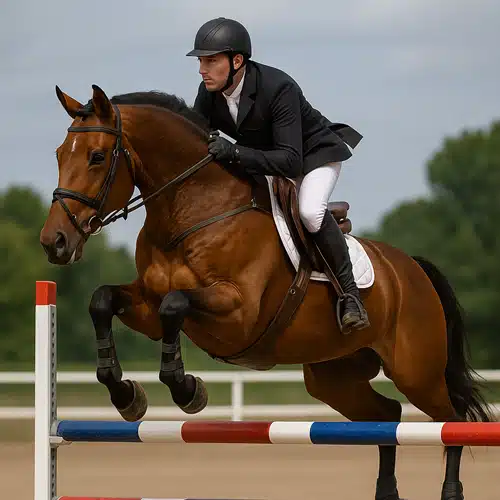
The Hanoverian horse is one of the most highly regarded warmblood breeds in the world. Originating from Germany, it has long been a symbol of elegance, versatility, and top-quality breeding. Representatives of this breed consistently achieve success in show jumping, dressage, and eventing, winning medals at the most prestigious competitions — from world championships to the Olympic Games.
Hanoverians are known not only for their outstanding athletic abilities but also for their excellent temperament — they are intelligent, willing to cooperate, and highly ambitious. This makes them ideal partners for both professional riders and training programs. For decades, this breed has helped shape the modern equestrian world and continues to serve as a model for breeders across Europe and beyond.
Table of Contents
Origin and History of the Breed
The Hanoverian horse originates from Germany, specifically from the region of Lower Saxony, which once formed part of the former Duchy of Hanover. The breed’s beginnings date back to the 18th century, when King George II of Great Britain, who was also Elector of Hanover, established the State Stud at Celle in 1735. Its main purpose was to improve the quality of local utility horses that could serve effectively in agriculture, transportation, and the military.
Initially, Hanoverians were strong and heavy horses, bred primarily for pulling carriages and performing demanding work. However, breeders soon recognized the potential to create a more versatile horse, combining strength with elegance. To achieve this, they began crossbreeding local mares with Thoroughbred and Trakehner stallions, which added refinement, improved movement, and significantly enhanced the breed’s sporting aptitude.
Worth reading:
- If you are interested in precision and refinement in sport, explore the Trakehner horse, known for its elegance and performance.
- For show jumping power and athletic ability, check out the Holsteiner horse, one of the top sport breeds in the world.
- You can also discover the Oldenburg horse, valued for its strength, movement, and success in modern competitions.
- If you want to understand the roots of many sport breeds, read about the Arabian horse, one of the most influential in history.
A major turning point came in the 19th and 20th centuries, when changing social needs and the rise of equestrian sports redirected breeding efforts toward producing riding horses with exceptional athletic ability. Hanoverians began to gain international recognition — first in dressage, and later in show jumping and eventing (Three-Day Eventing).
Today, Hanoverian horses are considered one of the best and most prestigious sport horse breeds in the world. They combine traits that make them ideal partners for ambitious riders: excellent movement, elegance, endurance, intelligence, and a steady temperament.
The State Stud at Celle continues to play a crucial role in maintaining the breed’s high quality, and the Hanoverian studbook remains one of the most selective and respected breeding registries in Europe.

Appearance and Distinctive Features of Hanoverian Horses
The Hanoverian horse is considered one of the most harmoniously built sport horse breeds. Its conformation combines the classic beauty of a warmblood with athleticism and modern elegance, making it highly appealing not only to riders but also to judges in dressage arenas and show jumping rings.
Build and Proportions
Hanoverians are medium to large-framed horses, typically standing between 160 and 175 cm (15.3–17.1 hands) at the withers, though taller individuals are sometimes found, especially in lines bred for jumping. Their build is balanced — they appear neither too heavy nor too delicate.
- Head: Relatively small and refined, with a clear profile and large, expressive eyes that give an intelligent, alert expression. The ears are of medium length, mobile, and reflect the breed’s lively yet composed temperament.
- Neck: Long and elegant, smoothly set on the withers, well-muscled, and slightly arched. This structure allows the horse to achieve correct carriage easily and creates a graceful outline in motion.
- Withers: Prominent and well-defined, providing a solid saddle position and aiding stability of the back during movement.
- Back: Medium-length, straight, elastic, and strong — efficiently transmitting power from the hindquarters, which is essential for both show jumping and dressage performance.
- Croup (hindquarters): Muscular, broad, and slightly sloping, with a strong muscle group responsible for energy and impulsion — truly the “engine” of the Hanoverian horse.
- Limbs: Long, dry, with strong joints and clearly visible tendons. Hanoverians have hard, durable hooves that withstand intense athletic use. Their correct leg alignment minimizes the risk of injury and contributes to their longevity in sport.
Coat Colors
The most common coat colors among Hanoverians include:
- Bay – in various shades, from light to dark bay,
- Chestnut – often with a rich, deep hue,
- Black – elegant and uniform, highly valued in dressage arenas,
- Gray – less common, but still recognized in breeding.
Large white markings are rare — breeders prefer solid-colored horses with only small, discreet markings on the head and legs.
Movement and Dynamics
One of the most recognizable strengths of the Hanoverian breed is its movement. For generations, breeders have focused on the quality of gaits, making Hanoverians some of the most impressive horses in dressage arenas.
- Walk: Long, free, rhythmic, and well-defined — judges often highlight its clarity and regularity.
- Trot: Ground-covering, elastic, with natural elevation in the front and strong engagement from the hindquarters. The movement is expressive and eye-catching, yet well-balanced.
- Canter: Balanced, powerful, energetic, and supple — ideal for both dressage and show jumping disciplines.
Overall Impression
The Hanoverian horse immediately gives the impression of an athletic, harmonious, and energetic animal. Its conformation reflects enormous sporting potential, while its elegance and fluid movement distinguish it from other warmblood breeds.
Unlike some other sport horse breeds (such as Oldenburgs or Trakehners), Hanoverians are considered slightly more versatile — not only beautiful and refined but also highly functional and practical in everyday training and use.
Temperament and Abilities
For decades, Hanoverian horses have been valued not only for their excellent physical qualities but also for their remarkable temperament and balanced disposition. Their strong psyche, combined with elegant movement and athletic build, has made them one of the most popular warmblood breeds in the world.
Character and Disposition
Hanoverians are known for their intelligence and willingness to cooperate with humans. They learn new exercises quickly, respond well to consistent training, and rarely display excessive nervousness. Their calm and stable nature makes them suitable for both professional riders and ambitious amateurs seeking a dependable partner for high-level sport.
At the same time, they possess energy and spirit, maintaining their athletic edge. They can stay focused even under challenging conditions — during competitions, in noisy environments, or when faced with new surroundings — a quality highly valued in sport horses.
Sensitivity and Communication
Hanoverians are responsive to the rider’s aids but not overly sensitive. They react willingly and clearly to cues, allowing for precise communication in dressage or show jumping. This responsiveness helps them quickly form a bond of trust with their rider, creating a partnership based on mutual understanding.
Versatility in Use
Hanoverians have an impressively wide range of athletic abilities. Their elasticity, strong hindquarters, and natural balance make them ideal for:
- Dressage – expressive, fluid gaits and an aptitude for learning advanced movements,
- Show Jumping – power, courage, and excellent jumping technique,
- Eventing (Three-Day Eventing) – endurance, focus, and mental stability,
- Recreational or amateur sport riding – thanks to their predictable and steady nature, they are safe and enjoyable for everyday work.
Who Is the Hanoverian For?
The Hanoverian horse is an ideal choice for:
- Professional competitors in dressage or show jumping,
- Juniors and young riders developing skills for higher-level sport,
- Amateurs looking for a horse that combines athletic talent with a reliable temperament.
Their trainability, patience, and eagerness to work make Hanoverians extremely rewarding partners. This is why they are so often found in riding academies, training stables, and youth equestrian programs, helping shape the next generation of successful riders.
Use in Sport
The Hanoverian horse is without a doubt one of the most versatile sport horse breeds in the world. Its conformation, movement, and temperament make it perfectly suited for multiple equestrian disciplines, consistently earning top positions in international rankings.
Show Jumping
Hanoverians have long been among the world’s elite show jumpers. They combine powerful hindquarters, excellent jumping technique, and great courage. They remain calm under pressure on technical courses filled with challenging combinations and high fences. Many world champions and Olympic riders have chosen Hanoverians for their reliability and precision. Their jumps are natural, dynamic, and consistent, translating into remarkable competition success.
Dressage
The Hanoverian is an iconic dressage breed. Its elastic, ground-covering, and harmonious gaits perfectly meet the demands of the discipline. Intelligent and eager to cooperate, Hanoverians quickly master complex movements such as piaffe, passage, and pirouettes. Their natural expression, rhythm, and elegance make them favorites among judges and spectators alike.
Eventing (Three-Day Eventing / WKKW)
Many Hanoverians excel in eventing, a discipline that requires not only jumping ability but also endurance, courage, and mental stability. They perform exceptionally well in the cross-country phase, thanks to their strong legs and steady temperament. Their stamina allows them to handle long and demanding courses, while maintaining precision in dressage and clean rounds in show jumping.
Endurance Riding
Although less common in this discipline than Arabians, some Hanoverians successfully compete in medium-distance endurance rides. Their physical fitness and resilience allow them to handle these challenges, making them an interesting alternative for riders seeking a versatile sport horse.
Shows and Recreational Riding
With their elegance and harmonious movement, Hanoverians also shine in equestrian shows, exhibitions, and ceremonial parades. In everyday riding, they are known for their calm disposition and predictability, which makes them suitable even for ambitious amateurs who wish to train and compete at a higher level.
International Achievements
Hanoverians are a regular presence at the Olympic Games, World Championships, and World Cup events. Horses of this breed have won numerous gold medals in dressage, show jumping, and team eventing. Their dominance on the world stage is no coincidence — it is the result of decades of rigorous selection and breeding excellence maintained by the German Hanoverian Breeders’ Association.
Breeding and Selection
The breeding of Hanoverian horses is among the most prestigious and rigorous in the world. It is overseen by the Hannoveraner Verband — the German Hanoverian Breeders’ Association, headquartered in Verden. For generations, this organization has set and upheld the strict standards of quality that keep Hanoverians at the top of international equestrian sport.
Strict Breeding Standards
The goal of breeding is to produce a modern sport horse — athletic, harmoniously built, with excellent movement and a stable, cooperative temperament. To achieve this, breeders follow a multi-stage selection process.
The evaluation process includes:
- Conformation assessment: Horses must meet strict standards of proportions, body structure, leg shape, and hoof quality. Every detail is analyzed with future sport use in mind.
- Performance testing: Young stallions and mares undergo tests assessing their movement, jumping ability, fitness, and willingness to work under saddle.
- Temperament evaluation: Judges assess character, mental balance, and willingness to cooperate — all crucial qualities for sport horses.
- Pedigree analysis: Great emphasis is placed on bloodlines, favoring families with proven success in show jumping, dressage, or eventing.
- Offspring evaluation: Only the success of a stallion’s progeny ultimately confirms his value as a breeding sire.
Studbook Admission
Approval of a stallion for breeding is a long and demanding process. Each candidate must pass the Körung (stallion licensing), during which judges evaluate conformation, movement, and free jumping technique. The horses then complete a performance test (Hengstleistungsprüfung) lasting several weeks, involving training and assessment in multiple disciplines under saddle.
Only after meeting all requirements is the stallion entered into the main breeding studbook, granting him the right to cover mares and pass on his traits to offspring. Mares are also evaluated — their breeding and performance suitability determine whether they are admitted to the mare registry.
Results of Selection
This rigorous system ensures that every Hanoverian horse represents exceptional quality. Breeders strive to produce versatile, modern, and internationally competitive horses. As a result, Hanoverians make up a significant portion of horses competing at the Olympic and championship levels, continuing to define excellence in global sport horse breeding.
Successes of Hanoverian Horses
For decades, Hanoverian horses have dominated international arenas, consistently winning Olympic, World, and European Championship medals. Their combination of elegance, power, and outstanding temperament makes them the breed of choice for top riders and national teams worldwide.
Most Famous Hanoverian Horses
Salinero – the legendary gelding ridden by Anky van Grunsven. With him, the Dutch rider won Olympic gold medals in dressage at Athens 2004 and Beijing 2008. Salinero is considered one of the greatest dressage horses in history.
For Pleasure – an icon of international show jumping and one of the most influential stallions in sport horse breeding. A two-time Olympic team gold medalist (Atlanta 1996, Sydney 2000) and winner of countless Grand Prix competitions, For Pleasure left a lasting mark both as a champion jumper and a prolific sire.
Desperados FRH – a top-class dressage stallion ridden by Kristina Bröring-Sprehe. He earned team gold at the Rio 2016 Olympics and multiple podium finishes at the European Championships, admired for his elegance and precision.
Gigolo FRH – the famous mount of Isabell Werth, regarded as one of the most decorated dressage horses in history. He won four Olympic gold medals (1992–2000) along with numerous World and European Championship titles.
Shutterfly – though best known as the legendary partner of Marcus Ehning, this horse originated from Hanoverian bloodlines. Shutterfly was one of the most versatile and consistent show jumpers in the sport’s history.
Dominance in Sport
Hanoverians have long been a cornerstone of national teams from Germany, the Netherlands, and Denmark. They regularly appear in the World Cup Finals, European Championships, and Olympic Games. Their reliability, willingness to work, and outstanding athletic ability make them equally valued outside Europe — in countries such as the United States, Japan, and China.
Legacy of Success
Thanks to their remarkable individual and team achievements, Hanoverians have secured their place in equestrian history as one of the most versatile and accomplished breeds. Their victories not only emphasize the prestige of German breeding, but also guide future breeding programs — each new generation of Hanoverians is developed to meet the ever-evolving demands of modern equestrian sport.
Hanoverian Horses in Poland
The Hanoverian breed has been present in Poland for many decades, earning great recognition among both breeders and competitive riders. Thanks to their versatility, elegance, and superior athletic potential, Hanoverians have become one of the most popular imported warmblood breeds in the country.
Major Breeding Centers
Polish Hanoverian breeding has been developing dynamically, with the breed represented in several renowned state and private studs:
- Racot Stud Farm – one of Poland’s oldest sport horse breeding centers, specializing for years in jumping and dressage lines.
- Pępowo Stud Farm – known for implementing modern selection methods and maintaining close cooperation with the German Hannoveraner Verband.
- Walewice Stud Farm – a historic breeding center that has produced numerous outstanding warmbloods, including Hanoverians of great significance to Polish sport.
- Ochaby Stud Farm – focused on breeding high-performance Hanoverians, often competing successfully at international events.
International Cooperation
Polish breeders actively invest in modern genetics, importing valuable stallions and mares from Germany. Collaboration with German bloodlines and regular participation in licensing events and auctions help maintain the high quality and competitiveness of Hanoverian breeding in Poland.
Inspections and Performance Tests
Poland also hosts breeding inspections, licensing events, and performance tests for Hanoverian horses conducted according to the standards of the Hannoveraner Verband. This ensures breeding consistency across Europe and preserves the quality and reputation for which the breed is known worldwide.
Hanoverians in Polish Equestrian Sport
More and more Polish riders are choosing Hanoverians as competition horses for dressage, show jumping, and eventing. Their steady temperament, intelligence, and top athletic predispositions make them highly valued by both professional competitors and ambitious amateurs.
Most Common Health Issues in Hanoverian Horses
Although Hanoverians are generally considered a healthy, strong, and long-lived breed, their intensive athletic use makes them more prone to certain conditions than purely recreational horses. Proper preventive care and regular veterinary supervision are essential to ensure long-term soundness and performance.
Tendon and Joint Injuries
Due to their mass and dynamic movement, Hanoverians are susceptible to strain injuries affecting the locomotor system. The most common issues involve:
- Flexor and extensor tendons,
- Fetlock and carpal joints,
- Knee joints.
Horses competing in show jumping and eventing are particularly vulnerable to such injuries caused by impact stress, landings, and sharp turns.
Navicular Problems
Navicular disease is one of the more frequent ailments among sport horses. It can cause lameness and significantly shorten a horse’s competitive career. For this reason, leg conformation and hoof quality receive special attention in Hanoverian breeding programs.
Sensitivity to Dietary Changes
Hanoverians have well-developed musculature, requiring a balanced diet rich in protein and energy. However, sudden feed changes, excessive grain (especially oats), or insufficient fiber can lead to:
- Colic,
- Digestive disorders,
- Metabolic issues.
Careful nutritional management — including gradual dietary adjustments, constant access to roughage, and hydration — is key to maintaining the horse’s overall health and performance.
Metabolic Issues
When improperly fed, Hanoverian horses may be prone to several metabolic disorders, including:
- Obesity – especially in horses with limited turnout or insufficient physical activity,
- Exertional myopathies (tying-up) – common in intensively trained sport horses,
- Insulin resistance – seen in older or overweight individuals.
Prevention and Care
To avoid these problems, it is essential to provide:
- Proper living conditions – regular access to paddocks, pastures, and free movement,
- Routine veterinary and orthopedic check-ups,
- Regular hoof maintenance and farrier visits,
- A well-balanced diet adjusted to the horse’s age, workload, and metabolism.
Consistent management, exercise, and attentive care allow Hanoverians to maintain optimal health and perform at their best for many years.
The Hanoverian Horse Compared to Other Breeds
Hanoverian vs Arabian Horse
The Arabian is an unmatched long-distance horse — light, enduring, and exceptionally elegant. The Hanoverian is more versatile: stronger, steadier, and outstanding in sport disciplines such as show jumping, dressage, and eventing. While the Arabian excels in stamina and endurance, the Hanoverian stands out for its power and all-around athleticism.
Hanoverian vs Thoroughbred (Full-Blood)
The Thoroughbred is built for speed and explosive power, bred primarily for racing. The Hanoverian, on the other hand, has more mass, strength, and a balanced temperament, making it better suited for disciplines requiring precision and control. Thoroughbreds dominate racetracks; Hanoverians reign on dressage arenas and show-jumping courses.
Hanoverian vs Paso Fino
The Paso Fino is famous for its unique four-beat gait, offering unmatched comfort for leisure riding and shows. The Hanoverian cannot rival that smoothness, but it far surpasses the Paso Fino in athletic ability and competition performance. It’s a horse made for international sport, where strength, elasticity, and discipline matter most.
Hanoverian vs Rocky Mountain Horse
The Rocky Mountain Horse is a calm, family-oriented breed known for its soft, ambling gait and dependable temperament. In contrast, the Hanoverian is ambitious, energetic, and bred for high-level sport. The Rocky Mountain horse offers comfort; the Hanoverian offers power, precision, and competitive drive.
Hanoverian vs American Saddlebred
The American Saddlebred is a show horse, admired for its high-stepping action and striking presence. The Hanoverian is a performance horse, designed for athletic achievement rather than spectacle. While the Saddlebred shines in parades and show rings, the Hanoverian earns Olympic medals in dressage, show jumping, and eventing.
Is the Hanoverian Horse Right for You?
The Hanoverian horse is one of the most prestigious and respected breeds in the equestrian world. Choosing this breed, however, should be a well-considered decision — it is a horse with enormous potential but also one that requires proper conditions, knowledge, and consistent training.
Who Is It Ideal For?
- Ambitious athletes – If you dream of competing at a high level, the Hanoverian is an excellent choice. With the right training, it excels in show jumping, dressage, and eventing.
- Developing riders – This breed helps ambitious amateurs progress from local competitions to international arenas.
- Riders training under professional supervision – Hanoverians reveal their full potential through regular, structured, and professional work.
What Does It Offer the Rider?
- A chance to fulfill sporting ambitions – Hanoverians have stood on Olympic podiums many times.
- A partner of exceptional intelligence and sensitivity – They learn quickly and respond to the subtlest cues.
- Immense satisfaction – Their harmonious movement and willingness to cooperate make every ride enjoyable.
And for Beginners?
Although Hanoverians are known for their steady temperament and gentle nature, they are not typical leisure horses. For beginners, they can be suitable only under specific conditions, such as:
- Regular work under a qualified instructor,
- A horse properly prepared for less experienced riders,
- A patient, systematic training approach.
The Hanoverian embodies sporting excellence, elegance, and versatility. Its genetic foundation, refined conformation, and exceptional character make it one of the most sought-after sport horses in the world.
It is, however, a demanding breed — one that needs consistency, movement, and structured training. When guided correctly, the Hanoverian rewards its rider with loyalty, ambition, and success, becoming an irreplaceable partner both in the show ring and on the dressage arena.
Zapoznaj się z artykułami:
FAQ
Are Hanoverian Horses Good for Recreational Riding?
Yes — provided they come from less competition-oriented bloodlines and have been properly trained and socialized.
What Are the Prices of Hanoverian Horses?
They range from tens of thousands of PLN for a young horse to hundreds of thousands for a proven champion or medalist.
Czy można kupić hanowerczyka w Polsce?
Tak, wiele renomowanych stadnin w Polsce prowadzi hodowlę i sprzedaż.
Can You Buy a Hanoverian in Poland?
Yes — many reputable stud farms in Poland breed and sell Hanoverian horses.
How Long Do Hanoverian Horses Live?
On average, 25–30 years, though with proper care, they often live even longer.