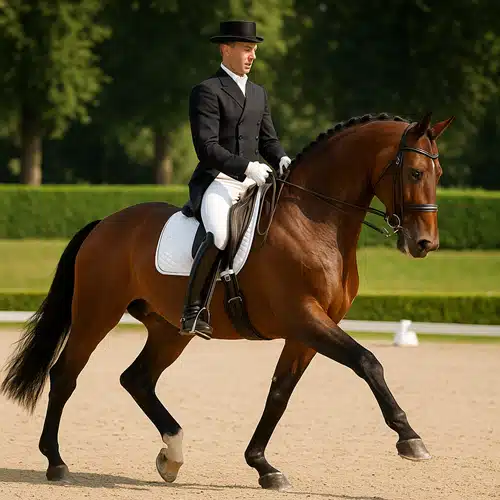
The Trakehner horse, also known simply as the Trakehner, is a true legend in the equestrian world. Considered one of the oldest and most noble warmblood breeds in Europe, it has fascinated both breeders and riders for centuries. Its unique combination of elegance, intelligence, and strength has secured it a special place in the history of sport horse breeding and equestrianism.
Trakehners are famous for their exceptional precision of movement, light yet energetic gaits, and harmonious conformation, which allow them to compete at the highest levels. They are horses of outstanding character – ambitious, hardworking, and loyal to humans – making them ideal partners both in professional sport and for ambitious recreational riders.
Today, the Trakehner is regarded as a symbol of tradition blended with modernity. Bred since the 18th century with excellence as the goal, it continues to rank among the top performers in dressage, eventing, and show jumping. This is a breed that has earned the status of an elite horse, still captivating equestrian enthusiasts all around the world.
Table of Contents
Origin and History of the Breed
The Trakehner breed traces its origins back to the 18th century, when in 1732, King Frederick William I of Prussia founded the famous Trakehnen Stud — then the largest and most advanced breeding center in Europe. The goal was to create a versatile horse: an elegant mount for the aristocracy, yet also a durable military horse capable of long marches and hard work under challenging conditions.
The foundation of the breeding program consisted of local Prussian mares, known for their strength and endurance. To refine the breed’s lightness, nobility, and quality of movement, they were crossed with Arabian, Anglo-Arabian, and Thoroughbred stallions. As a result, the Trakehner inherited its hallmark traits: harmonious conformation, stamina, courage, and graceful movement.
Worth reading:
- If you are interested in modern sport performance, explore the Hanoverian horse, known for its versatility and success in competitions.
- You can also discover the Oldenburg horse, valued for its powerful movement and strong presence in sport disciplines.
- For show jumping excellence, check out the Holsteiner horse, one of the leading breeds in jumping competitions.
- If you value endurance combined with performance, read about the Anglo-Arabian horse, known for its balance of stamina and power.
In the 19th century, Trakehner horses became a symbol of Prussian cavalry power — fast, obedient, and exceptionally enduring, making them ideal for military use. In peacetime, they served as parade, carriage, and sport horses.
A tragic chapter in the breed’s history came at the end of World War II, when most of the horses from the Trakehnen Stud were lost during the evacuation to the West. Only a few herds survived and were transported to West Germany. Thanks to the extraordinary determination of breeders, the population was painstakingly rebuilt, studbooks were reestablished, and breeding traditions continued.
Today, Trakehner horses are bred all over the world — from Germany and Poland to the United States and Scandinavia. In Poland, the breed developed particularly strongly after the war, and to this day, Trakehners are regarded as one of the most valued breeds in Olympic equestrian disciplines.

Appearance and Conformation
The Trakehner horse embodies nobility and harmony — its silhouette is elegant, well-proportioned, and immediately reveals its athletic character. Considered one of the most harmoniously built warmblood breeds in Europe, the Trakehner combines the lightness and refinement of oriental horses with the power and endurance of European breeds — a deliberate outcome of breeding efforts in former Prussia. It is a textbook example of the ideal sport horse: balanced, athletic, and refined in every detail.
General Conformation
The Trakehner has a dry, slender build that gives it a distinguished and expressive appearance — often earning it the nickname “the aristocrat among horses.” The average height at the withers ranges from 160 to 170 cm, placing it among medium to large-sized horses. Its outline is long and graceful, yet not lacking the strength and substance required for competitive sport.
Head and Neck
- Head: small to medium-sized, dry, with a straight or slightly convex profile. The large, expressive eyes reflect the horse’s intelligence and spirited nature.
- Ears: medium-length, mobile, showing attentiveness and alertness.
- Neck: long, slender, elegantly arched, and high-set — giving the Trakehner an impressive, collected posture and elegant presence in motion.
Body and Topline
- Withers: prominent and long, allowing correct saddle placement and promoting stability under the rider.
- Back: medium-length, strong, and elastic — ensuring smooth transmission of energy from the hindquarters to the forehand.
- Loins: short and well-muscled, contributing to endurance and springy, efficient movement.
- Chest: deep and spacious, with a well-developed rib cage — a sign of excellent respiratory and cardiovascular capacity.
- Croup: broad, slightly sloping, and strongly muscled, providing powerful impulsion for jumping and a dynamic canter.
Limbs
- Forelegs and hindlegs: long, dry, with well-developed joints and clearly defined tendons — traits associated with soundness and durability.
- Joints: strong and flexible, enabling dynamic yet stable movement.
- Hooves: regular, proportionate, and hard — one of the breed’s major advantages, ensuring longevity and resilience under demanding conditions.
Coat Colors
The most common coat colors among Trakehner horses are:
- Bay – classic and very popular,
- Chestnut – ranging from light to dark shades,
- Black – elegant and noble,
- Gray – less common but particularly striking.
Some Trakehners also feature subtle markings on the head or legs, adding individuality and charm to their appearance.
Movement and Presence
What truly captivates in the Trakehner horse is its lightness and fluidity of movement. Its trot is elastic and dynamic, the canter expansive and expressive, and the walk clear and efficient. Thanks to their long body lines, these horses possess natural aptitude for performing complex dressage movements and display remarkable expressiveness in the arena.
The Trakehner perfectly combines beauty with functionality. Its appearance is not merely aesthetic — every aspect of its conformation has a practical purpose, enhancing strength, endurance, and movement efficiency. This is why the breed has remained one of the most sought-after in the world of sport and breeding for generations.
Character and Temperament
The Trakehner horse combines nobility, intelligence, and remarkable emotional sensitivity. Its temperament is what makes the breed so highly valued by experienced riders — yet it also requires the right approach to unlock its full potential.
Intelligence and Sensitivity
Trakehners are known for their keen intelligence — they learn quickly, respond instantly to cues, and easily adapt to new situations. Their emotional sensitivity allows them to read human intentions with astonishing accuracy, often seeming to “read their rider’s mind.”
However, this quality can be both a strength and a challenge. With a calm, patient hand, a Trakehner becomes a loyal and trusting partner. But under stress or excessive pressure, these horses can become tense or overly reactive.
Loyalty and Bond with Humans
Trakehners are horses that form deep emotional bonds with their riders. When trust is built, they become devoted and hardworking companions, willing to give their all. It is often said that a Trakehner “rewards care with loyalty,” becoming a truly exceptional partner in the hands of a consistent and patient person.
Sporting Temperament
Trakehners are ambitious, energetic, and naturally motivated to work. Their athletic drive makes them outstanding in sport training, yet their temperament is often more reactive than that of other warmblood breeds such as Hanoverians or Holsteiners.
They can be sensitive to stimuli — sudden noises, changes in environment, or the rider’s tension — all of which can influence their behavior. In the hands of an experienced equestrian, however, this sensitivity becomes an advantage, allowing the rider to draw out the expression, dynamism, and precision of movement that make the Trakehner so admired in dressage and jumping.
Who Are Trakehners For?
While Trakehners can be calm and balanced, they are not ideal for complete beginners. Their delicate psyche and heightened sensitivity require a rider who:
- works consistently and calmly,
- knows how to build a trusting, cooperative relationship,
- maintains gentle discipline without excessive pressure.
Trakehners are perfect for those seeking an intelligent, ambitious, and loyal sport partner. In the right hands, they reveal extraordinary potential — blending elegance, strength, and endurance. This is a demanding yet deeply rewarding breed; riders who earn their trust gain not only a top-level athlete, but also a faithful friend for life.
Use in Sport
The Trakehner horse has always been a working and utility breed — initially bred for cavalry and carriage work — but over time, its role evolved toward high-performance sport. With its refined conformation, exceptional intelligence, and graceful, expressive movement, the Trakehner has earned worldwide recognition. It is a horse that perfectly blends precision, elegance, and endurance, making it a natural fit for Olympic disciplines.
Dressage – Masters of Expression
Dressage is the discipline where Trakehners truly shine. Their natural lightness, flexibility, and expressiveness enable them to perform the most demanding Grand Prix movements such as the piaffe, passage, flying changes, and pirouettes. Their quick learning ability and sensitivity to aids make them ideal partners for advanced dressage riders.
Trakehners are famous for their beautiful trot — elevated, rhythmic, and elastic — captivating both judges and spectators. In dressage, they are often seen as the artists of the arena, combining precision with elegance and emotional depth in their presentation.
Eventing – Endurance and Versatility
Eventing (Three-Day Eventing) is one of the most demanding equestrian sports, combining dressage, cross-country, and show jumping. Trakehners excel here thanks to their remarkable stamina, bravery, and mental resilience.
They perform confidently across all three phases — showing balance and focus in dressage, agility and courage on cross-country courses, and precision in jumping rounds. Their strong physique, excellent conditioning, and determination allow them to compete successfully even at World Championships and Olympic Games. Within this discipline, Trakehners are widely regarded as some of the finest all-around horses in history.
Show Jumping – Precision and Balance
Although Trakehners are not as commonly seen in show jumping as Hanoverians or Holsteiners, a well-trained Trakehner can achieve excellent results. Success depends on individual traits such as a strong back, elasticity, quick leg action, and natural balance.
Their courage, intelligence, and willingness to cooperate make them capable competitors at medium and higher levels. When correctly ridden, Trakehners demonstrate both accuracy and grace, proving that refinement can go hand in hand with power.
Trakehner Precision in Motion
One of the breed’s greatest assets lies in its unique biomechanics, blending beauty with function. Trakehners move not only impressively but also comfortably and efficiently for the rider:
- Walk – four-beat, relaxed, and ground-covering, showing suppleness and correct back movement.
- Trot – energetic, elastic, and expressive, featuring suspension and rhythm ideal for dressage work.
- Canter – collected, balanced, and flexible; while not as explosive as that of jump-bred horses, it provides excellent stability and rhythm.
The Trakehner’s movement is smooth, efficient, and easy to sit, enabling precise communication and harmonious cooperation with the rider. This combination of athleticism and elegance makes them one of the most versatile and admired sport horses in the world.
Breeding and Selection
The Trakehner breeding system is one of the most strict and carefully regulated in Europe, ensuring the consistency and integrity of the breed. The Trakehner Studbook is closed, meaning that the introduction of new bloodlines is heavily restricted. Only limited and carefully controlled outcrosses are allowed — specifically with Thoroughbred, Anglo-Arabian, and Arabian horses. This approach preserves the refined, noble type while subtly strengthening desired athletic traits.
Stallion Selection
To be approved for breeding, a Trakehner stallion must undergo a multi-stage evaluation process, which includes:
- Conformation and movement inspection – assessment of type, balance, and freedom of movement in all three gaits during the presentation “on the triangle.”
- Performance testing – typically a minimum 30-day test, evaluating the stallion’s performance under saddle in dressage, jumping, and behavior during training.
- Veterinary examinations and X-rays – screening for orthopedic soundness and eliminating any predisposition to hereditary conditions.
- Progeny evaluation – final breeding approval is only granted after the stallion’s offspring demonstrate high quality in conformation and movement.
Mare Evaluation
While often less publicly showcased than stallions, Trakehner mares also undergo thorough evaluations to ensure only the best individuals contribute to the breed. They are assessed for:
- Conformation and free movement – structural harmony, correct limbs, and quality of gaits.
- Character and trainability – mares must be intelligent, cooperative, and mentally stable, reflecting the breed’s reliable nature.
- Breeding performance – emphasis is placed on the quality and soundness of offspring, not merely the number of foals produced.
Result of Rigorous Selection
This highly selective breeding system ensures that Trakehners are consistent and predictable in type, temperament, and athletic ability. Both breeders and riders can rely on horses that are:
- Healthy and durable,
- Capable of long, successful sports careers,
- Elegant in conformation and refined in movement,
- Mentally balanced and willing to work.
Thanks to these qualities, Trakehner horses have earned a reputation for excellence and reliability in the international sport horse world and remain highly valued by professional riders, trainers, and breeders across the globe.
Trakehner Horses in Poland
The history of Trakehner horses in Poland dates back to the pre-war period, when our country was one of the most important breeding centers for this breed in Europe. Horses from the Prussian Trakehnen stud were brought to Polish military facilities and private breeding farms, where they quickly gained recognition for their endurance, noble conformation, and utility value. During the interwar period, Trakehners were among the most popular choices for cavalry and sport horses, and Polish officers valued them for their courage and loyalty under difficult conditions.
After World War II, many valuable Trakehner bloodlines were lost, but thanks to the dedication of breeders, Poland once again began to rebuild its position as a country friendly to this breed. In the 1960s and 1970s, several state studs imported horses from Germany and Russia, which were later crossed with native breeds to produce valuable sport horses.
Leading Trakehner Breeding Centers in Poland
Today, several studs and centers in Poland have made a significant contribution to the promotion and development of the breed:
Liski Stud Farm – long known for breeding horses with aptitude for eventing and dressage. Liski focuses on preserving the traditional Trakehner type while combining it with modern sport lines.
Racot Stud Farm – a center where Trakehners were crossed with Anglo-Arabians, resulting in more versatile and energetic horses. Racot remains an important location on the map of Polish warmblood breeding.
Kadyny Stud Farm – in the past, horses bred here were intended for military riding, which had a major influence on shaping the utility character of Polish Trakehners.
Nowe Jankowice Stud Farm – one of the leading modern centers, continuing to breed horses with European pedigrees and actively participating in international genetic exchange.
Trakehner Horses in Polish Sport
Horses of this breed regularly compete in national and international competitions, representing Poland in dressage, eventing (WKKW), and show jumping. They are particularly valued for their:
- endurance in cross-country trials,
- lightness and expressiveness in dressage performances,
- willingness to cooperate with the rider.
Polish Trakehners also perform well in young sport horse championships, where they achieve high rankings and attract the attention of judges and potential buyers.
The Trakehner Breed Appreciated by Breeders and Riders
Today, Trakehners in Poland are regarded as one of the most prestigious sport horse breeds. Although their population is smaller than that of Hanoverians or Holsteiners, the high quality of breeding and selection makes them highly valued among professional riders and ambitious amateurs. They are increasingly found not only in state studs but also in private breeding centers, especially in the Masuria and Pomerania regions.
While the Trakehner population is not as large as that of the Hanoverian or Holsteiner, many have written their names in gold in the history of sport and breeding. Their achievements demonstrate how exceptional traits — nobility, endurance, and intelligence — translate into success at the highest level.
Abdullah
A legendary Trakehner stallion who became a true icon of equestrian sport. In the 1980s, he achieved spectacular success in eventing, including winning an Olympic gold medal. His courage, stamina, and extraordinary bond with his rider made him a symbol of the breed’s capabilities. Abdullah proved that Trakehners can successfully compete with the best horses in the world.
Habicht
An outstanding breeding stallion who had a major influence on modern Trakehner breeding. Habicht combined excellent conformation, intelligence, and temperament. His offspring regularly excelled in dressage and eventing, ensuring that his bloodline remains highly valued across Europe to this day.
Pepel
A horse that also holds a special place in Polish equestrian history. Pepel was the mount of Jan Kowalczyk, the Olympic gold medalist in show jumping at the 1980 Moscow Games. Although less known internationally, Pepel played a key role in shaping Poland’s sporting tradition and remains a notable example of the Trakehner’s athletic and utility qualities.
Peron
A Trakehner who captivated audiences with his elegance in dressage during the 1990s. In 1996, under German rider Klaus Balkenhol, Peron won team gold in dressage at the Atlanta Olympic Games. He proved that Trakehners can successfully compete in the most demanding Grand Prix movements, standing shoulder to shoulder with the best Hanoverians and Oldenburgers.
Other Notable Trakehners
Over the years, many Trakehner horses have achieved international acclaim. Among the most recognized are:
- Biotop – a dressage horse known for his performances with Anna Merveldt,
- Sixtus – a renowned breeding stallion passing on powerful movement and an excellent temperament,
- Windfall – an eventing horse successful in the United States, considered one of the best Trakehner representatives in that discipline.
The Trakehner Horse Compared to Other Breeds
Trakehner vs Hanoverian
The Hanoverian is a strong, powerful, and very versatile horse, often used in show jumping and dressage. The Trakehner is lighter, more refined, and known for its exceptional fluidity of movement. The Hanoverian emphasizes strength and stability, while the Trakehner stands out for flexibility and elegance.
Trakehner vs Thoroughbred
The Thoroughbred is bred for speed and racing performance. The Trakehner, though also dynamic, has a more balanced temperament and stronger conformation, giving it greater versatility. The Thoroughbred is a track specialist; the Trakehner is an all-around athlete.
Trakehner vs Paso Fino
The Paso Fino is known for its smooth, natural gait, making it perfect for leisure riding and shows. The Trakehner does not have special gaits but moves with energy and lightness, making it ideal for sport work. The Paso Fino offers comfort; the Trakehner delivers athletic precision.
Trakehner vs Rocky Mountain Horse
The Rocky Mountain Horse is a family-friendly breed, known for its gentle temperament and unique single-foot gait that provides exceptional riding comfort. The Trakehner, with its hot-blooded temperament, requires more training and experience. The Rocky Mountain suits everyone; the Trakehner is for ambitious riders.
Trakehner vs American Saddlebred
The American Saddlebred is a show breed, famous for its high-stepping action and spectacular performances. The Trakehner, on the other hand, is characterized by a sport-oriented movement — less visually flamboyant but far more functional for dressage and jumping. The Saddlebred is a show horse; the Trakehner is a sport horse.
Most Common Health Issues
Although Trakehner horses are known for their endurance and longevity, they also have certain specific health sensitivities and care requirements. Importantly, many of their problems stem not from physical conformation but from their delicate psyche and high sensitivity to external factors.
Sensitivity to Stress
Trakehners are highly intelligent and observant horses, which makes them prone to stress in new environments or when faced with frequent changes. This can manifest as anxiety, hyperactivity, or loss of focus during training. They require patient, calm handling and clear, consistent routines.
Susceptibility to Gastric Ulcers
Like many sport horses, Trakehners can suffer from gastric ulcers, especially under stressful conditions, intense training, or improper feeding systems (e.g., too little forage, too much concentrated feed). Symptoms include reduced appetite, irritability when grooming the sides, and decreased athletic performance. Prevention involves a proper diet, constant access to hay, and minimizing stress.
Sensitivity to Dietary Changes
The Trakehner digestive system requires stability. Sudden changes in feed or supplements can cause digestive problems — from diarrhea to colic. Therefore, any dietary changes should be introduced gradually, and the diet must be well-balanced in terms of energy, protein, and micronutrients.
Delicate Psyche
Although Trakehners are loyal and willing to work, they do not respond well to pressure or harsh training methods. They need a patient approach and a relationship based on trust. Excessive strictness can lead to behavioral problems and, in extreme cases, refusal to cooperate.
Other Potential Issues
Metabolic problems – Some individuals are more susceptible to weight loss during stressful periods or competition seasons.
Excessive leanness – Trakehners often have a “dry” body type, requiring careful feeding to maintain proper condition.
Sports injuries – Like all sport horses, they may be prone to joint and tendon injuries, especially during intense training.
Zapoznaj się z artykułami:
FAQ
Is the Trakehner Horse Suitable for Beginners?
Usually not. Trakehners are sensitive horses that require calm, balanced, and experienced handling.
Can you buy Trakehner horses in Poland?
Yes. There are several reputable studs and breeders offering Trakehner horses.
How much does a Trakehner horse cost?
From around 30,000 PLN for a young horse to over 200,000 PLN for a dressage champion.
How long do Trakehner horses live?
Usually 25–30 years. With proper care, they can live even longer.
Are Trakehner horses good at jumping?
They can perform well, although they are more often chosen for dressage and eventing.