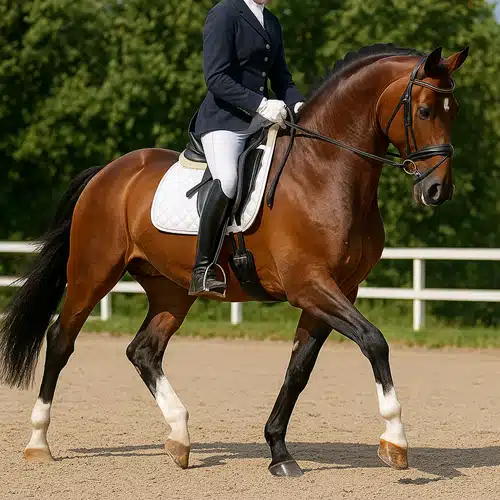
The Westphalian horse is one of the most recognizable and respected sport horse breeds in Europe. Originating from Germany, its pedigree and selective breeding make it a horse of exceptional athletic quality. This breed combines strength, elegance, and harmonious conformation, allowing Westphalians to excel in show jumping, dressage, and eventing.
Thanks to their balanced temperament and high intelligence, Westphalians quickly gain the rider’s trust and respond well to training. These horses are capable of meeting the demands of competitors performing on international arenas, while also impressing with their versatility and calm demeanor in everyday work.
Westphalian horses are increasingly appearing in Poland, where they are gaining popularity among breeders, competitors, and sport riding enthusiasts. Their versatility has earned them the nickname “universal athletes with German heritage,” which perfectly reflects their character and importance in modern equestrian sport.
Spis treści
Origin and History of the Breed
The Westphalian horse originates from Germany, specifically from the region of Westphalia, which for centuries was known for breeding strong work and carriage horses. Initially, these horses were used primarily in agriculture and transportation due to their great strength and endurance. However, with the rise of industry and changing societal needs in the 19th century, breeders began working to develop a modern riding horse suitable for both saddle and carriage use.
A key moment in the breed’s development was the crossbreeding of heavier local horses with warmbloods—mainly Hanoverians and Oldenburgs. This gave the emerging breed elegance, refinement, and improved athletic potential. In later years, Thoroughbreds and Trakehners were also introduced into the breeding program, further enhancing the breed’s athleticism and performance abilities.
Worth reading:
- If you are interested in top German sport horses, explore the Hanoverian horse, known for its versatility and competition success.
- You can also discover the Oldenburg horse, valued for its strength, movement, and performance in modern equestrian sports.
- For jumping power and athletic ability, check out the Holsteiner horse, one of the leading breeds in show jumping.
- If you value endurance combined with sport performance, read about the Anglo-Arabian horse, known for its balance of stamina and power.
A true turning point in the history of the Westphalian horse came in 1904 with the establishment of the Westphalian Horse Breeders’ Association (Westfälisches Pferdestammbuch) and the development of the state stud farm in Warendorf. From that moment on, breeding selection took on a new dimension—the goal became to produce a versatile horse capable of competing at the highest levels of equestrian sport.
Thanks to strict breeding standards and carefully managed selection programs, the Westphalian horse quickly gained recognition throughout Germany and later on the international stage. Today, the breed is considered one of the most modern and prestigious in Europe. Westphalians consistently achieve top rankings in show jumping and dressage arenas around the world, and their reputation as versatile and reliable sport horses continues to grow.

Appearance and Conformation of the Westphalian Horse
The Westphalian horse is the embodiment of elegance and the modern sport horse type. Its silhouette has been shaped by years of precise, selective breeding in Germany. It combines harmonious proportions, a strong frame, and refined features, making it an ideal partner for both dressage and show jumping.
The average Westphalian stands between 165 and 175 cm at the withers, though some individuals may be slightly smaller or taller. This height places the breed in the optimal range for sport horses—providing impressive movement and power while maintaining elegance and manageability.
Head and Neck
The Westphalian’s head is dry, well-proportioned, and noble in appearance. It most often features a straight or slightly convex profile, which gives the horse character. Large, expressive eyes convey intelligence and alertness, while wide nostrils indicate good respiratory capacity. The ears are medium-sized, mobile, and attentive, highlighting the breed’s lively temperament.
The neck is long, well-muscled, and elegantly set. It blends smoothly into a prominent, well-defined wither, providing an excellent base for saddle placement and contributing to the rider’s balance.
Body and Back
Westphalians are distinguished by a strong, medium-length back that ensures stability and efficient energy transfer during movement. The chest is deep and spacious, allowing for free lung and heart function—essential traits for intense athletic performance. The croup is broad, muscular, and slightly sloping, enabling powerful takeoff in jumping and strong propulsion in the canter.
Legs and Foundation
The legs of the Westphalian horse are strong, dry, and correctly aligned. Both the knee and hock joints are well-formed and durable, allowing these horses to handle significant training loads. The pasterns are of proper length and elasticity, serving as natural shock absorbers. The hooves are regular, hard, and well-proportioned to the body.
Coat Colors
The most common coat colors among Westphalians are bay, chestnut, and gray, with black being less frequent. These classic colors enhance the breed’s natural elegance. Their coats are typically solid-colored, with minimal white markings, which adds to their harmonious appearance.
General Impression
Westphalians captivate with their balanced build and flowing body lines. Their appearance combines the strength needed for jumping with the lightness and elasticity required in dressage. This is a horse whose conformation not only draws attention in competition but also provides comfort and efficiency during everyday training.
Elegance, harmony, and a modern sport-horse type make the Westphalian one of the best-built representatives of warmblood breeds. It is no coincidence that this breed enjoys immense respect among riders around the world.
Character and Temperament of Westphalian Horses
Westphalian horses have gained great popularity not only because of their conformation and athletic ability but also due to their exceptional temperament. This breed has long been valued for its calm nature, intelligence, and friendly disposition, which make it a favorite among riders worldwide.
Intelligence and Willingness to Cooperate
Westphalians are intelligent and quick learners. Under saddle, they show great attentiveness and easily pick up new exercises. For this reason, they are especially appreciated in disciplines that demand precision, such as dressage. They pose no difficulties in training, provided they are handled consistently and with respect for their sensitivity.
Calmness and Balance
One of the most important traits of the Westphalian is its balanced temperament. These horses are neither overly nervous nor excitable, distinguishing them from some other warmblood breeds. They can maintain focus even in challenging environments, such as competitions with large crowds, loud music, or other distractions.
Bond with Humans
Westphalians are known for forming strong connections with people. They appreciate calm, consistent handling and quickly learn to trust their caretakers. Loyal and patient, they enjoy human interaction and thrive in a structured, regular work routine. In daily stable life, they are cooperative and composed.
Ambition and Motivation
Despite their calmness, Westphalians possess ambition and a desire to perform. This combination makes them ideal for sport, where both strength and determination are required. Their inner motivation allows them to take on challenges willingly and persist through demanding training sessions.
Suitable for Different Riders
The Westphalian’s character makes it a versatile partner. On one hand, it is calm and predictable enough for intermediate riders; on the other, it has the potential and athletic capacity to meet the expectations of professionals. This versatility explains why the breed is so popular in both competitive sport and ambitious recreational riding.
The character and temperament of Westphalians combine balance, intelligence, and loyalty. These are horses that work with joy and dedication while forming deep bonds with their riders. As a result, they are not only excellent athletes but also reliable and affectionate partners in everyday work and training.
Use in Sport
The Westphalian horse is a true sport horse through and through—its versatility and athletic potential make it excel across multiple equestrian disciplines. With a combination of strength, fluid movement, and a steady temperament, Westphalians are popular choices for riders at both national and international levels.
Dressage – Masters of Harmony and Expression
Westphalians are highly valued in dressage, where their natural elegance and balanced conformation allow them to perform even the most demanding movements with precision. Their trot is rhythmic, ground-covering, and expressive, captivating both judges and spectators. The Westphalian canter is balanced and powerful, enabling smooth transitions into flying changes and pirouettes.
It’s no coincidence that many Westphalians compete successfully at the Grand Prix level—they are capable of executing piaffe, passage, and other advanced movements with remarkable precision and lightness. In dressage, they are known as horses that combine quality of movement with obedience and a genuine willingness to cooperate.
Show Jumping – Power and Technique
Although the breed was not originally developed solely for jumping, many Westphalian bloodlines now specialize in this discipline. These horses possess dynamic takeoff power, excellent leg technique, and a natural jumping instinct, allowing them to perform successfully in both junior and high-level competitions.
Their calm and focused temperament gives them a clear advantage in challenging conditions—they rarely lose concentration, even under pressure. This reliability makes them especially popular with young riders who need a predictable yet talented partner capable of advancing in the sport.
Eventing – Versatile Athletes for Demanding Tasks
While Westphalians are less common in eventing than Trakehners or Irish sport horses, they still hold their place in the discipline. When bred from lines emphasizing endurance and character, they perform very well in three-day events. Westphalians handle demanding cross-country courses with courage and confidence, and their trust in the rider makes them eager to tackle challenging natural obstacles.
Versatility and High-Level Recreation
Beyond competitive sport, Westphalian horses also excel in advanced recreational riding and training programs in sport-oriented riding schools. Thanks to their calm temperament and high intelligence, they are well suited as training horses for talented juniors preparing for their first competitions.
Movement and Performance Abilities
The Westphalian horse is among the sport horse breeds whose movement captivates with harmony and natural impulsion. This is the result of decades of selective breeding aimed at creating a versatile horse capable of excelling in dressage, show jumping, and eventing.
Walk – Energy and Rhythm
Westphalians are characterized by a ground-covering, four-beat walk that displays elasticity and a natural willingness to lengthen the stride. These horses maintain balance even when stretching their necks forward, a quality highly valued in dressage tests. Their walk is energetic yet relaxed, reflecting looseness and freedom through the back.
Trot – Elasticity and Expression
The Westphalian trot is the hallmark of the breed. It is rhythmic, springy, and expressive, while still soft and comfortable for the rider. Westphalians naturally show expressive, forward-moving gaits, which makes them ideal for medium and advanced levels of dressage. The trot is even and biomechanically efficient, allowing for both powerful extensions and precise collected movements such as half-pirouettes or passage.
Canter – Power and Balance
The canter of the Westphalian horse is strong, balanced, and elastic, with a natural moment of suspension that gives it lightness and lift. This quality is especially appreciated in show jumping and advanced dressage work. Westphalians can maintain rhythm both in a short, collected canter and in an extended stride down long lines. This versatility allows them to perform equally well in dressage arenas, jumping courses, and cross-country phases.
Practical Versatility of Movement
The Westphalian’s movement combines dynamism, precision, and collectability, offering great versatility in use. These horses not only impress judges and spectators but also provide comfort and balance for riders—their gaits are relatively “soft to sit,” and their biomechanics promote learning and refining riding skills.
Westphalians are regarded as horses with technical, modern movement that allows them to compete with the best sport horses in the world. This is precisely why they are so often seen at top-level equestrian competitions.
Breeding and Selection
The breeding of Westphalian horses has, since the creation of the breed, been based on a strictly controlled selection system overseen by the Westphalian Horse Breeders’ Association (Westfälisches Pferdestammbuch), headquartered in Warendorf—a city regarded as the heart of German equestrianism. Thanks to this program, Westphalians have earned a reputation as horses that are not only beautiful but, above all, functional and proven in sport.
Stallion Qualification Process
The most important stage in breeding is the qualification of stallions, which takes place during official inspections. Young horses are presented “on the triangle,” where their conformation, free movement, and jumping ability are evaluated. Selected stallions then proceed to performance tests, lasting either 30 or 70 days. During these tests, judges assess the horse’s temperament, willingness to cooperate, aptitude for dressage and jumping, and overall physical condition.
Under-Saddle Evaluation
Westphalians must also prove their abilities under saddle. These tests include dressage riding, show jumping, and behavioral evaluation in various scenarios. A key aspect is rideability—the ease with which the horse can be handled—which makes Westphalians versatile and suitable for riders of different experience levels.
Progeny Evaluation and Breeding Lines
A breeding license is not granted for life—stallions must also prove their worth through the quality of their offspring. Evaluations include the foals’ type, conformation, and early behavior during initial training. Westphalian breeding lines are closely monitored, and those demonstrating exceptional athletic potential gain widespread recognition across Europe.
Health Requirements
Great emphasis is placed on the health of breeding horses. Veterinary examinations, including detailed X-rays of the joints, are standard to eliminate individuals predisposed to musculoskeletal problems. As a result, Westphalians are known for their above-average soundness and lower susceptibility to sport-related injuries.
Introduction of Other Bloodlines
Although the Westphalian breed maintains a strong, well-established population, controlled infusion of other warmblood bloodlines—primarily Trakehner, Hanoverian, and Thoroughbred—is permitted. This practice helps refresh the gene pool, enhance endurance, and add refinement to movement, while preserving the characteristic Westphalian type.
Thanks to this rigorous system, Westphalians are today recognized as some of the most consistent, reliable, and predictable sport horses, offering breeders and riders a true guarantee of quality.
Westphalian Horses in Poland
Although other German warmblood breeds—especially Hanoverians and Holsteiners—have long dominated in Poland, Westphalian horses are gradually gaining significance. A few decades ago, they were relatively rare, but with the development of equestrian sport and increasing breeder awareness, Westphalians have become increasingly imported from Germany.
Import and Breeding
The first Westphalians arrived in Poland mainly through private riders and trainers seeking horses with proven sport pedigrees. Today, many stables not only import horses from Germany but also breed Polish mares with Westphalian stallions or use semen from top sires based in Warendorf. As a result, the population of this breed in Poland is slowly but steadily growing.
Popularity Among Polish Riders
Westphalians are especially valued for their balanced temperament and excellent movement, making them ideal for both dressage and show jumping. In recent years, Polish riders have increasingly chosen Westphalians for competition, appreciating their versatility, reliability, and cooperative nature in training.
Presence in Competitions
At national competitions, the number of horses with Westphalian bloodlines is steadily increasing. They appear both in junior classes—where a calm character and safety are most important—and in national and international-level competitions, where they stand out for their movement quality and jumping strength.
Prospects in Poland
Although Westphalians are still less numerous than Hanoverians or Holsteiners, their reputation and prestige are growing year by year within the sport and breeding community. Thanks to strong cooperation between Polish breeders and German breeding associations, access to top-quality stallions of this breed is possible, allowing the domestic Westphalian population to develop at a high level.
Westphalian horses in Poland can thus be considered a rapidly developing breed, one that is likely to play an increasingly important role in both competitive sport and national breeding in the coming years.
Famous Westphalian Horses
In the history of equestrian sport, Westphalian horses have established themselves as some of the most talented and decorated warmbloods in the world. Thanks to their harmonious build, lightness of movement, and exceptional willingness to work, they have achieved remarkable success on international arenas.
Rembrandt
Without a doubt, Rembrandt is the most famous Westphalian horse in history. This phenomenal gelding, ridden by Nicole Uphoff, won two Olympic gold medals in dressage (Seoul 1988 and Barcelona 1992). In addition, he triumphed at World and European Championships, becoming a true icon of modern dressage. His expressive trot and effortless movement set the standard for generations of sport horses that followed.
Warum Nicht FRH
Also known as “Hannes”, this outstanding Westphalian was one of Isabell Werth’s most successful mounts. Together, they won European Championship medals and competed at the highest levels of international sport, demonstrating remarkable precision and great mental strength. Warum Nicht FRH helped renew global interest in the Westphalian breed among top-level riders.
Bella Rose
A mare forever remembered by dressage enthusiasts, Bella Rose—also ridden by Isabell Werth—was often called “the queen of the dressage arena.” Her movement was characterized by extraordinary expression and elasticity, and her performances captivated both judges and audiences. Bella Rose proved that Westphalians can compete on equal footing with the best Hanoverian and Holsteiner horses.
Other Notable Westphalians
In addition to these legendary horses, many other representatives of the breed have achieved success in show jumping and eventing. Although Westphalians are most commonly associated with dressage, their versatility and talent have earned them recognition in multiple equestrian disciplines worldwide.
The Westphalian Compared to Other Horse Breeds
Westphalian vs Hanoverian
Both breeds belong to the group of German sport warmbloods and are known for their versatility. The Hanoverian is more commonly recognized for show jumping and lower to mid-level dressage. The Westphalian, on the other hand, offers greater elegance and lightness of movement—especially at the Grand Prix level—along with a more expressive and artistic style in dressage.
Westphalian vs Thoroughbred
The Thoroughbred is a racing specialist—light, fast, and full of energy. The Westphalian, being heavier and more muscular, is a balanced athlete, ideal for endurance work, dressage, and show jumping. The Thoroughbred represents speed, while the Westphalian embodies structure and organization in sport.
Westphalian vs Paso Fino
The Paso Fino provides maximum comfort thanks to its naturally smooth, gaited movement. The Westphalian does not offer the same riding comfort, but it far surpasses the Paso Fino in Olympic disciplines, excelling in strength, precision, and masterful movement technique.
Westphalian vs Rocky Mountain Horse
The Rocky Mountain Horse is a family-friendly and recreational breed, valued for its smooth gait and gentle disposition. The Westphalian, by contrast, is a professional sport horse—dynamic, energetic, and demanding. The Rocky Mountain offers calmness and comfort, while the Westphalian delivers ambition and athletic drive.
Westphalian vs American Saddlebred
The American Saddlebred is a show breed, prized for its flamboyance, high-stepping action, and elegance in the show ring. The Westphalian, in contrast, represents true sporting excellence—with steady, harmonious movement and strength—making it perfectly suited for demanding training and high-level competition.
Health and Care
Westphalian horses, like other warmblood breeds, are known for their good health and natural resilience. Their strong build and harmonious proportions make them less prone to common injuries associated with poor conformation. However, as sport horses, they require appropriate training, nutrition, and recovery management to stay in peak condition.
Most Common Health Issues
Tendon and muscle strain – Intensive work at a high level, especially in dressage and show jumping, can lead to micro-injuries. These horses need regular warm-ups, proper cool-downs after training, and adequate rest periods for regeneration.
Metabolic problems – Improper feeding, excess concentrate feed, or irregular feeding schedules can cause metabolic imbalances. Although Westphalians are large horses, they need a well-balanced diet tailored to their workload.
Sensitivity to feed changes and stress – Despite their generally calm temperament, Westphalians may react poorly to sudden changes in diet or environment. As sport horses, they require a consistent routine and thoughtful, steady management.
Tendency toward arthritis – Older horses, especially those that have been used intensively in sport, may develop degenerative joint changes. Preventive care is therefore essential: proper footing, balanced training loads, and joint-supporting supplements all help reduce the risk.
Care and Management
Specialized care – Regular visits from the farrier, physiotherapist, or osteopath help keep Westphalians in top form and prevent injuries.
Nutrition – Their diet should be based on high-quality hay and concentrated feed, supplemented with vitamins, minerals, and nutrients supporting joints and muscles.
Daily grooming – Brushing, hoof cleaning, and regular veterinary check-ups are essential to prevent skin and hoof conditions.
Training and recovery – Westphalians thrive in consistent yet non-excessive training programs. After intense competitions or workouts, they benefit from active rest—such as lunging, hand walking, or free movement in the paddock.
With proper care, balanced nutrition, and thoughtful management, Westphalians maintain their health and athletic performance for many years, continuing to impress with their strength, elegance, and willingness to work.
Zapoznaj się z artykułami:
FAQ
Is the Westphalian Horse Suitable for Beginners?
Yes, for beginners under the supervision of a trainer. It is a calm and cooperative horse.
Are Westphalian Horses Good for Show Jumping?
Yes, some bloodlines are specifically bred for show jumping.
Are Westphalian Horses Suitable for Grand Prix Dressage?
Yes, many horses of this breed achieve top results in dressage.
What Is the Price of a Westphalian Horse?
From 30,000–40,000 PLN for a young horse to several hundred thousand PLN for a trained sport horse.
Is the Westphalian Horse a Sport or Recreational Horse?
Primarily a sport horse, but it can also be successfully used for high-level recreational riding.