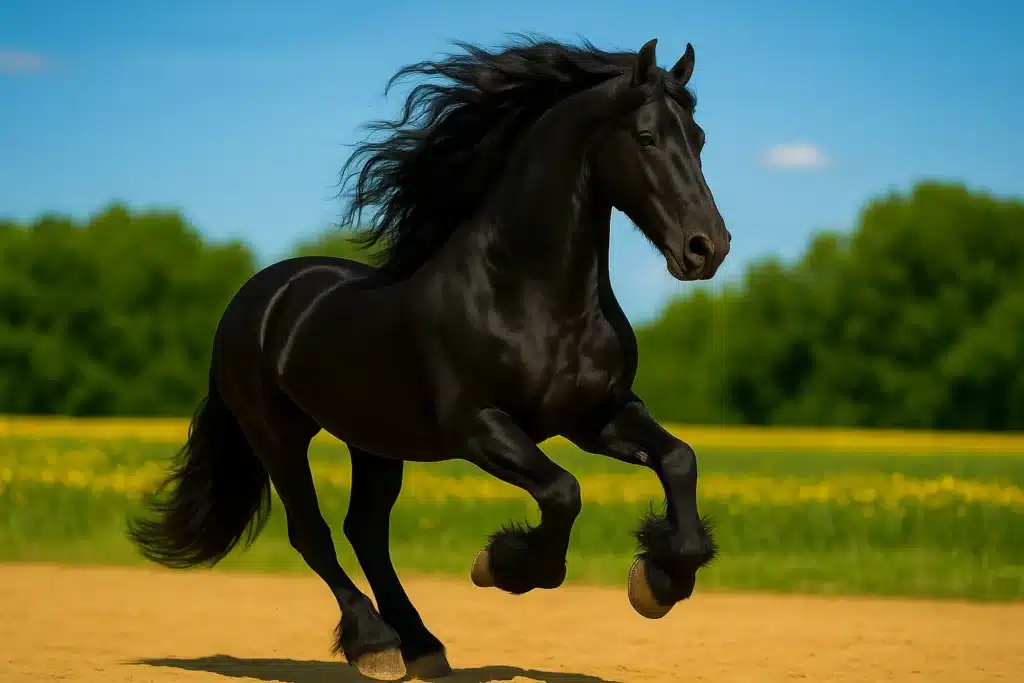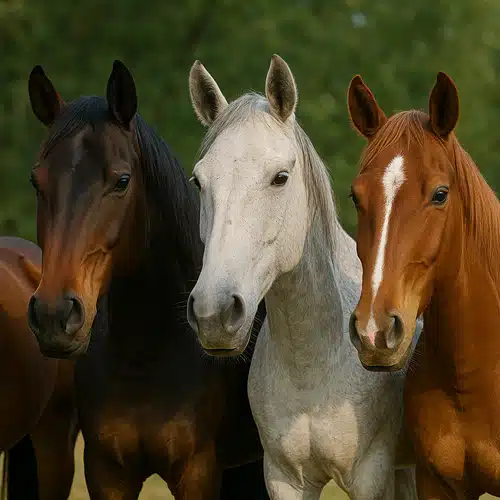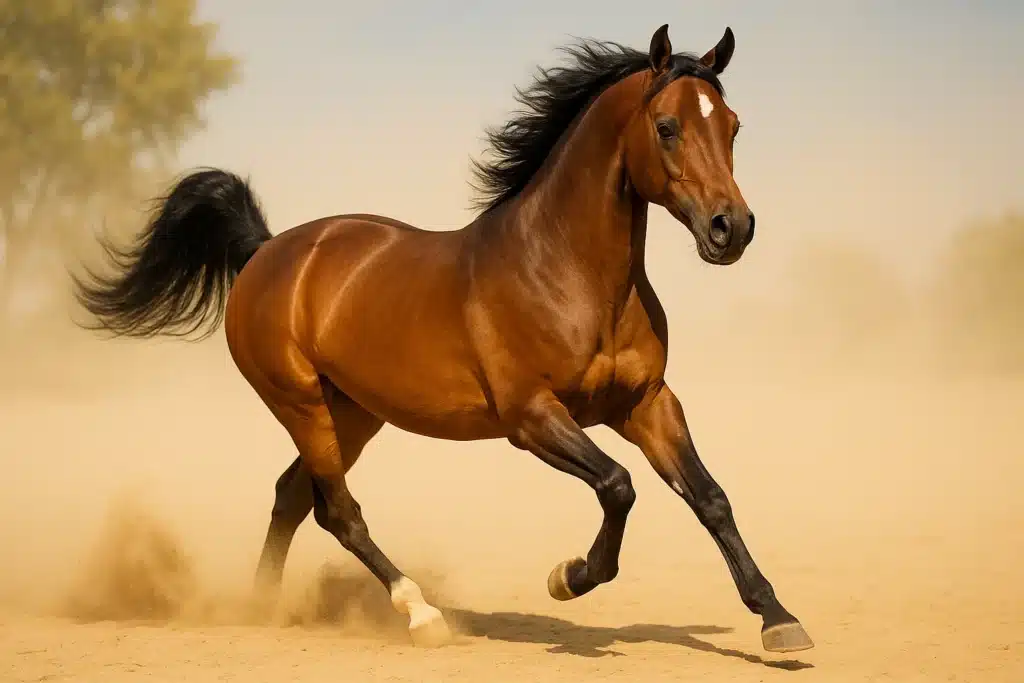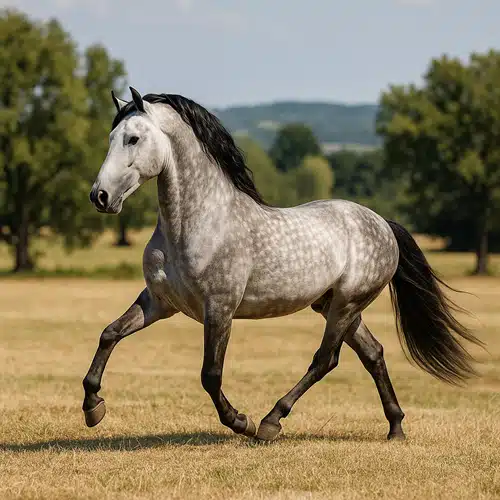
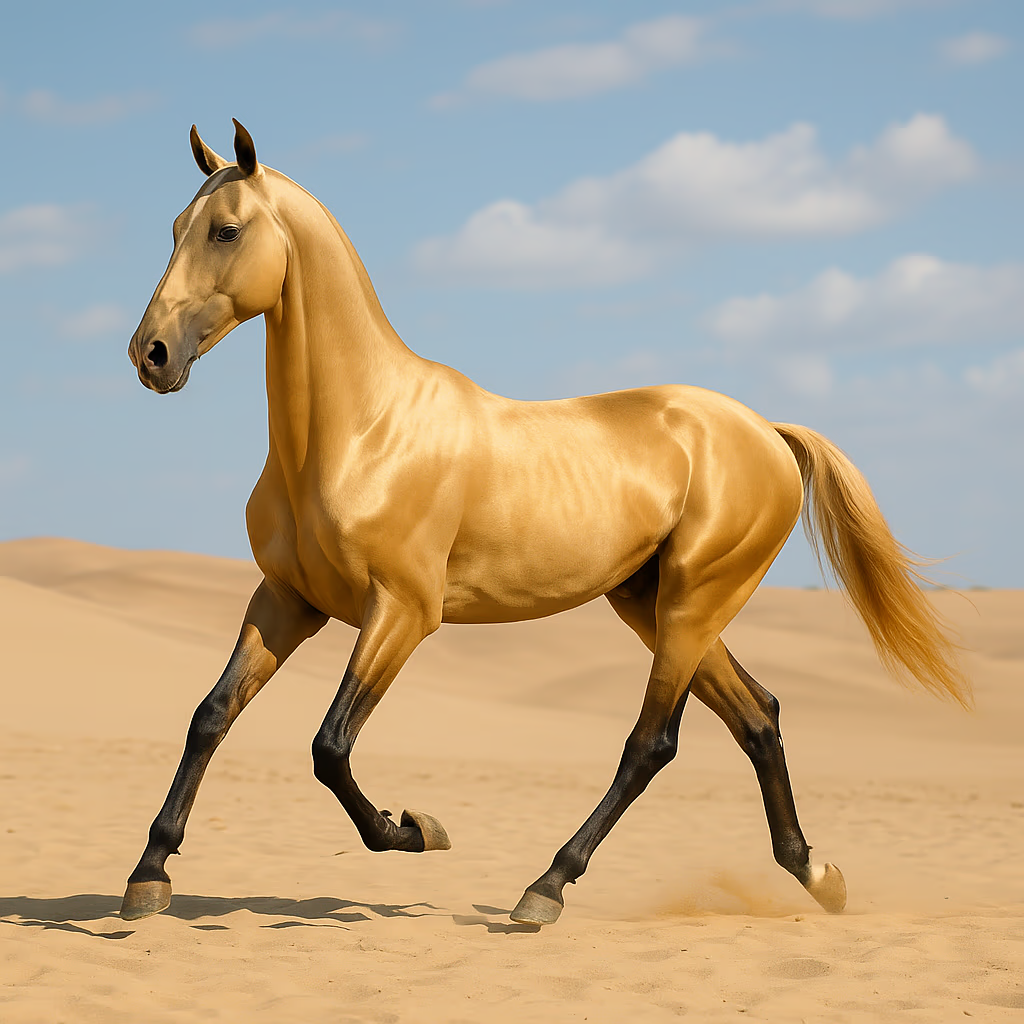
The Akhal-Teke horse is one of the oldest and most unique horse breeds in the world. Known as the “golden horse of the desert,” it is distinguished by its incredible coat sheen, endurance, and loyalty to its rider. It is not only a horse of exotic beauty but also an athlete with exceptional potential.
Spis treści
Origin and History
The Akhal-Teke horse originates from the territory of present-day Turkmenistan, with its cradle in the Ahal oasis at the foot of the Kopet Dag mountains. It was there that nomadic tribes — particularly the warlike Teke people — began selective breeding of these horses, focusing not only on appearance but also on utility, endurance, and loyalty to humans.
The history of this breed goes back more than 3,000 years, making it one of the oldest and most ancient horse breeds in the world. It is believed that the ancestors of Akhal-Teke horses were closely related to those that played a key role in the armies of ancient Persians, Parthians, Scythians, and other Central Asian peoples. They were prized as war mounts — fast, agile, brave, and dependable in harsh conditions. They were also used for long-distance journeys and desert races, which required tremendous stamina and the ability to survive without water for many hours, or even days.
Thanks to long-term geographic isolation, the harsh climate of Turkmenistan, and careful breeding, Akhal-Teke horses developed extraordinary traits found in no other breed. Their remarkable resistance to extreme temperatures — from desert heat reaching +50°C to frost below –20°C — is the result of life in severe desert conditions. Their bodies are slim, sinewy, and dry in build, allowing for efficient thermoregulation and minimal energy consumption.
Zapoznaj się z artykułami:
- Poznaj więcej ras koni. Zapoznaj się dokładnie z ich charakterem, cechami.
- Poznaj konia arabskiego – legendę pustyni, znaną z niezwykłej wytrzymałości i szlachetnego wyglądu.
- Odkryj konia Marwari – wyjątkową rasę z Indii, rozpoznawalną po charakterystycznie zakrzywionych uszach.
- Dowiedz się, dlaczego koń pełnej krwi angielskiej jest najszybszym koniem wyścigowym na świecie.
Their coat color is equally extraordinary — shimmering and metallic, often with golden hues — which earned these horses the nickname “the golden horse.” In sunlight, their coat gleams like polished metal, inspiring admiration from breeders and horse lovers around the world. Thanks to this unique beauty and the legends surrounding the breed, the Akhal-Teke is often called the “golden horse of Turkmenistan,” serving as a national symbol of the country.
Akhal-Teke horses are also renowned for their incredible endurance — they can cover hundreds of kilometers per day, as proven in many long-distance endurance rides. One legendary achievement took place in the 1930s, when a group of Turkmen riders on Akhal-Teke horses traveled nearly 4,300 kilometers from Ashgabat to Moscow in just 84 days — including three days without access to water while crossing the Karakum Desert.
Equally remarkable is the deep bond these horses form with humans. Due to the harsh breeding conditions and close contact with their owners, Akhal-Teke horses are exceptionally loyal, intelligent, and sensitive. They often develop relationships based on trust and devotion, which makes them demanding in training — they do not tolerate harsh treatment or inconsistency. However, when treated with respect, they reward their riders with extraordinary cooperation and willingness to work. Many experienced horsemen describe them not just as mounts, but as true partners — golden horses that give their hearts to only one rider.
Appearance and Distinctive Features
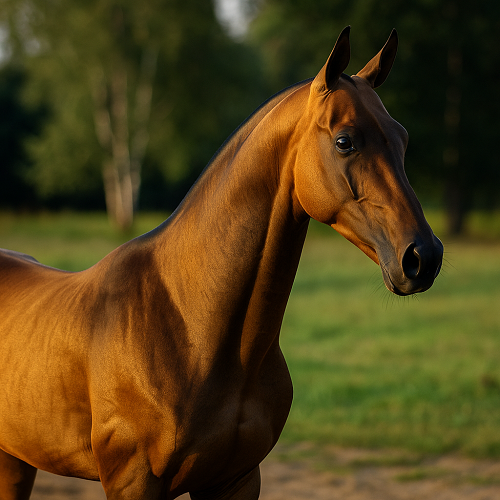
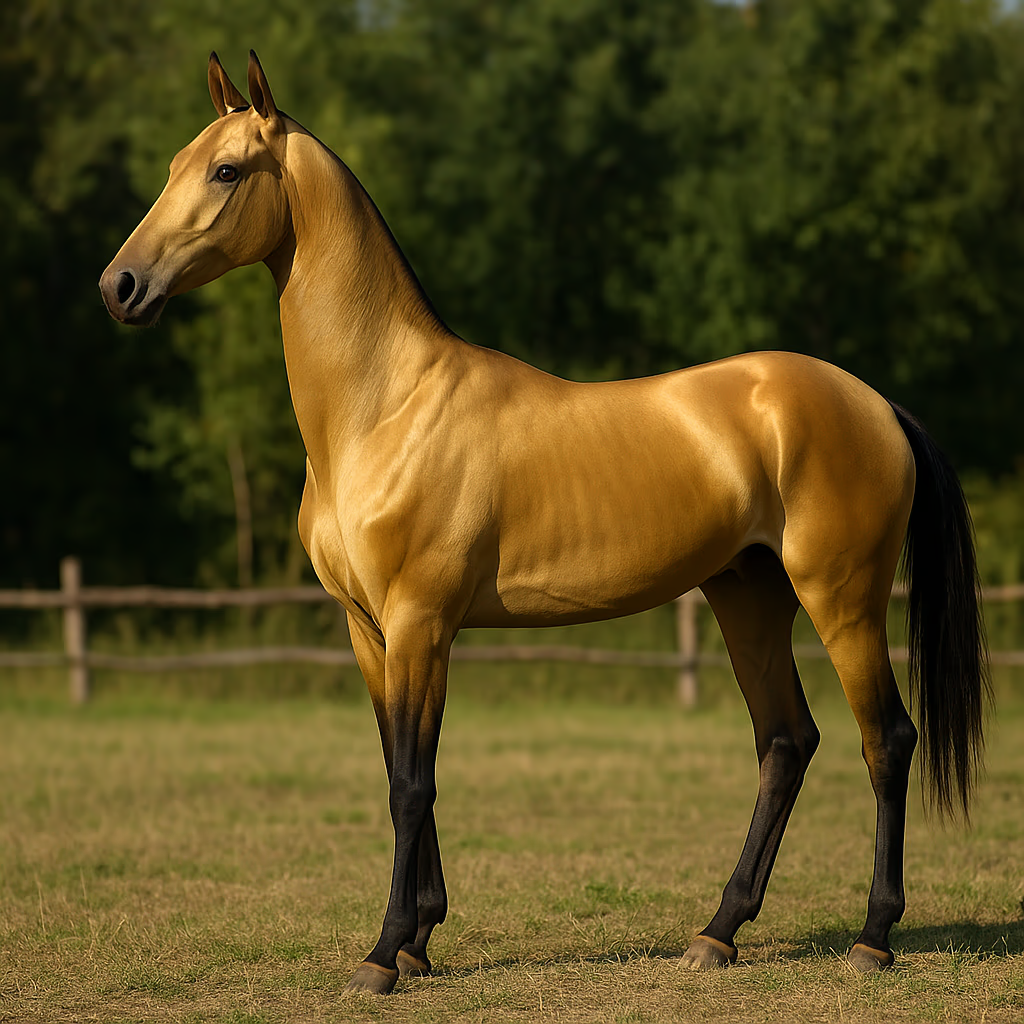
The Akhal-Teke, known as the “golden horse,” has a very distinctive silhouette — slender, elongated, and elegant.
Typical Breed Characteristics:
- Height at the withers: 150–165 cm
- Head: dry, long, with large expressive eyes
- Neck: long and flexible
- Withers: prominent; back: long and elastic
- Croup: slightly sloping; legs: thin but strong
- Coat: short, shiny, and without undercoat
- Mane and tail: sparse, often silky
- Colors: bay, palomino, buckskin, black, and gray.
Palomino (isabelline) horses are famous for their metallic sheen, which earned the breed its nickname — the golden horse.
Character and Temperament
These horses are extremely loyal to their riders. They are intelligent, alert, and independent. They do not tolerate harsh treatment — they require gentleness and understanding.
Their strong survival instinct makes them cautious but not skittish. They are not ideal for beginners, but when trust is built, they can become exceptional and devoted partners.
Endurance Riding
For centuries, Akhal-Teke horses have been renowned for their incredible endurance, making them excellent mounts for long-distance rides. Thanks to their efficient metabolism, they can function with minimal food and water, maintaining their energy for many hours of strenuous effort. Their lean, dry body structure enables effective thermoregulation, allowing them to work efficiently even in scorching heat.
In endurance races ranging from 80 to 160 kilometers (and even more), Akhal-Tekes have repeatedly proven their superiority. Their light movement, resistance to fatigue, and willingness to cooperate with the rider make them well-suited to varied terrain — from mountain trails to desert landscapes. In Central Asia and the Caucasus, they are still used in traditional endurance rides, which serve both as sport and as a tribute to the ancient caravan routes.
Equestrian Sports (Dressage, Show Jumping, Eventing)
Although Akhal-Teke horses are not as massive as Hanoverians or Holsteiners, they can successfully compete in Olympic disciplines. They are known for their flexible movement, intelligence, and eagerness to learn, which make them well-suited for dressage. Their conformation — long limbs, light build, and energetic gaits — gives them precision and elegance in movement.
In show jumping, they achieve good results, especially at lower and medium levels. Their agility, quick reflexes, and determination allow them to navigate courses with ease and speed. In eventing (Three-Day Eventing), Akhal-Tekes excel in cross-country phases and maintain good control in both dressage and jumping tests.
However, they require an experienced rider who understands their independent nature and can offer trust-based training. In the hands of a patient trainer, the golden horse can truly “spread its wings” and become a remarkable sporting partner.
Shows, Parades, and Historical Reenactments
The unique beauty of the Akhal-Teke — its refined build, long swan-like neck, and shimmering coat — makes it visually stunning. For this reason, they often appear at oriental horse shows, equestrian galas, and professional photo sessions or advertising campaigns.
They are especially popular in historical reenactments and parades, where they portray the war horses of ancient civilizations — Persians, Scythians, Parthians, and Sarmatians. Their exotic appearance perfectly captures the spirit of the past, and their proud bearing draws the admiration of audiences and directors alike. It’s no surprise that Akhal-Teke horses have appeared in feature and historical films, often cast as royal or battle horses.
Gaits and Abilities
The Akhal-Teke moves lightly, elastically, and with great efficiency. Its movement is smooth and rhythmic, though less flamboyant than that of classical breeds.
- Walk – long, calm, and unhurried
- Trot – elastic, with good use of the back
- Canter – extended, fluid, and highly enduring
Their rhythm and economical motion are particularly valued — they can cover vast distances without showing signs of fatigue.
Breeding and Bloodlines
In Turkmenistan, the breeding of Akhal-Teke horses is considered part of the nation’s cultural heritage and is strictly supervised by state breeding institutions. The Akhal-Teke horse is recognized as a national symbol, and its image appears on the coat of arms and emblem of Turkmenistan. Breeding traditions have been passed down through generations — these horses are a source of immense national pride and have accompanied the Turkmen people for thousands of years.
The Studbooks (the General Studbook managed by Turkmen Atlary and the International Studbook ITSB) contain detailed records of all Akhal-Teke stallions and mares. Stallion selection is extremely rigorous — horses must show not only excellent breed type but also proper performance abilities and temperament. The process often involves evaluation commissions that assess conformation, movement, and sporting or racing results.
Major Bloodlines of Akhal-Teke Horses
Within the breed, there are several male sire lines, some of which dominate the modern population. Below are the most significant and widely known:
- Gelishikli (Гелишикли) – originating from a stallion born in 1953. Horses from this line are known for their good temperament, balance, and strong conformation. They are often used in dressage and endurance riding, recognized for their elegance and quality of movement.
- Kaplan (Каплан) – founded by a stallion born in 1946. This line produces fast, light, and athletic horses with a dynamic temperament and strong endurance. It is less common in Western Europe but remains highly valued in Asia, particularly for racing and sports use.
- Sovkhoz 2 (Совхоз 2) – derived from the stallion Sovkhoz II (born in 1941), a son of the famous sire Skak. Horses of this line are graceful, with elegant, light movement, making them ideal for dressage and show performances.
- Peren (Перен) – named after a stallion born in 1956, this is the most numerous and widespread line in modern breeding. Horses from this lineage are balanced, harmonious, and versatile — often used in sport breeding programs across Europe. They perform well in eventing, endurance, and dressage.
Other historically important lines include Skak, Arab, El, Sere, Karlavach, Toporbai, and Melekush — each contributing unique traits to the breed’s genetic pool. Their significance varies depending on breeding goals, whether for sport, show, preservation, or working use.

Akhal-Teke Horses in Poland
Although Akhal-Teke horses are still rare in Central Europe, their popularity in Poland has been steadily growing — especially among experienced riders, enthusiasts of oriental breeds, and those interested in endurance riding and natural horsemanship.
The first representatives of this breed appeared in Poland in the 1990s, but true interest emerged after 2000. Today, several private studs and breeding farms across the country are devoted to Akhal-Teke horses. These are usually small facilities run by passionate breeders who import horses mainly from Russia, Kazakhstan, Ukraine, and occasionally Turkmenistan — although direct exports from Turkmenistan are rare due to strict government regulations and breeding policies.
Notable and active breeders operate in the Mazowieckie, Wielkopolskie, and Lower Silesian regions, where breeding programs and sport training are conducted. Many horses have pedigrees confirmed in the International Studbook (ITSB), and some are registered with the Polish Horse Breeders Association (PZHK), although the Akhal-Teke does not have its own national studbook in Poland — they are generally listed under foreign horse registries.
Uses of Akhal-Teke Horses in Poland
While Akhal-Tekes are not yet widely represented in competitive sports in Poland, their numbers — and interest in them — are growing steadily. The most common uses of this breed in the country include:
- Endurance riding: Thanks to their stamina and efficient metabolism, Akhal-Tekes perform exceptionally well in endurance competitions. Although the Polish endurance scene is still small, it is developing steadily, and these horses are gaining recognition among long-distance riders.
- Shows and equestrian events: Their exotic appearance, proud movement, and shimmering coats make Akhal-Tekes popular attractions at breed showcases, parades, and historical reenactments. They draw the audience’s attention wherever they appear, standing out from other breeds.
- Natural training methods: Because of their intelligence and sensitivity, these horses respond well to trust-based and ground training. They are often chosen by practitioners of natural horsemanship and positive reinforcement training, who value their emotional intelligence and responsiveness.
Their calm temperament, loyalty, and sensitivity require a patient and conscious rider, but in return, the horse can form a deep bond and become a willing, devoted partner — qualities especially valued by those who prioritize the human–horse relationship.
Breeding Challenges in Poland
Breeding Akhal-Teke horses in Poland presents unique challenges. The limited population, difficulty accessing new bloodlines, and necessity of importing stallions or semen from abroad make it a demanding and costly endeavor. Additionally, Akhal-Tekes are not a “commercial” breed — they are rare, expensive, and require specialized care, which limits their popularity in general recreational riding.
Nevertheless, Polish breeders remain determined to preserve the breed’s purity and heritage. Through their dedication, the Akhal-Teke — the Golden Horse of the East — is gradually taking root on European soil, earning admiration for its beauty, endurance, and spirit.
Humanize 465 words
Facts and the Legend of the Golden Coat
- Akhal-Tekes were royal diplomatic gifts — presented to tsars and emperors as symbols of honor, loyalty, and prestige.
- The stallion Absent won a gold medal in dressage at the 1960 Rome Olympic Games, bringing worldwide fame to the breed.
- In Turkmen culture, the Akhal-Teke horse represents national pride — its image appears on the national emblem and state coat of arms.
- Their unique coat structure reflects light in a way that creates a metallic shimmer, giving them the famous nickname — “the golden horse.”
Care and Health
Although Akhal-Teke horses are famous for their resilience and exceptional endurance, they require thoughtful care adapted to their unique physiology. Bred in the harsh climate of Central Asia, they are naturally tough, yet their exotic build and certain sensitivities mean that they need special attention — particularly in European conditions.
Protection Against Cold – Lack of Undercoat
One of the most distinctive features of the Akhal-Teke is the absence of a dense undercoat, a trait typical of desert horses. Their coat is thin, glossy, and close to the skin, giving it the famous metallic sheen. However, the lack of insulation makes them sensitive to cold, rain, and humidity — especially in autumn and winter.
In Poland’s climate, they require blanketing (even when kept in open stables) and access to a dry, well-ventilated shelter. Keeping them outdoors without protection can lead to respiratory infections, chills, or weight loss.
Diet – Delicate Digestive System
Akhal-Tekes have an efficient metabolism, meaning they do not need large amounts of feed. However, their digestive systems are sensitive, particularly to abrupt dietary changes, excess starch, or mineral deficiencies. Recommended feeding includes:
- high-quality hay (often sufficient as the base diet),
- low-sugar forage,
- supplementation with electrolytes, zinc, and selenium (especially for training horses),
- small portions of concentrated feed, ideally formulated for sport or Arabian horses.
Some individuals tend to lose weight easily under stress, cold, or feed changes, so dietary stability and gradual feed transitions are crucial.
Training – Moderate and Fitness-Oriented
Akhal-Tekes are naturally energetic and enduring, but they do not respond well to heavy, force-based training. Due to their lean build and fine joints, intensive strength work or training on hard ground is not recommended. Ideal activities include:
- conditioning training (long walks, cantering outdoors),
- flexibility and precision work (dressage, natural horsemanship),
- moderate jumping or endurance work, after proper conditioning.
Increasing training intensity too quickly may lead to injuries or mental burnout, as these horses are highly sensitive and emotionally perceptive.
Hooves – Dry, Hard, but Maintenance-Intensive
Akhal-Tekes typically have dry, dense, and hard hooves — an adaptation to their desert origins. In natural, arid conditions, they are rarely problematic, but in Europe’s humid climate and soft pastures, issues may arise, such as:
- thrush,
- softening of the hoof wall,
- increased sensitivity on rocky or uneven terrain.
Regular hoof trimming (every 5–7 weeks), suitable footing (avoiding muddy or wet surfaces), and, when needed, protective shoes or hoof boots are essential. Some horses perform well barefoot, depending on management and workload.
Longevity and General Health
One of the most remarkable traits of Akhal-Teke horses is their longevity. Their average lifespan exceeds 25 years, with many individuals living into their 30s, often remaining rideable into old age. When properly cared for, they are also less prone to common musculoskeletal diseases such as laminitis or arthritis.
In summary, while Akhal-Tekes are exceptionally hardy and healthy, their exotic physiology requires informed management and environmental adaptation. In the hands of an experienced owner, these “golden horses” can shine not only with their beauty but also with lasting health, vitality, and longevity.
Comparison of the Akhal-Teke with Other Breeds
For centuries, the Akhal-Teke has been regarded as one of the most extraordinary horse breeds in the world. To fully appreciate its uniqueness, it’s worth comparing it with other famous breeds — the Arabian, Anglo-Arabian, and Thoroughbred. Though all share elegance and athleticism, they differ in character, conformation, and purpose.
Akhal-Teke vs. Arabian – Two Desert Legends
At first glance, both breeds appear similar: they originate from the harsh deserts of Central Asia and the Middle East.
However, the differences are significant:
- Conformation: The Arabian is more compact, with a shorter back and soft, rounded lines. The Akhal-Teke, by contrast, is taller, slimmer, and has longer limbs and neck, giving it an almost exotic silhouette.
- Temperament: Arabians are emotional, spirited, and deeply bonded to people. Akhal-Tekes are more independent, intelligent, and trust-based — they do not tolerate harsh handling.
- Use: Arabians excel in endurance riding, while Akhal-Tekes are often chosen for sports requiring power, stamina, and precision, such as eventing or dressage.
Akhal-Teke vs. Anglo-Arabian – Elegance vs. Energy
The Anglo-Arab combines the spirit of the Arabian with the speed of the Thoroughbred. Compared to it, the Akhal-Teke stands out with a drier build and incredibly fluid movement.
- Conformation: Anglo-Arabs have stronger hindquarters and a springier stride, while Akhal-Tekes are lighter and display a longer, more flowing gait.
- Temperament: Both are intelligent, but the Akhal-Teke is more sensitive and needs a gentle, understanding rider. The Anglo-Arab is typically more athletic and steady.
- Endurance: Akhal-Tekes can survive extreme conditions on minimal food and water, a trait unmatched by most other breeds.
Akhal-Teke vs. Thoroughbred – Speed vs. Stamina
The Thoroughbred is the symbol of speed and racing, while the Akhal-Teke is the master of endurance and resilience.
- Conformation: Thoroughbreds are more muscular, with broad chests and powerful hindquarters. Akhal-Tekes are leaner, with an athletic and efficient physique.
- Performance: Thoroughbreds dominate short-distance races, but Akhal-Tekes can maintain a steady pace for hours without signs of fatigue.
- Character: Thoroughbreds tend to be high-strung and demanding, whereas Akhal-Tekes are calmer, consistent, yet emotionally perceptive.
Akhal-Teke vs. European Breeds – Climate and Temperament Contrast
When compared with European warmbloods like Hanoverians, Oldenburgs, or Trakehners, the Akhal-Teke appears more refined and lighter.
While Western breeds are designed for sport in temperate climates, the Akhal-Teke retains many primitive desert traits — endurance, efficiency of movement, and loyalty to a single human.
Riding style: You cannot ride an Akhal-Teke with strength — only with gentleness and trust.
Sensitivity: Akhal-Tekes respond to the subtlest cues, often described as horses that can “read” their rider.
Living conditions: Unlike European sport horses, they struggle with cold and damp climates, requiring careful management in winter.
Zapoznaj się z artykułami:
FAQ
Is the Akhal-Teke suitable for beginners?
Not really. It’s a horse that requires gentleness, experience, and understanding.
Are horses of this breed resistant to diseases?
Yes, but they need protection from the cold and a stable feeding routine.
What are the typical coat colors?
The most famous is palomino (isabelline), but bay, black, gray, and buckskin are also common.
Can you buy an Akhal-Teke in Poland?
Yes, although they are rare. There are breeders and importers from Russia, Kazakhstan, and France.
Can this horse perform in Olympic disciplines?
Yes, although it requires an individual approach and patience. It can be an excellent partner in dressage and endurance riding.