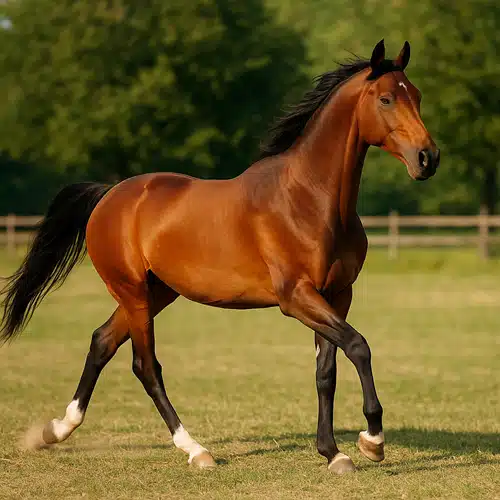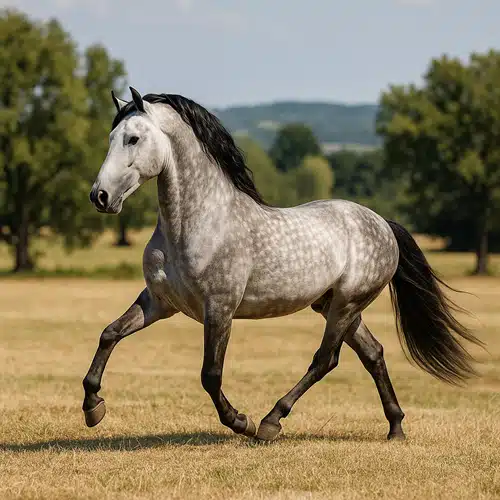
The Anglo-Arabian horse is a unique breed, created by combining two of the most prestigious horse lines in the world – Arabian horses and Thoroughbreds. Thanks to this blend, the Anglo-Arabian combines the endurance, intelligence, and elegance of the Arabian with the power, speed, and athleticism of the Thoroughbred.
Originally bred as a war and utility horse, it has now become one of the most valued sport horse breeds in Europe. It stands out for its versatility, which is why it can be found in dressage and show jumping, as well as in demanding disciplines like eventing or endurance riding.
Anglo-Arabians are praised for their balanced temperament, ease of learning, and strong bond with humans. These are horses that perform well in the hands of professionals, but also suit ambitious amateurs looking for a capable sport horse.
Although less popular than Hanoverians or Holsteiners, this breed is gaining increasing recognition – also in Poland, where it is appreciated for its elegance and versatility.
Table of Contents
Origin and History of the Breed
The Anglo-Arabian breed originated in France in the first half of the 19th century, when French breeders began searching for a horse that would combine the endurance and intelligence of the Arabian horse with the speed and power of the Thoroughbred.
The first breeding experiments began in the area around Toulouse and at the famous Pompadour stud farm, which is still considered the cradle of the breed. Initially, Arabian stallions imported from the Middle East and North Africa were crossed with Thoroughbred mares. In some cases, oriental horses (such as Turkmen or Persian) were also used to enhance the refinement and endurance of the offspring.
Over time, clear breeding principles were established – an Anglo-Arabian had to contain a defined percentage of Arabian and Thoroughbred blood in its pedigree. This was formalized with the introduction of studbooks, which made it possible to control the purity and development of the breed.
The Anglo-Arabian quickly gained recognition not only in France but throughout Europe. These horses were used in military cavalry because they were resilient, fast, and easy to handle, while also proving themselves as both working and sport horses.
In the 20th century, the breed developed especially in Germany, Poland, Italy, and Spain. Anglo-Arabians became a foundation for the development of many other sport horse lines—their blood can be found in the pedigrees of numerous modern dressage, show jumping, and eventing horses.
Today, the Anglo-Arabian has retained its identity as a distinct breed, while also remaining a valuable source of genetics for modern sport horses, appreciated by breeders around the world.

Appearance and Distinctive Features
The Anglo-Arabian horse is considered one of the most harmonious representatives of warmblood horses. Its build reflects a perfect combination of two worlds—the lightness and refinement of the Arabian and the strength and athletic potential of the Thoroughbred.
Conformation and Proportions
- Height at the withers: from 155 to 170 cm, with sport-bred horses often being taller.
- Build: elegant, refined, yet well-muscled, with visible power in the hindquarters and flexibility in the neck.
- Head: noble, with a straight or slightly concave profile (more common in horses with a higher percentage of Arabian blood).
- Eyes: large, expressive, and full of intelligence.
- Neck: long, flexible, often gently arched—allowing for an elegant carriage in movement.
- Withers: well-defined, supporting proper saddle placement.
- Back: straight, medium in length, strong and capable of carrying weight.
- Croup: muscular, slightly sloping, providing power for galloping and jumping.
- Limbs: long and refined, with strong joints and hard hooves—traits inherited from Thoroughbreds.
Coat and Color
The coat of Anglo-Arabians is dense, glossy, and close-fitting. The most common coat colors include:
- bay,
- chestnut,
- gray,
- less commonly black.
Overall Impression
Anglo-Arabians are often described as “aristocratic” horses. They have a proud expression, a slender build, and elegant movement that draws attention. Depending on the proportion of Arabian and Thoroughbred blood in their pedigree, they may appear lighter and more refined (with more Arabian influence) or more substantial and athletic (with more Thoroughbred influence).
These are horses that display energy, dynamism, and natural balance in motion, making them excellent athletes.
Character and Temperament
The Anglo-Arabian horse is an animal of exceptional intelligence and sharpness. It combines traits from two worlds—the liveliness and sensitivity of the Arabian with the determination and power of the Thoroughbred. The result is a horse that can be both ambitious and loyal to its rider.
Character Traits
- Strong personality – the Anglo-Arabian can be independent and strong-willed, but with consistent handling, it willingly cooperates with humans.
- Ambition and energy – this is a horse that enjoys challenges. It responds well to sport training and does not tolerate monotony or routine.
- Balanced temperament – compared to the Thoroughbred, it is calmer and more predictable, yet still retains the vigor of a racehorse.
- Fast learning ability – thanks to its Arabian intelligence, it easily absorbs new exercises and quickly adapts to new situations.
- Need for connection – the Anglo-Arabian requires a bond based on trust and consistency. Once it trusts its rider, it becomes a loyal partner.
Who Is the Anglo-Arabian For?
This is a horse best suited for intermediate and experienced riders. It may not always be the best choice for complete beginners, as it requires feel, patience, and regular work. In return, it offers great satisfaction, loyalty, and strong sport potential.
The Anglo-Arabian is a partner that perfectly combines energy, intelligence, and balance. These qualities are exactly why it is gaining increasing popularity in both sport and breeding.
Uses of the Anglo-Arabian Horse
The Anglo-Arabian breed has been developed from the very beginning with versatility in mind—the horse was meant to perform well both in the military and in sport, and today it excels in many equestrian disciplines.
Eventing – The Ultimate Equestrian Challenge
This is the discipline in which Anglo-Arabians feel most at home and achieve their greatest success. Thanks to their combination of speed, jumping ability, and endurance, they perform exceptionally well in all three phases:
- in dressage, they show balance and precision,
- in show jumping, they demonstrate courage and technique,
- in cross-country, they display unlimited energy, determination, and endurance.
Some Anglo-Arabian lines have specialized specifically in producing eventing horses, and many top riders in this discipline have chosen them as partners at the level of World Championships and the Olympic Games.
Dressage and Show Jumping
Although not the most represented breed in these disciplines, a well-trained Anglo-Arabian can also achieve success in both dressage and show jumping. In dressage, it is valued for the harmony of movement and willingness to work, while in jumping, it stands out for its light take-off and great flexibility. It may not be as massive as a Hanoverian or Holsteiner, but it makes up for it with courage and energy.
Endurance Riding
Thanks to its Arabian heritage, the Anglo-Arabian also excels in endurance riding. Its stamina, strong heart, and well-developed muscles allow it to maintain a high pace over demanding distances. It is less delicate than a pure Arabian but retains its endurance and resistance to tough terrain conditions.
Recreation and Trail Riding
The Anglo-Arabian can also be an excellent recreational horse—for more ambitious riders who want a horse that is easy to handle yet full of energy. It performs well in long trail rides, where its fitness and intelligence allow for a safe and enjoyable riding experience.
Movement and Performance Abilities
The Anglo-Arabian horse is distinguished by smooth, rhythmic, and efficient movement. It is not a horse bred for exaggerated, highly elevated gaits, but rather for effective and economical movement that performs well in sport and in the field.
Movement Characteristics
- Walk – even, ground-covering, with a clear stride. The horse moves forward willingly while maintaining rhythm and relaxation. Ideal for long trail rides and dressage phases in eventing.
- Trot – elastic and active, with natural impulsion coming from the hindquarters. The movement is not overly elevated like in Friesians or Andalusians, but highly functional—supporting rhythm and balance.
- Canter – one of the Anglo-Arabian’s greatest strengths. It is long, efficient, and perfectly balanced. This is the gait that makes Anglo-Arabians excel in eventing and perform so well in endurance riding.
Performance Abilities
- The Anglo-Arabian has an excellent “engine” in the hindquarters, giving it power for jumping and dynamic acceleration.
- Thanks to its Arabian blood, it shows natural elasticity and an ability to work in collection, which supports training in dressage.
- The Thoroughbred influence provides endurance and determination, essential in sports requiring speed and courage.
- The horse learns quickly and responds well to systematic training. Trainers appreciate its openness to new tasks and adaptability.
The Anglo-Arabian is a breed that demonstrates not only beauty in movement but, above all, functionality and athletic potential. This makes it suitable for both Olympic disciplines and recreational riding or endurance events.
Comparison of the Anglo-Arabian with Other Breeds
Although the Anglo-Arabian is a unique breed, its traits are often compared to other sport horses. This makes it easier to determine who it is best suited for.
Anglo-Arabian vs Arabian Horse
- Similarities: intelligence, loyalty, endurance, elegance of movement.
- Differences: the Arabian is smaller, more sensitive, and less powerful. The Anglo-Arabian is larger, stronger, and better suited for sport disciplines requiring strength and jumping ability.
Anglo-Arabian vs Thoroughbred
- Similarities: speed, courage, powerful canter, endurance.
- Differences: the Thoroughbred can be more nervous and requires an experienced rider. The Anglo-Arabian is more balanced, forms bonds with humans more easily, and handles systematic training better.
Anglo-Arabian vs Hanoverian or Holsteiner
- Similarities: sport potential, elegant build, ability in jumping and dressage.
- Differences: Hanoverians and Holsteiners are more massive and spectacular in movement, while the Anglo-Arabian is lighter, more enduring, and excels in eventing and endurance riding.
Anglo-Arabian vs Andalusian / Lusitano
- Similarities: noble appearance, intelligence, willingness to cooperate.
- Differences: Andalusians and Lusitanos are known for their elevated, expressive movement and are best suited for classical dressage. The Anglo-Arabian is more functional and versatile, better suited for sport disciplines requiring speed and stamina.
Breeding and Bloodlines
The breeding of Anglo-Arabian horses has been strictly regulated from the very beginning through the use of studbooks. This has allowed the breed to maintain its identity and consistency, while also contributing to the development of many modern sport horse lines.
Studbook Entry Requirements
- To be recognized as an Anglo-Arabian, a horse must have at least 25% Arabian blood and at least 12.5% Thoroughbred blood.
- Random crossbreeding is not allowed—every horse must have documented ancestry.
- Entry into the studbook is granted only after meeting conformation, performance, and health criteria.
Studbooks
- France – the most important breeding center, with headquarters in Tarbes and Pompadour. This is where the foundations of the breed were established. French studbooks focus on the sport type, selecting larger and more athletic horses.
- Germany – German Anglo-Arabians are often crossed with Trakehners and Hanoverians, resulting in stronger builds and enhanced abilities for jumping and eventing.
- Poland – Anglo-Arabian breeding in Poland has a long tradition, especially in state stud farms (including Janów Podlaski and Walewice). Polish Anglo-Arabians are more versatile and slightly lighter than their French counterparts, making them suitable for both eventing and recreational riding.
Breeding Lines and Their Significance
- French lines – dominated by larger, more massive horses, specialized in high-level sport, especially eventing and jumping.
- Polish lines – valued for versatility, good temperament, and resilience. A lighter type, closer to the Arabian, often used in recreation and endurance riding.
- German lines – stronger and more powerful jumpers, thanks to the influence of Trakehner and Hanoverian blood. Often chosen for professional sport.
Anglo-Arabian Horses in Poland
Poland is one of the countries that has played a significant role in the breeding and popularization of the Anglo-Arabian horse in Europe. The breed was present here as early as the 19th century, but its greatest development took place in the post-war period.
Anglo-Arabians During the Communist Era
In the post-war years, Anglo-Arabians formed the foundation of military and sport horse breeding. The Polish army needed horses that were strong, durable, and noble—the Anglo-Arabian perfectly met these requirements. For this reason, it was widely used in cavalry units and military training centers.
Key Stud Farms in Poland
- Janów Podlaski Stud Farm – famous for Arabian horse breeding, but also home to Anglo-Arabian lines. Many valuable mares and stallions were bred here.
- Białka Stud Farm – one of the centers where numerous Anglo-Arabians used in sport were bred.
- Walewice Stud Farm – an important location for breeding half-blood horses and Anglo-Arabians, known for high-quality breeding stock.
- Michałów Stud Farm – although mainly associated with Arabians, it has also periodically conducted breeding programs involving Anglo-Arabians.
The Anglo-Arabian Today
Today, Anglo-Arabian horses in Poland:
- can be found both in sport centers and private stud farms,
- are chosen for eventing, endurance riding, and higher-level recreational riding,
- stand out for their good temperament, intelligence, and endurance, making them valued by riders across the country.
The Importance of Polish Breeding
The Polish Anglo-Arabian breeding line is respected not only domestically but also internationally. In Poland, emphasis is placed on versatility, elegance, and endurance, which makes Polish Anglo-Arabians lighter and more versatile than their French or German counterparts.
Interesting Facts and Influence on Other Breeds
The Anglo-Arabian horse is not just an interesting cross between two well-known breeds—it is a breed that has played a major role in the history of horse breeding and equestrian sport in many countries.
Influence on Other Breeds
- Wielkopolski horse – in Poland, Anglo-Arabians played an important role in the development and refinement of the Wielkopolski breed. Thanks to them, these horses gained better movement, endurance, and sport potential.
- Trakehner – the infusion of Anglo-Arabian blood improved the endurance and temperament of Trakehners, increasing their versatility in sport.
- In many European countries, the Anglo-Arabian was used as a breeding horse to enhance the performance traits of other warmblood breeds.
A National Breed
In France, the Anglo-Arabian is considered a national breeding treasure. Studbooks are maintained with great care, and horses of this breed are a source of pride in French equestrian tradition.
In Poland, the Anglo-Arabian was also treated as a national breed—especially during the communist era, when it formed the foundation of military and sport horse breeding.
Anglo-Arabians in Sport
Horses of this breed have regularly competed at the Olympic Games, European Championships, and top-level eventing competitions. Thanks to their endurance and courage, they are regarded as some of the best horses for this discipline.
Anglo-Arabians also perform well in show jumping, where they compete with Hanoverians and Holsteiners.
Anglo-Arabians in Poland
In Poland, Anglo-Arabians took part in military competitions and cavalry shows, where their endurance and elegance were highly valued.
To this day, they are sometimes used in historical reenactments, battle reconstructions, and displays of traditional Polish cavalry riding.
Care and Health
Anglo-Arabian horses are known for their resilience and stamina, but proper care requires attention and consistency. These are horses built for movement and work—lack of activity or stimulation can lead to frustration, excess energy, and behavioral issues.
Basic Care Needs
- Constant access to fresh air – Anglo-Arabians thrive in open or free-range systems, where they can move freely in paddocks. Restricting movement has a negative impact on them.
- Daily, regular work – horses of this breed need human interaction and consistent training. They require physical activity, but balance is essential—overtraining can lead to tendon or joint injuries.
- Balanced diet – their metabolism is efficient, but during competition season, it is necessary to enrich their feed with additional energy sources, electrolytes, and recovery-supporting supplements. They tolerate forage well, but their diet should be supplemented with vitamins and minerals.
- Limb care – due to their use in sport, Anglo-Arabians may be more prone to musculoskeletal injuries. Regular hoof checks, proper trimming/shoeing, and appropriate training surfaces are essential.
Health Predispositions
Although the breed is considered relatively healthy and robust, attention should be paid to:
- tendon and joint strain—especially in horses actively competing in eventing,
- sensitivity to feed changes and stress—partly inherited from Arabians,
- the need for mental balance—lack of work or monotonous training can lead to nervousness.
Lifespan and Stamina
With proper care, Anglo-Arabians often reach 25–30 years of age while maintaining good performance condition. Their high physical stamina allows them to remain active in both sport and recreational riding for many years.
FAQ
Is the Anglo-Arabian Suitable for Children?
It is not a breed recommended for complete beginner children. It is better suited for young riders who are already training in sport.
Is the Anglo-Arabian Suitable for Recreational Riding?
Yes—especially for intermediate and ambitious trail riders.
What Are the Typical Coat Colors?
Bay and chestnut are the most common, but gray and black can also be found.
Can an Anglo-Arabian Compete in Competitions?
Yes. It is a horse bred for eventing, but it also performs well in dressage and show jumping.
Can You Buy an Anglo-Arabian in Poland?
Yes. There are many breeders and private owners who offer horses of this breed.
The Anglo-Arabian horse is a combination of nobility and athletic energy. This breed brings together the best qualities of Arabian horses and Thoroughbreds, creating an excellent partner for riding, sport, and work. It is a horse for those who seek elegance, endurance, and versatility in one form.