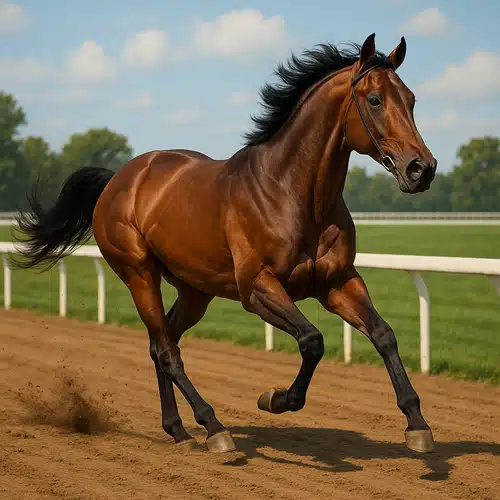
The Thoroughbred, also known as the Folblut, is one of the most renowned and prestigious horse breeds in the world. It stands out not only for its incredible speed but also for its noble appearance, spirited temperament, and rich history dating back to the 17th century. Originally bred for racing, its versatility has made it useful in many other equestrian disciplines — and even in recreational riding.
In this article, we’ll explore the history of this exceptional breed, its appearance, temperament, uses, and care requirements. We’ll also debunk common myths and answer the most frequently asked questions about Thoroughbreds. Whether you’re wondering if this is the right partner for you or simply want to learn more about this remarkable breed — this guide is for you.
Table of Contents

Breed History – From Desert Stallions to Race Tracks
The origins of the Thoroughbred date back to the 17th century, when British breeders began crossing local mares with oriental stallions imported from the Middle East. The most famous of these foundation sires were Byerley Turk, Darley Arabian, and Godolphin Arabian. These three stallions became the ancestors of nearly all Thoroughbred bloodlines known today.
Darley Arabian, born in Syria, arrived in England in 1704 and became known as the ancestor of Eclipse, a legendary racehorse that never lost a single race. Godolphin Arabian came from Tunisia, while Byerley Turk was a warhorse belonging to a British officer. These three stallions also initiated the tradition of keeping official studbooks. In 1791, James Weatherby published the first edition of the General Stud Book, which recorded all racehorses and ensured the purity of breeding lines.
Horse racing gained immense popularity in Great Britain and soon spread across the globe. The Thoroughbred breed reached the United States, Australia, Ireland, Japan, and Poland. In each of these countries, breeding developed its own unique character, but the breed’s hallmark traits remained the same — speed, endurance, and courage on the racetrack.
Zapoznaj się z artykułami:
- Poznaj więcej ras koni. Zapoznaj się dokładnie z ich charakterem, cechami.
- Poznaj konia hanowerskiego – rasę, która od lat króluje w ujeżdżeniu i skokach przez przeszkody.
- Dowiedz się, dlaczego koń holsztyński należy do najlepszych koni sportowych świata.
- Odkryj konia westfalskiego – idealnego partnera zarówno do sportu, jak i rekreacji.
- Przeczytaj o koniu angloarabskim – rasie łączącej szybkość pełnej krwi i wytrzymałość arabów.
Appearance and Distinctive Features of the Thoroughbred Horse
The Thoroughbred is a true symbol of sporting elegance — its silhouette immediately reveals an athlete built for speed. Every aspect of its body is designed for maximum movement efficiency, lightness, and endurance necessary for racing.
The height at the withers typically ranges from 155 to 170 cm, making the breed fairly versatile in size — neither too small nor too heavy. Their build is lean yet perfectly muscular. Long legs with strong but slender bones end in dry joints and tough hooves — ideal for the hard surfaces of racetracks.
A Thoroughbred’s head has a refined, dry profile, usually straight or slightly concave, with large, expressive eyes. Their gaze is often described as sharp, alert, and spirited. The ears are mobile and gently curved inward — they often reflect the horse’s current mood.
The neck is long and gracefully arched, giving the horse balance while galloping and supporting its natural agility. The back is relatively short and strong, leading into a well-rounded, muscular croup — the main source of propulsion during gallop.
Another distinctive feature is the skin — very thin, elastic, and often showing visible veins. The coat is usually glossy, sleek, and fine, emphasizing the animal’s elegant musculature. The most common coat colors among Thoroughbreds include:
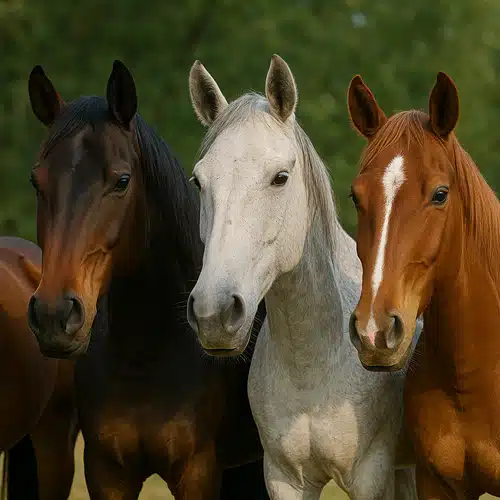
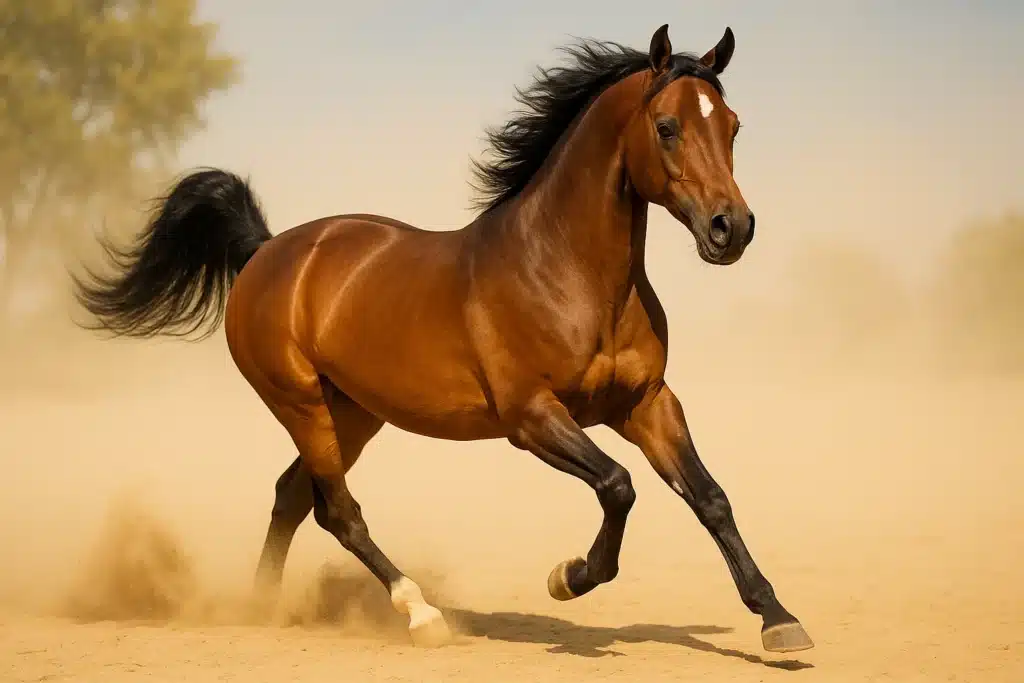
- Bay – from dark chocolate to light brown,
- Chestnut – reddish with copper tones,
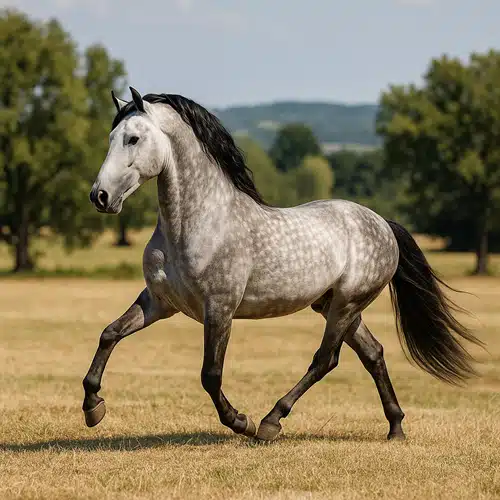
- Gray – particularly striking in motion,
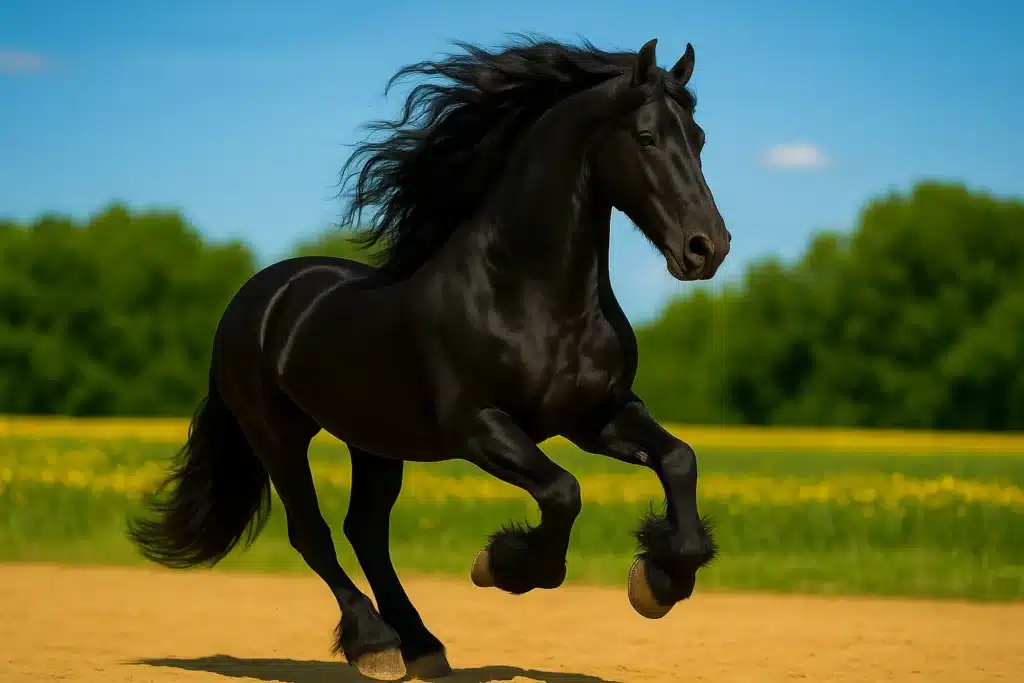
- Black – deep and glossy, giving an elegant appearance.
Thoroughbreds move with exceptional elasticity and dynamism. Their gait is efficient, the trot is long and springy, and the gallop — low, smooth, and incredibly fast. It’s no wonder the gallop is considered the breed’s defining movement — the Thoroughbred seems to float above the ground, maintaining speed and rhythm without heavy impact.
Within the breed, two main types can be distinguished:
- Sprinters – more compact and muscular, with powerful hindquarters, built for short, explosive distances.
- Distance runners – taller, lighter, with less muscle mass but greater movement efficiency and stamina.
These traits are no coincidence — they are the result of centuries of selective breeding aimed at meeting the specific demands of racetracks and climates. This is why Thoroughbreds bred in Ireland may differ slightly in conformation from those in Japan or the United States.
Temperament and Character of the Thoroughbred Horse
Thoroughbreds are famous for their fiery temperament — in practice, this means they are extremely sensitive, quick-reacting, and highly energetic. This unique combination of traits makes them both ideal athletes and demanding partners. Their minds are as dynamic as their bodies — they dislike monotony, get bored easily, and react intensely to any changes in their environment.
Intelligence is one of the first things their caretakers notice — Thoroughbreds learn new stimuli quickly, respond to human tension, and can even anticipate what’s coming next. However, this intelligence goes hand in hand with vigilance and nervousness, especially in horses that have undergone intense race training. For them, every unexpected change may seem like a potential threat.
Reactivity to stimuli — sounds, movements, and the rider’s emotions — is one of their defining traits. This means that a Thoroughbred may respond sharply to something other horses would ignore. On the trail, they can spook easily, and in an indoor arena, they may tense up due to strange light or echoes. This doesn’t make them “bad” — their nervous systems simply work faster and more intensely than those of calmer breeds.
Who are Thoroughbreds for? Definitely not for beginners. Even a gentle individual of this breed requires a rider who can read equine body language, recognize signs of stress, and introduce new exercises skillfully. When handled correctly, a Thoroughbred can become a deeply loyal and devoted partner — but it takes patience, empathy, and consistency.
Managing stress is one of the most important aspects of working with a Thoroughbred. Training should be regular but not monotonous. They need plenty of movement, natural conditions to release energy, and contact with a knowledgeable handler. Stress in this breed can manifest as crib-biting, excessive sweating, nervous tics, or even gastric ulcers.
Yet their will to fight and ambition are legendary. These are horses that rarely give up — they give everything they have, but only when they feel safe. That’s why, on racetracks, they can achieve almost superhuman results, pushing the boundaries of physical ability.
In the hands of the right person, a Thoroughbred can truly flourish. Increasingly, these horses are found not only in racing, but also in dressage, show jumping, eventing, and even leisure riding — once properly retrained. The key lies in building trust and providing stability. When that bond is achieved, the horse will reward you with devotion, loyalty, and an enormous heart for work.

Uses of the Thoroughbred (Folblut)
Although the Thoroughbred has been associated with racetracks for centuries, its potential reaches far beyond racing. Its exceptional qualities — speed, intelligence, ambition, and endurance — make it well-suited for many other equestrian disciplines, as well as recreational and even therapeutic purposes.
Horse Racing – Their Natural Domain
It’s impossible to overlook the primary purpose for which Thoroughbreds were bred — horse racing. This is where they display their full potential: explosive gallop, racing instinct, and incredible will to win. They compete in flat races as well as steeplechase races, especially in countries like Great Britain and Ireland. Many of them retire from racing as early as between ages 4 and 6, but that doesn’t mark the end of their active careers.
Eventing (Three-Day Eventing / WKKW)
Eventing is one of the most demanding equestrian disciplines, combining dressage, show jumping, and cross-country. Thoroughbreds excel in this field thanks to their agility, courage, and boundless energy. Horses of pure Thoroughbred blood — or with a high percentage of it — dominate international competitions. Their natural speed and competitive spirit give them an advantage in cross-country, while their focus and athleticism allow them to perform well in dressage and jumping phases.
Show Jumping
Although Thoroughbreds are not typical show-jumping horses (like Holsteiners or Belgian Warmbloods), many of them perform impressively in this sport. Their quick reflexes, willingness to cooperate, and speed through turns make them formidable in lower and mid-level competitions. They are often used in amateur events and by young riders transitioning from ponies to full-sized horses.
Dressage
It may come as a surprise, but an increasing number of ex-race Thoroughbreds are finding success in dressage arenas. Their suppleness and ability to learn quickly allow them to achieve solid results at lower levels. With proper retraining after racing careers, they can show elastic movement and graceful, expressive performances.
Polo
In countries like Argentina, the United States, and India, Thoroughbreds are widely used in polo — a fast-paced team sport requiring quick turns, bursts of speed, and instant reactions. Their natural agility, intelligence, and athleticism make them ideal polo ponies. Many polo clubs maintain their own breeding programs based on Thoroughbred bloodlines, training horses for the sport from a young age.
Recreation and Hippotherapy
Although it may seem unusual, some Thoroughbreds — especially those with calmer temperaments or raised in peaceful environments — find new roles in recreational riding or even hippotherapy centers. These are, of course, carefully selected individuals, requiring patient retraining and proper handling. A well-balanced Thoroughbred can become a wonderful companion for trail riding or light arena work, provided it receives the right psychological environment and care.
Famous Examples of Thoroughbred Horses
Kasztanka – the beloved mare of Marshal Józef Piłsudski, a symbol of Polish independence and national pride. Although her exact lineage is not fully confirmed, she is often described as a Thoroughbred mare. Kasztanka became an icon not only because of her beauty but above all for her loyalty and courage.
Secretariat – the American racing legend, winner of the Triple Crown in 1973. Known for his extraordinary heart (literally — it weighed twice as much as an average horse’s) and unbelievable speed. He is still regarded as one of the fastest horses of all time.
Frankel – the undefeated stallion trained by Sir Henry Cecil in Great Britain. He won all 14 races he competed in and is considered the greatest racehorse in history according to the World Thoroughbred Rankings. Today, he is one of the most valuable breeding stallions in the world.
The Thoroughbred is much more than just a racehorse. It’s a horse with character, history, and enormous potential. Once its abilities beyond the racetrack are recognized, it can become a remarkable partner for both work and sport.
Breeding and Selection of Thoroughbred Horses
The breeding of Thoroughbred horses is one of the most strictly regulated and carefully controlled branches of horse breeding in the world. From the very beginning, the key principles have been pedigree purity, precise selection, and meticulous genealogical documentation. To this day, registration of any Thoroughbred horse follows rules that have remained virtually unchanged since the publication of the first studbook.
Studbooks – The Guarantee of Breed Purity
The foundation of Thoroughbred breeding is the General Stud Book, established in 1791 by James Weatherby. This register serves as the global standard for Thoroughbred documentation. To be officially recognized as a Thoroughbred, a horse must descend exclusively from ancestors recorded in this book or its officially approved international equivalents.
In Poland, the equivalent is the Polish Stud Book for Thoroughbred Horses, maintained by the Polish Jockey Club (Polski Klub Wyścigów Konnych – PKWK). A horse can only be entered in the book if its pure lineage is confirmed and it meets the breed’s standards. Breeders are required to maintain detailed records, identify horses (most often by microchipping), and report all births and coverings to the appropriate authorities.
Polish Stud Farms – Tradition and Quality
Poland has a long and proud tradition of racehorse breeding. The most notable and historically significant studs include:
- Iwno Stud Farm – famous for breeding horses with excellent conformation and dynamic gallops. It is one of the most respected names in the Polish racing industry.
- Kozienice Stud Farm – specializes in training horses for the Warsaw Służewiec Racecourse. Horses from Kozienice regularly achieve success in top-level races.
- Krasne Stud Farm – with over a century of history, it combines deep tradition with a modern approach to the selection and rearing of young racehorses.
All these centers cooperate closely with PKWK, undergo regular inspections, and participate in the national breeding program. Importantly, Polish Thoroughbred breeding is gaining growing international recognition — horses from Polish studs are now exported to Ireland, Germany, France, and the United Arab Emirates.
Selection – Focusing on Athletic Genes and Health
The selection process in Thoroughbred breeding is multidimensional. Evaluation covers not only pedigree but also:
- Performance records of parents and ancestors – racing success, career longevity, and injury resistance,
- Conformation – body structure, proportions, and quality of movement,
- Veterinary assessments – including X-rays of limbs, and examinations of the musculoskeletal, cardiac, and respiratory systems,
- Performance tests – such as stable training results, trial gallops, and psychological evaluations.
Many modern breeding centers also utilize advanced scientific tools, including:
- DNA testing – to detect genetic predispositions to diseases or mutations affecting endurance and recovery,
- Biomechanical motion analysis – recording the horse’s movement in slow motion to measure stride length and joint angles.
In Thoroughbred breeding, managing bloodlines is of utmost importance. Breeders strive to avoid inbreeding, maintain genetic diversity, and match stallions and mares strategically to balance and complement desired traits.
This careful combination of tradition and science ensures that each new generation of Thoroughbreds continues to embody the perfect balance of speed, stamina, and elegance that defines the breed.
Industrial Breeding and International Cooperation
In countries such as Ireland, the United Kingdom, Japan, the United States, and the United Arab Emirates, Thoroughbred breeding has taken on an almost industrial scale. Hundreds of horses are bred each year, and the value of a single stallion can reach several million dollars. For example, the stallion Galileo (son of the legendary Sadler’s Wells) was for years the most valuable and sought-after sire in the world.
Modern Thoroughbred breeding frequently employs advanced reproductive technologies, including:
- Embryo transfer – collecting embryos from top-quality mares and implanting them into surrogate mothers,
- Cloning – though controversial, it is used in some countries to preserve the traits of exceptional horses,
- Artificial insemination – while official Thoroughbred registries only recognize natural cover, modern breeding centers research semen storage and transport methods for scientific and preservation purposes.
Today, international cooperation is standard practice. Horses are exported, leased, or co-owned by investors from different countries. Breeding consortia are increasingly common, pooling resources to invest jointly in mares and stallions, sharing offspring or profits from sales.
Thoroughbred breeding is not only a matter of tradition and passion but also one of great responsibility and advanced expertise. It requires continuous improvement and a deep understanding of genetics, biomechanics, and veterinary science. These high standards make it possible not only to preserve the uniqueness of the breed but also to ensure its continued evolution as one of the most elite horse breeds in the world.
Famous Thoroughbred Horses Around the World
The history of the Thoroughbred is not just about pedigrees and racing statistics — it is also the story of legendary horses whose names are written in gold in the chronicles of horse racing and popular culture. Their achievements have inspired films, books, and generations of breeders across the globe. Here are some of the most famous representatives of this extraordinary breed:
Secretariat – The Record-Breaker with a Heart Twice the Size
Secretariat is an American racing icon. Born in 1970, he made history by winning the Triple Crown — the Kentucky Derby, Preakness Stakes, and Belmont Stakes — in 1973. At Belmont, he set a world record for the 2,400-meter distance (2:24 minutes), which still stands today.
What made Secretariat exceptional was not only his speed and endurance but also his unique anatomy. After his death, it was discovered that his heart weighed over 10 kilograms, nearly twice the size of an average horse’s. He became a symbol of determination and athletic greatness, and his image has been featured on U.S. postage stamps and memorial statues.
Frankel – The Undefeated Champion of the British Isles
Frankel is one of the most celebrated racehorses in British history. Born in 2008 and trained by the legendary Sir Henry Cecil, he won all 14 of his races, leaving no doubt about his superiority. In 2011, he was ranked by the International Federation of Horseracing Authorities (IFHA) as the best racehorse in the world.
Frankel impressed not only with his record but also with his graceful gallop and remarkable composure during races. After retiring from competition, he became an equally successful stallion, with his offspring selling at auctions for hundreds of thousands — even millions — of pounds.
Arkle – The King of Steeplechase and Ireland’s National Hero
While most famous Thoroughbreds raced on flat tracks, Arkle excelled in steeplechase racing (National Hunt). Born in 1957 in Ireland, Arkle won the prestigious Cheltenham Gold Cup three times — one of the greatest achievements in jump racing.
His incredible agility and stamina made him a national symbol of Ireland — often compared to icons like George Best in football or Muhammad Ali in boxing. His official handicap rating of 212 remains unmatched for decades, cementing his legacy as one of the greatest jump horses of all time.
Kasztanka – The Patriotic Mare with a Hero’s Spirit
Though Kasztanka, the beloved mare of Marshal Józef Piłsudski, was not a pure Thoroughbred, she is believed to have carried a significant amount of English blood. She was a strong, loyal, and brave mare deeply attached to her rider.
Kasztanka accompanied Piłsudski during key moments in Polish history — including military parades, triumphal entries into Warsaw, and meetings with soldiers. Her image became a symbol of independence and national pride, and she was buried with honors at the Belweder Palace. To this day, she remains one of the most famous horses in Poland’s history.
Health, Endurance, and Care of Thoroughbred Horses
Thoroughbreds are true athletes — their physique, metabolism, and temperament have been shaped over centuries for speed and competition. However, behind this impressive endurance lies a certain physical and emotional sensitivity, requiring owners to provide exceptional care, attention, and expertise.
The Musculoskeletal System – Power That Needs Protection
Although Thoroughbreds can reach breathtaking speeds, their musculoskeletal system is delicate and prone to injuries — especially as a result of intensive race training. The most common health issues include:
- Tendon injuries – particularly to the flexor tendons of the forelegs, which are often strained during galloping on hard surfaces.
- Joint trauma – affecting the fetlocks and knees, caused by overload and micro-injuries that may lead to inflammation or lameness.
- Hoof strain – rapid growth combined with intensive work means that Thoroughbreds require frequent trimming and corrective shoeing.
For this reason, orthopedic care for Thoroughbreds is not a luxury but a necessity. Regular veterinary check-ups, ultrasound examinations of tendons, physiotherapy, and proper horseshoeing are essential to maintain long-term health and performance.
The Digestive System – Sensitive to Stress
Another critical aspect of Thoroughbred health is the digestive system, particularly the stomach. Gastric ulcers are common in this breed and are often the result of stress, irregular feeding, long intervals between meals, and intensive training. Symptoms may be subtle — such as apathy, decreased appetite, belly sensitivity, or sudden mood changes.
A proper Thoroughbred diet should be:
- High in fiber (hay available ad libitum),
- Divided into small, frequent portions of concentrate feed,
- Supplemented with stomach-protective additives, such as linseed oil, ground flaxseed, or anti-ulcer supplements.
Providing a calm feeding environment and a consistent daily routine can significantly reduce the risk of digestive disorders.
The Respiratory System – A Common but Overlooked Issue
In racehorse stables, respiratory problems are frequent, especially in poorly ventilated spaces. Among Thoroughbreds, the most common conditions include:
- RAO (Recurrent Airway Obstruction) – equine asthma,
- Recurring viral and bacterial infections, such as equine influenza or upper respiratory tract infections,
- Epistaxis (nosebleeds) – common in horses subjected to intense physical exertion.
Preventive measures include:
- Using clean bedding (preferably dust-free shavings),
- Ensuring good stable ventilation,
- Reducing dust and stress,
- Providing inhalation therapy or bronchodilators when necessary.
Caring for a Thoroughbred requires knowledge, consistency, and empathy. With the right management — combining proper nutrition, regular health monitoring, and a stable, low-stress environment — these exceptional horses can enjoy long, healthy, and fulfilling lives even after their racing careers end.
Nutrition and Supplementation
The Thoroughbred horse has a fast metabolism and a high demand for energy, protein, electrolytes, and trace minerals. In the daily diet of professional Thoroughbreds, you’ll typically find:
- High-quality concentrates (muesli, pelleted feeds),
- Feed additives that support recovery — such as amino acids, electrolytes, MSM, magnesium, and vitamins E and C,
- Supplements that strengthen joints, muscles, the nervous system, and the digestive tract.
A well-balanced diet is essential to maintain the horse’s health and fitness — especially after retirement from racing, when many Thoroughbreds experience reduced nutrient absorption and sensitive intestines.
Mental Health – The Delicate Side of the Thoroughbred
The psychological well-being of a Thoroughbred is just as important as its physical condition. These horses are highly sensitive to emotions, environmental changes, stress, and routine. Prolonged stress not only affects their physical health (e.g., causing ulcers) but can also lead to stereotypic behaviors, such as crib-biting, weaving, or pawing at the stall walls.
Therefore, daily care should emphasize:
- Calmness and consistency in daily routines,
- Freedom of movement — regular turnout, even for non-active horses,
- Social contact — horses are herd animals, and isolation increases stress,
- Experienced handlers or riders — people who can read subtle signals and respond appropriately.
The Thoroughbred horse is demanding — both physically and emotionally. But when handled with understanding, it rewards its caretakers with incredible loyalty, strength, and passion for work. The health of this breed is not only determined by genetics but also by care, empathy, and proper management at every stage of life — from foal to retired athlete.
The Thoroughbred (Folblut) Compared to Other Horse Breeds
The Thoroughbred, also known as the Folblut, is one of the most famous sport horse breeds in the world. Its speed, light build, and immense energy make it truly unique. But how does it compare to other breeds?
Folblut vs Arabian Horse
- The Thoroughbred is bred for speed and racing, with a slender frame and long legs.
- The Arabian horse is more enduring, long-lived, and versatile, making it ideal for long-distance endurance rides.
- The Arabian tends to be calmer and steadier, while the Thoroughbred has a more fiery and demanding temperament.
Folblut vs Paso Fino
- The Paso Fino is admired for its comfortable and elegant gait, providing a smooth ride.
- The Thoroughbred offers power, speed, and athletic performance, but not the same comfort in motion.
- The Paso Fino is a family and show horse, whereas the Thoroughbred is a competitive sport and racehorse.
Folblut vs Rocky Mountain Horse
- The Rocky Mountain Horse is gentle, calm, and sure-footed — perfect for families and beginners.
- The Thoroughbred is dynamic, energetic, and requires an experienced rider.
- The Rocky Mountain focuses on comfort and reliability, while the Thoroughbred is built for performance and competition.
Folblut vs Tennessee Walking Horse
- The Tennessee Walker offers a smooth, gliding running walk, ideal for trail riding and recreation.
- The Thoroughbred has a hot-blooded temperament and speed that the Walker cannot match.
- They represent two very different worlds — the Walker is a family and leisure horse, while the Thoroughbred is a sport and racing horse.
Folblut vs American Saddlebred
- The American Saddlebred impresses with its elegant posture and high-stepping action in show rings.
- The Thoroughbred may be less flashy in movement but offers superior athletic performance.
- The Saddlebred embodies showmanship and style, while the Thoroughbred represents speed and competitive spirit.
Retraining – Life After the Racetrack
Not every racehorse becomes a breeding stallion or reaches the elite level of racing. Many Thoroughbreds end their track careers between the ages of 4 and 6, facing a brand-new chapter in their lives.
Thanks to growing public awareness and numerous retraining programs — such as OTTB (Off The Track Thoroughbred) initiatives in the USA — an increasing number of ex-racehorses find new homes as sport or leisure horses.
Retraining requires patience, understanding of the horse’s psychology, and a gradual introduction to a new routine. However, when done correctly, it can transform a former racehorse into a focused, willing, and hard-working partner with exceptional athletic ability and heart. Many successfully transition to careers in eventing, show jumping, or dressage.
Prices and Availability
The price of a Thoroughbred varies widely depending on its age, pedigree, achievements, and health condition:
- Young ex-racehorses (OTTB) can be purchased for 10,000–15,000 PLN.
- Sport prospects with good conformation and temperament typically cost 25,000–50,000 PLN.
- Breeding stallions and broodmares from prestigious bloodlines may exceed 100,000 PLN.
Retrained Thoroughbreds often offer an exceptional balance of athletic potential and value, making them increasingly sought after in both sport and recreation circles.
Zapoznaj się z artykułami:
FAQ
Are Thoroughbred Horses Good for Beginners?
No. They are best suited for experienced riders due to their fiery temperament and quick reactions.
How Much Does a Thoroughbred Horse Cost?
The price depends on its pedigree, age, and experience. It can range from tens of thousands to several million Polish zlotys.
Can a Thoroughbred Be Used for Recreational Riding?
Yes, but only after retiring from racing and undergoing proper retraining.
What Is the Difference Between a Thoroughbred and a Half-Blood Horse?
A Thoroughbred has a pure, documented racing pedigree, while a half-blood horse is a crossbreed, usually combining different sport horse lines.