Table of Contents
Definition
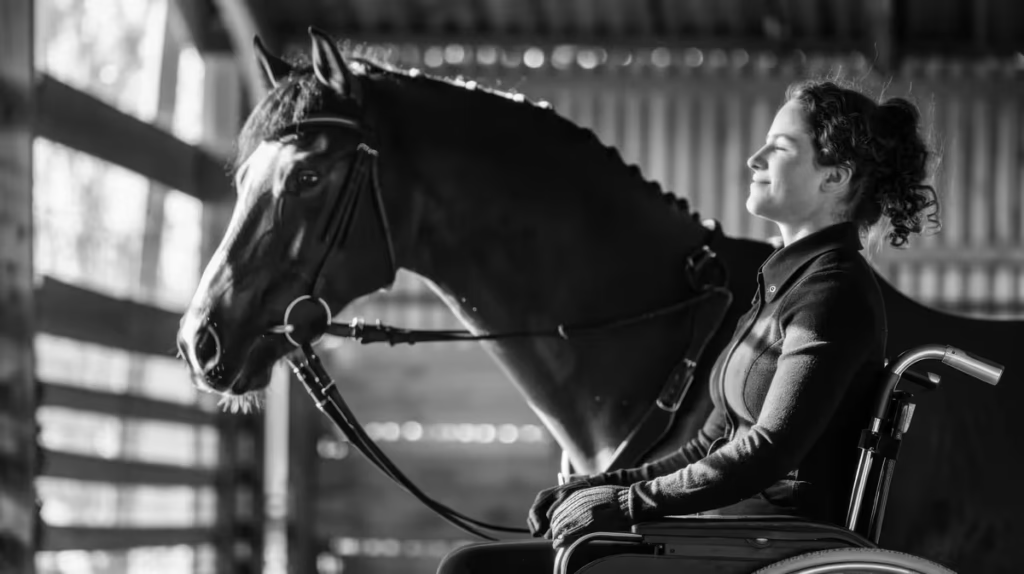
Equestrian parasports (para equestrian) are equestrian disciplines adapted for people with disabilities. Most participants have physical or visual impairments. Competitions are held according to special rules that ensure safe and fair participation.
According to the Polish Equestrian Federation (PZJ), para equestrian is competitive horseback riding for people with disabilities, governed by the International Equestrian Federation (FEI). Competitions follow rules similar to able-bodied equestrian sports but include athlete classification systems and specialized adaptive equipment.
Moreover, equestrian parasports play a key role in social inclusion and rehabilitation for people with disabilities. They enable riders to develop their passion for horses and compete at a high level. As the PZJ states, “the only part of the body truly necessary for riding is the head.” In practice, this means that determination, training, and cooperation with the horse are what matter most.
In addition, many riders with disabilities achieve significant success on the international stage. Through para equestrian sports, they can focus on their abilities rather than limitations, which helps build confidence.
History of Equestrian Parasports
Origins of para equestrian worldwide
The history of equestrian parasports is closely linked to hippotherapy and rehabilitation with the help of horses. Even in ancient times, the benefits of horseback riding for people with health conditions were recognized. However, it was not until the 20th century that scientific research on the impact of equine therapy on physical and mental health began.
In the 1950s and 1960s, hippotherapy became a popular rehabilitation method in Europe and the United States. In 1952, Danish rider Lis Hartel, partially paralyzed due to polio, won a silver medal in dressage at the Olympic Games. This historic achievement inspired the equestrian community to create competitions for people with disabilities.
Furthermore, in the 1970s and 1980s, organizations and classification systems were developed to enable fair competition. A major breakthrough came in the 1990s, when para dressage was included in the Paralympic Games in Atlanta in 1996. It was the first—and remains the only—Paralympic sport involving horses.
Development of equestrian parasports in Poland
In Poland, the first official initiatives supporting para equestrian began in the 1990s. The Polish Equestrian Federation (PZJ) started organizing courses and training programs for riders and coaches. In 2004, Polish para dressage riders made their debut at the Paralympic Games in Athens. Since then, Poland’s participation in international competitions has steadily increased.
Today, numerous national and international events are held, and equestrian clubs increasingly offer programs for riders with disabilities. Importantly, the Polish Para Dressage Championships have become a regular part of the PZJ competition calendar.
Key Disciplines of Equestrian Parasports
Para dressage
The most popular discipline in equestrian parasports is para dressage. It is an adapted version of classical dressage, in which riders demonstrate their ability to guide the horse through precise, choreographed movements. Competitors are classified into five functional grades (I to V), depending on their level of impairment.
Show jumping
Although less common, show jumping is also practiced by riders with disabilities. Adapted to the riders’ abilities, it usually involves lower obstacles and often includes assistance from a trainer.
Endurance riding
Endurance riding requires stamina and excellent cooperation with the horse. In many countries, equestrian endurance events are organized for riders with disabilities, promoting health, inclusion, and competitive sport.
Challenges and the Future of Equestrian Parasports
Challenges
Despite the development of equestrian parasports, athletes still face many challenges. The main ones include:
- Lack of sufficient funding – equestrian equipment, horse transport, and competition fees are expensive.
- Insufficient number of trained coaches – more specialists are needed to work with riders with disabilities.
- Limited number of national competitions – a greater number of events would increase opportunities for talent development.
Development prospects
To ensure further growth of para equestrian in Poland, it is necessary to:
- expand access to training programs for coaches and riders,
- promote equestrian parasports through awareness campaigns,
- increase funding through cooperation with international organizations.
In summary, equestrian parasports play a crucial role for people with disabilities. They provide opportunities for both athletic and personal development. Moreover, Poland can boast many talented riders, and the future of this discipline depends on continued support and promotion. Greater visibility and increased funding will lead to even more success on the international stage.
FAQ
What are equestrian parasports and who are they for?
Equestrian parasports are riding disciplines adapted for people with physical or visual disabilities. They enable safe and fair competition in a true sporting spirit.
What are the main disciplines of equestrian parasports?
The main disciplines include para-dressage, show jumping, and endurance riding. Each of them is adapted to the abilities of the riders and has its own set of rules.
Since when have equestrian parasports been part of the Paralympic Games?
Para-dressage was included in the Paralympic Games program in 1996 in Atlanta. It was the first Paralympic sport to involve horses.