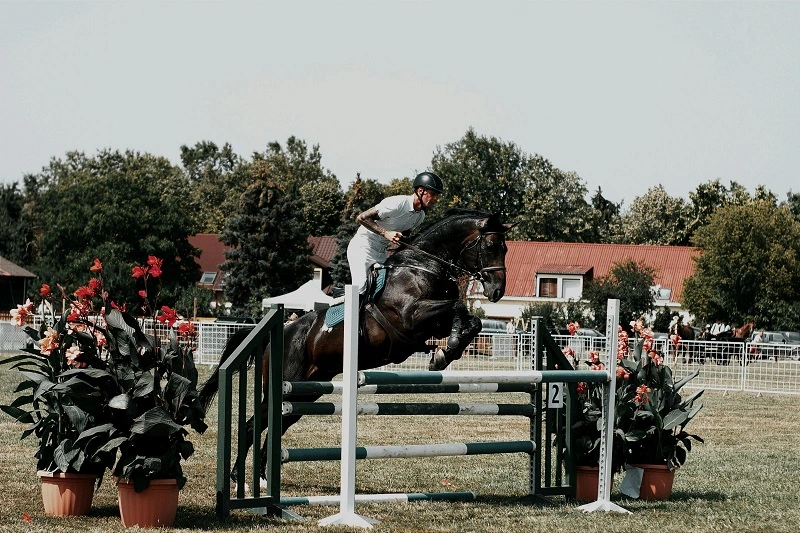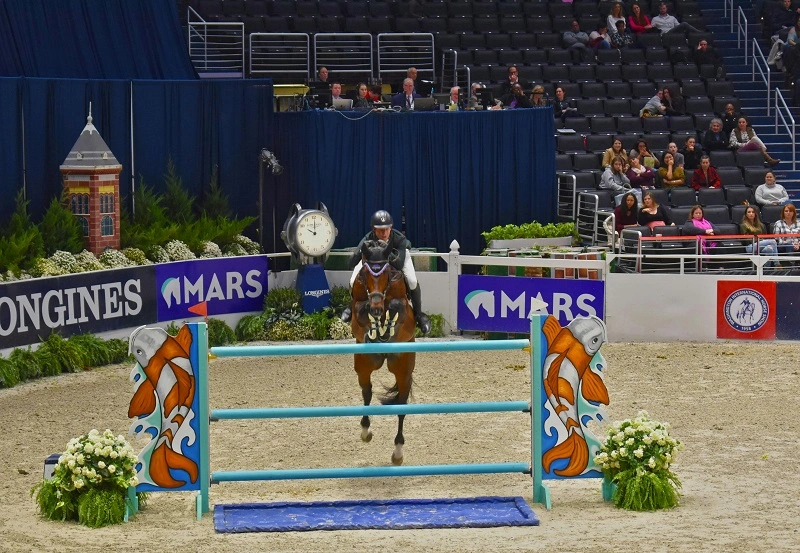
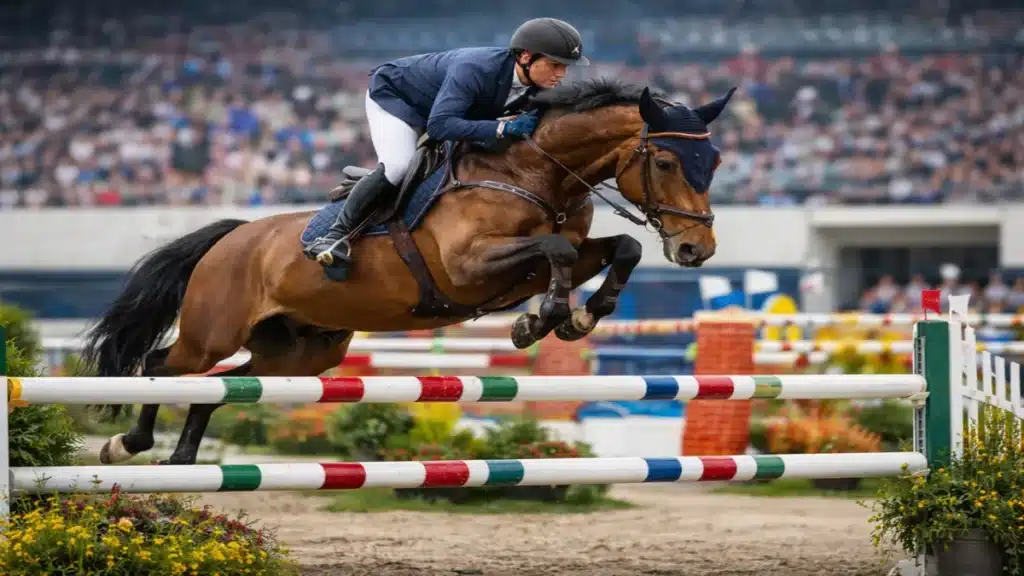
Abbreviations, classes, and star ratings in equestrian competitions can look like a code. Check what they mean and how to understand them quickly.
Markings in equestrian competitions – Equestrian competitions are not only an exciting spectacle, but above all a challenge that tests the skills of both the rider and the horse. Cooperation, precision, and technical preparation play a key role in achieving success. In this article, we present the division of classes in show jumping and dressage, as well as the system of equestrian badges that define the development path of every rider. You will also learn what different types of competitions look like – from local events to prestigious international tournaments. We invite you to read on and explore the details of the equestrian competition world!
Table of Contents
Classes in Equestrian Competitions
Competing in equestrian events is a unique opportunity to test your skills and the level of cooperation with your horse. To allow riders to compete at the appropriate level, competitions are divided into different classes that vary in difficulty and technical requirements. In this article, you will find a detailed description of classes in show jumping and dressage, making it easy to understand how to match your preparation to the competition requirements.
Show Jumping
Division of classes in show jumping:
- Class LL: obstacle height up to 90 cm – for beginners.
- Class L: obstacle height up to 100 cm – basic level.
- Class P: obstacle height up to 110 cm – intermediate level.
- Class N: obstacle height up to 120 cm – advanced level.
- Class C: obstacle height up to 130 cm – high level of difficulty.
- Class CC: obstacle height up to 140 cm – very high level.
- Class CS: obstacle height above 140 cm – the highest classes, including Grand Prix.
Worth reading:
Bronze Equestrian Badge (BOJ):
- Allows participation in LL and L class competitions.
- Class LL: obstacle height up to 90 cm – for beginner riders.
- Class L: obstacle height up to 100 cm – for riders with some experience.
Silver Equestrian Badge (SOJ):
- Allows participation in LL, L, and P class competitions.
- Class P: obstacle height up to 110 cm – for more advanced riders.
Gold Equestrian Badge (ZOJ):
- Allows participation in LL, L, P, and N class competitions.
- Class N: obstacle height up to 120 cm – for advanced riders with significant experience.
Higher Competition Classes:
Participation in classes higher than N (C, CC, and above) requires additional qualifications obtained during competitions, as well as appropriate sporting achievements.
Important Notes:
Holding the appropriate badge is a basic requirement for entering a given class, but proper technical and sporting preparation of both the rider and the horse is also necessary.
Classification also depends on the regulations of a specific competition, the organizer, and the type of event (regional, national, international).
Before planning a start, it is worth reviewing the current regulations of the Polish Equestrian Federation (PZJ).
We encourage you to read the article Show Jumping Classes to learn more.
Dressage
In dressage, equestrian badges/designations issued by the Polish Equestrian Federation (PZJ) determine the competition classes in which riders can participate. The level of the class depends on the badge held:
Division of classes in dressage:
- Class L – basic (simple elements, seat, and contact).
- Class P – intermediate (including leg yielding).
- Class N – advanced (including shoulder-in, flying changes).
- Class C – high (including half-passes, flying changes every 3 and 2 strides).
- Class CC – very high (flying changes every stride, piaffe, passage).
- Class CS – Grand Prix (the highest international level).
Bronze Equestrian Badge (BOJ):
- Allows participation in L class competitions (the lowest class in dressage).
- Intended for beginner riders.
Silver Equestrian Badge (SOJ):
- Allows participation in L and P class competitions.
- Class P (Preliminary) is a higher level, requiring greater precision and better horse preparation.
Gold Equestrian Badge (ZOJ):
- Allows participation in L, P, and N class competitions.
- Class N (Novice) is an advanced level of dressage, requiring very good cooperation with the horse and mastery of more difficult elements.
Higher Competition Classes:
Participation in classes higher than N (C, CC, and above) requires additional qualifications obtained during competitions, as well as appropriate sporting achievements.
Important Notes:
- Holding the appropriate badge is a basic requirement for entering a given class, but the trainer’s approval and proper preparation of both the rider and the horse are also necessary.
- Qualification rules may vary depending on whether the competition is regional, national, or international.
- Before planning a start, it is worth checking the current regulations of the Polish Equestrian Federation (PZJ), as they may change.
Types of Equestrian Competitions
Equestrian competitions held in arenas are divided into different categories, which correspond to the level of advancement of riders and organizers. The diversity of these events allows every equestrian enthusiast to find a suitable form of competition. From local events to international tournaments, each offers different challenges and goals. Below, we present three main types of competitions: training (friendly), regional, and international.
Training (Friendly) Competitions
Training competitions are the lowest level of equestrian competition, but they play an extremely important role in the development of both riders and horses. Their main goal is to create a friendly atmosphere that allows participants to gain their first experience in competitive riding. These are locally organized events, most often by stables, equestrian clubs, or other equestrian communities.
Characteristics
These competitions are primarily recreational and educational. They focus on participant integration and promote values such as cooperation, respect for animals, and fair play. Their organization does not require advanced technical facilities, making them accessible to most stables and equestrian clubs. Participants are mainly beginner riders who have the opportunity to get used to the competition atmosphere and learn the basic rules of competition.
Level of Difficulty
Courses and obstacles are adapted to the participants’ abilities, and the rules are simplified so as not to discourage less experienced riders. Common classes include mini courses, basic dressage tests, or simple skill challenges that help build confidence. As a result, training competitions are an excellent introduction to more demanding events.
Regional Competitions
Regional competitions are the next step in a rider’s sporting development. These are larger-scale events that include participants from a given region or province. They provide an excellent opportunity to compare your skills with other riders at a more advanced level.
Characteristics
In regional competitions, riders compete in various equestrian disciplines, such as:
Show jumping – requiring precision, speed, and courage from both rider and horse when navigating courses with higher and more challenging obstacles.
Dressage – focusing on harmony, elegance, and precise execution of set movements.
Eventing (WKKW – Eventing) – combining show jumping, dressage, and cross-country, requiring comprehensive preparation and versatile skills.
Regional competitions are more formalized, and organizers must meet specific standards, such as ensuring course safety and complying with national equestrian federation regulations.
Level of Difficulty
These competitions require greater experience and preparation from both riders and horses. Obstacles are higher, courses are more complex, and technical requirements are more demanding. Participants must be aware of strategy, their horse’s condition, and their own abilities, making this the next step toward an equestrian career.
International Competitions
International competitions represent the highest level of competition in the equestrian world, attracting riders from all over the globe. Organized according to the rules of the International Equestrian Federation (FEI), they are prestigious events in the calendar of every professional rider.
Characteristics
In international competitions, riders compete in the most demanding disciplines, such as:
CSI (Concours de Saut International) – international show jumping competitions, often featuring prize money and high-ranking points.
CCI (Concours Complet International) – international eventing competitions, considered one of the most challenging tests for both horse and rider.
CD (Concours Dressage) – prestigious dressage competitions, evaluating the highest level of technique and elegance.
Level of Difficulty
Participants in international competitions often compete as part of qualifications for world championships, the Nations Cup, or the Olympic Games. Organizing such events requires the highest standards, including excellent infrastructure, proper medical facilities, and support for horses.
Markings in Equestrian Competitions – What Do the Stars (★) Mean?
In equestrian sports, especially in disciplines such as eventing (WKKW), show jumping, and dressage, the star rating system (★) is used to classify competitions. The number of stars indicates the level of difficulty and the prestige of the event, which is important for both riders and spectators.
What do the individual stars mean in equestrian competition markings?
One star (★)
These are entry-level competitions, ideal for young horses and less experienced riders.
In eventing: Cross-country obstacles and courses are relatively low, and the dressage test is simple.
In show jumping: Obstacle height is around 1.10–1.20 m.
Two stars (★★)
Intermediate-level competitions for more experienced riders and horses ready for greater challenges.
In eventing: Higher and more technical cross-country obstacles.
In show jumping: Obstacles up to around 1.30 m.
Three stars (★★★)
A high level of competition, often with international status.
In eventing: Technically advanced jumping, with a long and demanding cross-country course.
In show jumping: Obstacles around 1.40 m.
Four stars (★★★★)
Elite-level competitions intended for highly experienced riders and top-level horses.
In eventing: The cross-country course is extremely demanding, the jumping course is difficult, and the dressage test is complex.
In show jumping: Obstacles up to 1.50 m.
Five stars (★★★★★)
The highest level in equestrian competitions, featuring the best riders and horses in the world. This includes Grand Prix show jumping events and legendary competitions such as Badminton and Burghley in eventing.
In show jumping: Obstacles up to 1.60 m.
In eventing: This is the ultimate test of endurance and skill for both horse and rider.
How to Qualify for Higher-Level Competitions?
Every rider and horse must go through appropriate qualifications, which depend on results achieved at lower levels. This system ensures safety and proper preparation for both competitors and their horses.
Why Are Markings in Equestrian Competitions Important?
The star rating system makes it easier to assess the difficulty of competitions, helps organizers match technical requirements to the level of participants, and allows for comparison of riders’ achievements worldwide. For spectators, it is also a simple way to understand how demanding the competitions they are watching are.
In summary, stars in equestrian competitions are a symbol of prestige and challenge. Each additional star represents a higher step in the equestrian sports world, requiring excellent cooperation, skills, and determination from both rider and horse.
Competing at the international level is a true test of ability. Riders must possess advanced technical knowledge, excellent fitness, and an outstanding relationship with their horses. Every mistake can cost valuable points, and the competition is extremely fierce. Preparing for this level requires years of training, the right horse, and the support of a professional team.
FAQ
What does the abbreviation CSI mean in show jumping?
(Concours de Saut International) refers to international show jumping competitions. This abbreviation is often combined with a star rating (CSI1–CSI5), where the more stars, the higher the level of difficulty and prestige of the event. For competitions involving young riders and horses, abbreviations such as CSIOY (young riders) and CSIJ (juniors) are used.
Can you compete in international equestrian competitions in Poland without a PZJ license?
No, to compete in international equestrian competitions (e.g., CSI, CCI, CDIO), a rider must hold a valid PZJ sports license as well as an FEI license. Additionally, horses competing in international events must have FEI passports.
What are the designations of speed classes in equestrian sports?
In equestrian competitions, speed classes are also organized, such as:
Speed Derby – jumping on a large course with a mix of natural and standard obstacles.
Six Bars – a competition with six fences set in a line, gradually raised.
Puissance – a power class in which a single obstacle (usually a wall) is progressively increased in height.
In Poland, “Potęga Skoku” (Power of Jump) competitions are also common, where the goal is to clear the highest obstacle.