
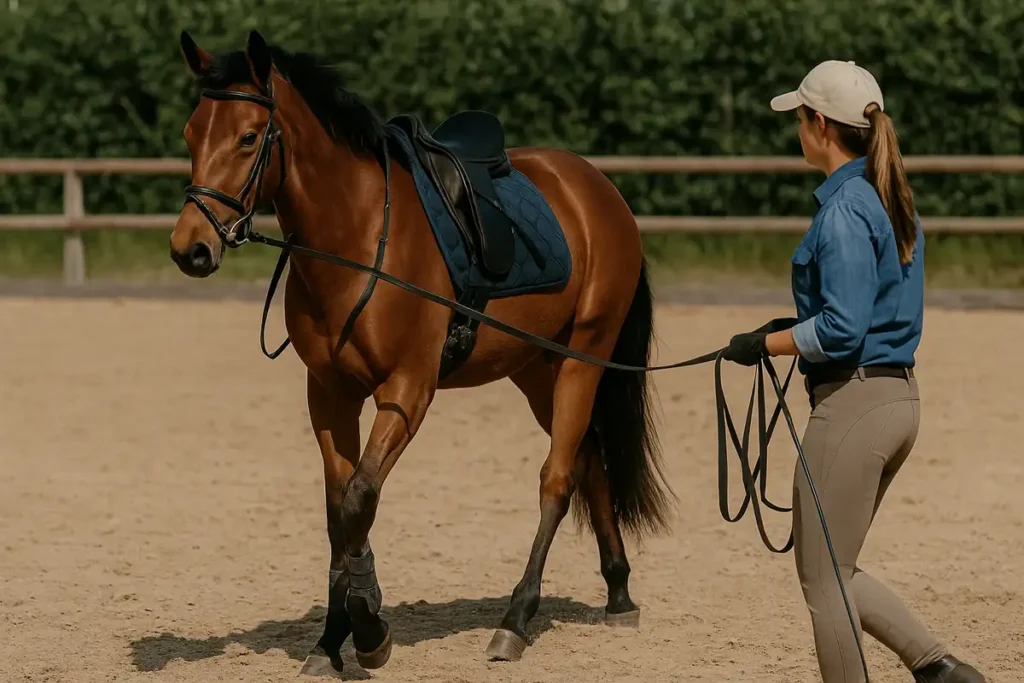
Young Horse Training: Working with a young horse is exciting, but also very demanding. Every horse matures at a different pace. Each has a different sensitivity, different experiences, and different reactions to the world. That is why there is no single universal training method for all horses. However, despite these differences, we can rely on principles that help prepare a horse for riding in a calm, safe, and conscious way. Thanks to them, the entire process becomes more harmonious, and working with a young horse becomes more predictable, while the horse gradually learns to understand the human, their signals, and expectations.
In this article, I will guide you through the most important stages of training a young horse. We will start with the first simple groundwork exercises that build communication. Then we will move on to leading and working on a lead rope. Next, we will discuss lunging a young horse, which is one of the key steps in preparing a horse for riding and an element that directly influences acceptance of tack. You will also see how introducing equipment looks—putting on the first saddle pad and girth, and later the first saddle for a young horse. Finally, we will move on to the moment many people eagerly await—the first mounting.
However, the technical side of training is only part of the success. The most important factor is the horse’s psychology. It is what determines whether a young horse will cooperate willingly or begin to associate training with stress and tension. A psychological approach helps us understand how a horse thinks. Thanks to this, we can work with its nature, not against it. This approach allows the horse to see the human as a leader it can trust, rather than a source of pressure. And pressure and rushing are the most common mistakes when working with a young horse—mistakes that can stop the entire training process.
In the following sections, I will show you not only “how” to perform each exercise, but also “why” a young horse reacts in a certain way and what we can do to ensure it feels confident at every stage of training. Because a well-trained young horse becomes a brave, calm, and reliable partner, ready to work for many years to come.
Table of Contents
What is a young horse and when does training begin?
A young horse is an animal whose body and mind are still developing. Its muscles are not yet strong. The joints and spine are still maturing. The nervous system is still learning how to respond to stimuli. That is why young horses often react suddenly, although it is not due to bad behavior. In most cases, it is a natural response to stress, uncertainty, and lack of experience, all of which strongly influence working with a young horse in the first months.
A young horse does not understand the rules of the human world. Everything is new to it—movements, sounds, the feel of equipment, and voice commands. This means that the first training sessions must be carried out very carefully and as calmly as possible, because this is the stage where real training begins.
When does training a young horse begin?
Initial training usually starts at the age of 2–3 years. This is the period when the horse is developed enough to begin basic exercises, but still too young for intensive physical work. At this stage, the focus is not on riding or rapid progress. Instead, it is about teaching the horse how to function in a relationship with a human and preparing it for later stages, such as lunging and eventually introducing the first saddle.
Worth reading:
Early training may include:
– calm leading on a lead rope,
– learning to stop and step back,
– accepting touch all over the body,
– first responses to pressure,
– getting used to the environment and equipment.
A young horse must develop without being rushed. Pushing too fast leads to overload. It can cause pain, which the horse may later associate with work. This, in turn, creates psychological barriers and common mistakes in working with a young horse that are very difficult to correct later. The horse may begin to avoid training, react nervously, or even resist the human. That is why a calm pace and a gentle approach are absolutely essential.
What is most important at this stage?
Three elements are crucial:
Patience
A young horse learns slowly. It repeats mistakes. It gets distracted. This is normal. Patience allows it to develop without fear and build solid foundations for further training.
Consistency
The horse must understand that the same signals always mean the same responses. Clear rules give it a sense of safety and predictability.
Ability to read the horse’s signals
A young horse communicates a lot through its body. Ears, tail, muscle tension, breathing—all of these form the horse’s language. A trainer who can read it is able to react before stress or panic appears.
All these elements build the foundation for future work under saddle. Without them, further stages become difficult, or sometimes even impossible. A young horse needs time to understand the human. And the human needs time to understand the young horse—and to guide its training in a wise, calm, and safe way.
Foundation: building trust
There is no working with a young horse without trust. It is the absolute foundation. Without it, every next step becomes difficult, and in many cases even impossible. A young horse does not know the human world. It does not understand our intentions. Every new situation may seem like a threat. That is why it is so important that from the very beginning the horse feels that a human provides safety, not anxiety—whether it is about the first exercises, lunging a young horse, or later introducing equipment.
Building trust is not about dominance or forcing anything. It is about calmness. It is also about predictability and clear rules. A young horse must know what to expect. An animal that does not understand boundaries begins to react with tension, because chaos scares it. On the other hand, a horse that sees consistency and stability learns to respond more calmly. This is the foundation on which all training of a young horse is built—from the first touch to the first saddle.
A horse learns about humans every day. It observes tone of voice, movements, breathing, and emotions. Experienced riders often say that a horse is a mirror. It reflects our attitude. If it senses tension, it becomes tense itself. If it senses calmness, it begins to trust. That is why it is so important for a person working with a young horse to remain composed, patient, and aware of their emotions—only then can they avoid common mistakes in working with a young horse.
Trust is built in small steps. Every gesture matters.
Helpful in building trust:
– a calm tone of voice
A horse reacts very quickly to voice. A quiet, low tone has a calming effect. A sharp and fast signal creates anxiety.
– no rushing
Rushing leads to mistakes. A young horse cannot keep up with interpreting stimuli. Stress increases, and trust disappears.
– rewarding even the smallest progress
For a young horse, every step forward is a big achievement. Rewarding reinforces positive associations.
– short training sessions
Long and repetitive work reduces concentration. Short sessions support development and minimize the risk of mental overload.
A young horse has a limited attention span. Its mind absorbs new information, but in small portions. Sessions lasting a few minutes are often more effective than a half-hour training. The horse remembers more and feels safer—whether it will later work on the lunge or prepare to accept equipment.
Building trust is a process. Sometimes fast, sometimes slow. Every horse develops differently. Some open up quickly. Others need many repetitions and more time. The most important thing is that the human does not lose patience. Trust, once gained, becomes a foundation for life. A horse that trusts is calmer, more willing to cooperate, and learns faster. Thanks to this, the next stages of training progress smoothly and without stress—for both the horse and the human.
First groundwork exercises
The first work with a young horse does not look like traditional training. There are no sporting demands, precise positioning, or complex tasks. It is more about learning how to live. Learning the rules that will allow the horse to function in the human world. A young horse must first understand who the human is and what it can expect. Only then can we teach more advanced skills that form the foundation of later training.
This is a stage that many riders underestimate. However, it is exactly here that the basics of future training are formed. Without solid groundwork, the next steps can become difficult. A young horse may begin to react with fear, uncertainty, or even aggression, because it does not understand what is expected—reactions that often lead to common mistakes in working with a young horse.
What should a young horse learn at the beginning?
The most important skills are those that help with everyday handling. Thanks to them, the horse feels safe, and the human can work without risk. They also form the basis for leading, lunging, and future work under saddle.
A young horse should learn to:
– walk on a lead rope beside a human
This is the foundation of communication. The horse walks next to the handler without pushing or rushing ahead. It learns the human’s pace and understands that leading is a shared movement, not pulling.
– stop on cue
Stopping provides a sense of control. The horse learns to regulate its emotions. This skill will be essential later during lunging and ridden work.
– step back
Backing up builds respect for the human’s space. It teaches the horse to yield when asked.
– yield to pressure
This is a key skill. The horse learns that light pressure means movement. It develops sensitivity to signals. This principle will later translate into riding aids—especially when introducing the first saddle and basic riding.
– stand calmly during grooming
A young horse must understand that there is a time for movement and a time for stillness. This teaches patience and emotional control. Without it, it is difficult to progress further.
Why are the first exercises so important?
This is the moment when communication begins. The horse gradually discovers that the human communicates through body language, voice, and touch. It starts to understand that pressure means movement and that voice cues provide guidance.
In this way, we create a language that will be used throughout the entire training process. If the horse does not know basic commands and does not respect personal space, later work becomes chaotic. The horse cannot relax, cannot wait, and does not understand stopping cues. This leads to frustration, nervousness, or avoidance of cooperation.
How should new tasks be introduced to a young horse?
A young horse does not understand our intentions immediately. This is completely natural. That is why every task must be presented in a simple and clear way—especially at the beginning, when we are building the foundation for further training.
The most important principles are:
– one instruction at a time
Do not combine multiple signals. A young horse gets confused easily, especially at the beginning.
– one clear signal
First pressure, then a command. Over time, the horse will respond to voice alone. Clarity reduces misunderstandings and prevents common mistakes.
– repetition
A horse learns through repetition. What it partially understands today, it will perform more confidently tomorrow. Repetition gives a sense of security.
– no rushing
Speeding up the process has the opposite effect. The horse begins to fear signals it does not understand, and stress makes further training more difficult.
The first groundwork exercises are very simple, but their impact is enormous. They form the foundation for all future work—from lunging, through accepting equipment and the first saddle, to the first rides. Without strong basics, it is impossible to expect confidence and harmony under saddle.
Teaching response to signals
A horse does not know our commands. It does not understand the meaning of words, gestures, or touch until we explain them. In a natural environment, horses communicate mainly through body language. That is why a human must teach a young horse that certain gestures and signals have specific meanings. This is a process that requires patience and repetition and is one of the most important elements of working with a young horse.
We start with the simplest signals. They are the foundation of all future work. Each of them will later become part of communication during riding—through leg aids, reins, and weight. That is why it is important for a young horse to understand them already during groundwork. Without them, training becomes chaotic, and later elements such as lunging or introducing the first saddle may become difficult.
The most important signals a horse learns at the beginning:
– forward
This is the cue to move forward. At first, we teach it by slightly increasing our energy and applying gentle pressure on the lead rope. Only later do we add a voice command, such as “walk on” or “forward.”
– stop
Stopping is one of the most important commands in the entire training process. The horse learns that lowering energy, stopping the handler’s movement, or applying light pressure means halt. A short voice cue, such as “whoa,” is added. A correct halt helps prevent future problems and reduces common mistakes in training.
– back
Backing up teaches the horse respect for the human’s space. It shows the horse that it must respond to a signal in a controlled way. It is also one of the best exercises for focus.
– turn
Turning allows the handler to direct the horse’s movement in a circle or while leading. It is a fundamental element of further work, both from the ground and under saddle, and an important step before lunging.
– yielding the hindquarters and shoulders
These signals teach the horse to respond to pressure. Yielding is the foundation of all riding aids. It helps the horse understand that pressure means movement in a specific direction, not tension or resistance. This principle becomes especially important under saddle—particularly when learning to respond to leg aids and preparing for the first saddle.
How does a young horse learn signals?
Each signal is first connected with a gesture, pressure, or body positioning. Only later do we add a voice command. This is the foundation of working with a young horse. The horse learns the relationship:
stimulus → response → reward
First comes a physical request, such as light pressure. Then the expected response—a step, a halt, or yielding. Finally, a reward that reinforces correct behavior. In this way, the horse learns logical connections and begins to understand that responding to signals brings comfort. This approach becomes essential at every stage of training, from groundwork to lunging and preparing for the first saddle.
At the beginning, the horse may react chaotically. It may step in the wrong direction, move too quickly, or stop suddenly. This is completely normal. The key is to remain calm and always show the correct response—otherwise, common training mistakes may develop, making communication more difficult later on.
Why do young horses struggle with focus?
Young horses have a short attention span. Their brains are still learning how to function in new conditions. Many stimuli distract them: sounds, movement in the stable, other horses, wind, or new equipment. All of this affects the horse’s attention, which is why we cannot expect long, uninterrupted focus—especially in the first weeks of training.
Attempts to extend training sessions usually end in frustration—for both the horse and the human. The horse begins to act impulsively rather than consciously.
How can you make learning easier for a young horse?
A very effective principle is:
difficult task → easy task → break
A difficult task stimulates thinking and teaches new responses. An easy task allows the horse to feel success. A break provides time to relax, recover, and process stimuli.
This rhythm of work not only supports learning but also builds positive associations. The horse learns that every more challenging task is only a moment of effort, followed by comfort. As a result, it becomes more willing to engage in further exercises and is less afraid of new challenges—both during basic groundwork and later during lunging and work under the first saddle.
Lunging – the first step toward work under saddle
Lunging is one of the most important stages in preparing a young horse for riding. It is the moment when the horse begins to move around the human in a defined rhythm. It also learns voice commands, working tempo, and the basic rules that will later apply under saddle. In practice, lunging a young horse becomes a bridge between basic groundwork and the first rides—a key element of the entire training process.
For a young horse, moving in a circle is a significant challenge. It requires balance, focus, and the ability to respond to signals from a distance. It is both a physical and mental exercise. The horse must understand that the human directs its energy, while it maintains a consistent distance and rhythm. This stage is extremely important before introducing the first saddle and moving on to more advanced work.
Why is lunging so important in training a young horse?
Lunging serves several key functions:
– the horse learns balance
Movement on a circle strengthens stabilizing muscles. A young horse begins to control its body, learning how to shift weight and maintain rhythm—skills essential for later work under a rider.
– it develops muscles needed to carry a rider
Lunging prepares the back, hindquarters, and deep muscles responsible for work under saddle. It is a safe way to build fitness without additional weight.
– it understands voice commands
Voice commands are the first form of communication at a distance. On the lunge, the horse learns to speed up, slow down, and stop in response to voice cues, which later become invaluable during the first rides.
– it learns to work in contact
Although there are no reins on the lunge, the horse begins to feel a light connection through the lunge line. It learns that tension means maintaining rhythm, while release is a reward. This is the foundation of later contact and connection under saddle.
How does a young horse behave during the first lunging sessions?
The first attempts may look chaotic. The young horse does not yet understand what is expected. Typical reactions include:
– pulling away
The horse may try to escape or return to the handler because it does not understand distance.
– jumping sideways
A new situation and the tension of the line can be surprising, leading to sudden reactions.
– stopping for no reason
The horse may lose rhythm or concentration. Young horses are easily distracted.
– trying to come into the circle
The horse does not yet understand that it should maintain distance and seeks safety near the human.
All of these reactions are normal. A young horse needs time to understand its task. The most important thing is not to apply pressure or punish misunderstandings—this is where many riders make mistakes that affect future training. Too much pressure creates fear, and fear is the most difficult emotion to remove from the training process.
How should the first lunging sessions be conducted?
The first sessions should be:
– short,
– calm,
– very simple,
– full of breaks and rewards.
At the beginning, 5–10 minutes per side is enough. This gives the horse time to process new stimuli without overloading its body or mind. This is what safe and correct lunging looks like before moving on to more demanding training elements.
Over time, as the horse begins to understand the rules, sessions can be gradually extended. However, this must be done carefully. Increasing workload too quickly leads to physical fatigue, frustration, or back tension—common mistakes that negatively affect motivation and trust.
The most important rule: no pressure
Lunging should not be used to “run the horse out” or force movement. It is a communication tool. The horse should understand signals, not fear them. Every movement on the circle should prepare it for the next stages, such as accepting equipment and the first saddle.
That is why, in cases of uncertainty or fear, we take a step back. We show the horse that we understand its emotions. In this way, we build trust—something that will be essential both during lunging and later work under saddle.
First protective boots, girth, and saddle pad
Introducing equipment is one of the most sensitive stages of working with a young horse. It is the moment when the horse encounters new sounds, smells, textures, and—most importantly—new sensations on its body. A young horse does not yet know what boots or a saddle pad are. It does not understand why something suddenly touches its skin or lightly presses on its belly. That is why the first experiences must be calm, gentle, and fully controlled. This stage has a huge impact on the entire training process, especially when preparing the horse for its first saddle.
The goal at this stage is not physical training. The goal is to create positive associations in the horse’s mind with the equipment. If we introduce it too quickly or in a stressful way, the young horse will begin to avoid it. However, if we give it time to become familiar with new stimuli, the equipment will become something natural. In this way, we avoid common mistakes that can later make training more difficult.
What do we introduce first?
To prepare a young horse for the saddle, we gradually introduce several elements:
– protective boots
They protect the legs, but for a young horse they are a new, unfamiliar object surrounding the fetlock and pastern. They may also make sounds during movement, which can initially be surprising.
– saddle pads
Soft materials with different textures. For many horses, this is the first contact with something covering a larger area of the back.
– gentle girth pressure (at first only simulated)
The girth should never be introduced suddenly. First, we simulate its presence using a hand or a loosely wrapped strap around the belly. The horse learns to tolerate touch in this sensitive area, which later helps with accepting the first saddle.
– different material textures
Blankets, rugs, smooth and rough materials. The more the horse experiences, the more calmly it will accept the saddle later. This is an excellent preparation step for further training.
How should equipment be introduced correctly?
The process should be done in small, calm steps.
Let the horse smell the equipment
Horses explore the world through smell. Allowing them to investigate a new object reduces uncertainty.
Touch the shoulder, back, and belly
Touch signals safety. We show the horse that nothing bad is happening by gently moving the material over its coat.
Place the saddle pad
Put it on the back for a few seconds, then remove it. If the horse remains calm, reward it with your voice or a short break.
Repeat several times
Repetition builds confidence. The horse begins to understand that the saddle pad is not a threat.
Introduce a “girth simulation”
Do not tighten it immediately. At first, only apply or simulate gentle pressure with your hand. The horse learns to accept touch in this area.
Why is caution so important?
A young horse remembers its first experiences very strongly. If the first contact with a saddle pad or girth is stressful, the horse will later react with tension to every piece of tack. On the other hand, calm and gradual introduction of equipment creates a strong foundation for the future.
The worst thing you can do is rush.
Rushing is the biggest mistake at this stage.
The horse must feel safe. It needs to understand what is happening. It needs time to get used to each new element. If this stage is carried out correctly, accepting the saddle will become a natural step, not a source of stress.
How to put the first saddle on a young horse?
Putting on the first saddle is one of the most symbolic stages of working with a young horse. It is the moment when the horse experiences something heavier on its back for the first time. Something that makes sounds, shifts, changes how movement is felt, and creates pressure in a completely new place — under the belly. For the horse, this is an intense experience, which is why the entire process must be calm, clear, and unhurried.
Introducing the saddle is not just a technical matter. It is also a stage of building trust. If the horse feels surprised or threatened, it will remember it for a long time. That is why the first saddle must be as neutral an experience as possible, and over time—even comfortable.
Steps for putting on the first saddle
Show the saddle and let the horse smell it
Horses explore the world through scent. A new object must first be accepted through smell. The horse will touch the saddle with its muzzle, sometimes nudging or moving it slightly. This is a natural way of exploring.
Gently place the saddle on the back — without fastening the girth
Make the movement slow and controlled. The saddle must not drop onto the back or be placed abruptly. Smoothness is key. Place it for a few seconds and observe the horse’s reaction.
Remove the saddle after a short moment
Take it off just as calmly. This is the first signal that the saddle does not “stick” to the horse and does not pose a threat.
Repeat the process until the horse becomes confident
Repetition works wonders. Horses learn through consistency. Each attempt becomes less surprising. After several repetitions, most young horses begin to react more calmly.
Fasten the girth — very lightly at first
Use minimal pressure. The girth must not tighten too much. The horse needs time to get used to the unfamiliar sensation under its belly. Some horses may inflate their abdomen, stand stiffly, or tense their muscles slightly — this is normal.
Observe the reaction
Observation is key. Every horse reacts differently. Some stand still, while others may start walking or even buck slightly. All of these reactions are part of the learning process.
Typical behaviors of a young horse
Some horses may react nervously. They may:
– hollow their back
Back tension is a defensive reaction — the horse feels a new load.
– buck
Bucking is usually a result of surprise, not disobedience.
– try to break free
The horse does not yet understand that the girth is not restricting it.
These reactions are completely natural. A young horse needs to understand new sensations and learn to live with them. It should not be punished for this. Stay calm and give it time.
The most important element: your emotions
The first saddle is just as important for the human as it is for the horse. The trainer often feels subconscious tension, knowing the horse may react suddenly. However, at this moment, what matters most is:
your emotional balance.
A horse reads human emotions more precisely than any other animal. If you feel stressed, the horse notices subtle muscle tension, hears a different tone of voice, and senses changes in your breathing. If you are afraid, the horse becomes afraid as well.
That is why during the first saddling you must be:
– calm,
– emotionally stable,
– predictable,
– patient.
Your calmness means safety to the horse. And safety is the foundation for accepting the saddle and continuing further work.
First movements with the saddle
When a young horse accepts the saddle while standing still, we can move on to the next stage of training. This is the moment when the horse discovers for the first time that the equipment moves together with its body. For many horses, this is surprising. The first saddle does not just lie on the back—it also shifts slightly, makes sounds, and changes the way the muscles work. That is why this stage requires calmness, patience, and careful observation.
First steps: leading in hand
We begin with a very simple exercise—leading the horse in hand. This stage allows the horse to feel:
– the gentle movement of the saddle on its back,
– the slight shifting of the saddle pad,
– the minimal pressure of the girth,
– the sound of equipment parts moving against each other.
During the first steps, the horse may feel stiff or “frozen.” This is a natural reaction, typical in the early stages of training. Some horses may hop, suddenly speed up, or move very cautiously—they are trying to understand the new sensations.
The most important thing is not to pressure the horse or expect immediate freedom of movement. After a few minutes, most young horses begin to move more naturally. They relax their back, lower their head, and return to a familiar rhythm. At this point, many horses practically “forget” they are wearing a saddle—which is a sign of well-conducted training.
This is the moment when we can move forward.
Transition to lunging
When the horse moves calmly in hand, we move on to lunging. This is another key stage—lunging allows the horse to understand how the saddle behaves during trot, canter, halts, and changes of direction. The horse also experiences:
– the swinging of the stirrups,
– the pressure of the girth during changes of pace,
– the sounds of moving equipment,
– greater dynamics in back movement.
Lunging helps the horse find balance with the new load, but without the stress of a rider. This is very important because the young horse must first learn to carry the saddle on its own. Only then can we move on to further stages and avoid common training mistakes.
Why is a well-fitted saddle so important?
In training a young horse, comfort and safety play a crucial role. The first saddle and the first movements under load can determine the horse’s attitude toward all future work under saddle. If the saddle:
– hits the shoulders,
– shifts from side to side,
– pulls the girth too tightly,
– causes pressure or pain,
– rubs the skin,
then the young horse will immediately associate this stage with discomfort. And first negative associations are very difficult to erase. The horse may react nervously even at the sight of the saddle, which later makes further training more difficult.
A good saddle:
– lies stable,
– does not press on the withers,
– does not hit the back,
– does not restrict the shoulders,
– does not shift during movement.
Such a fit gives the horse a sense of safety. As a result, the young horse can focus on learning, relaxation, and correct responses, instead of defending itself against discomfort. This is crucial if we want to avoid common mistakes and build a solid foundation for future riding.
First mounting – step by step
The first mounting is one of the most exciting moments in the entire process of starting a young horse. However, it is not a spontaneous moment. It is the result of careful preparation, where every previous stage had its purpose. The horse must feel confident and safe. Only then can we take the first step toward riding under saddle.
How to prepare a young horse for the first mounting?
Preparation includes several key elements. Each of them must be fulfilled before placing a foot in the stirrup:
– full acceptance of the saddle
The horse must not react with tension when the saddle is on its back or when the girth is gently tightened.
– calm response to touch around the belly
The young horse must tolerate girth pressure and touch in this sensitive area to avoid reacting suddenly during mounting.
– response to light stirrup pressure
Before the rider lifts themselves up, the horse must accept pressure on one side of the saddle.
– no fear of a person above its head
This is very important. A horse that fears movements above it may panic when the rider begins to rise over the saddle.
Only when all these points are met can the first mounting be carried out calmly and safely.
First mounting procedure
The first mounting should be done slowly, step by step. Every movement should be clear and gentle.
Positioning the horse
The horse stands calmly on a loose lead or between two people. One person holds the horse at the head and ensures its sense of safety. The other—the rider—prepares to mount.
Pressure on the stirrup
We begin by placing one foot in the stirrup and applying gentle pressure. The horse feels a shift in balance and weight. This is the first important stimulus. If the horse stands calmly—reward it.
Gently lifting above the saddle
The rider slowly lifts themselves up but does not sit down. This is the moment when the horse sees a person above it in a completely new position. Reward calm behavior.
Dismounting and repeating
Step down and take a short break. Then repeat the entire process a few more times. Repetition builds a sense of safety.
First full sit
If the horse stands stable and confident, the rider gently sits in the saddle. Very softly, without sudden movements. Remain standing still. Praise the horse.
Calm dismount
After a few seconds, the rider dismounts. The first session ends at this point.
What is most important during the first mounting?
The entire process should take only a few minutes. No more. This is not the moment to teach walking, steering, or even moving forward. This is a moment for one thing—a psychological experience.
The young horse should remember only one thing:
“Nothing bad happened to me. I feel safe.”
This positive association is the foundation of all further training. If the first mounting is calm, the next rides will be smoother. However, if it is rushed, too abrupt, or done when the horse is not ready—fear will appear and may return for a long time.
Psychology of a young horse
When working with a young horse, the most important thing is its mind. Technical skills and the next stages of training are important, but without understanding the horse’s psychology, we will not build a relationship based on trust. A young horse does not analyze situations or consequences. It does not plan how people will behave. It reacts in the moment, according to its nature. And a horse’s basic response to danger is flight — if something surprises it, its body reacts faster than its thoughts.
That is why it is so important for all work with a young horse to be calm, consistent, and predictable. Clear communication, time to process new experiences, and a stable, patient guide are the foundations that later make every stage easier — from groundwork, through lunging, to the moment of putting on the first saddle.
The most important psychological principles in training a young horse
A horse’s psychology is based on a few basic mechanisms:
- A horse learns through comfort and discomfort
Comfort reinforces the behaviors we want to keep. Discomfort — not pain — points the horse in the right direction. This is the natural way horses communicate within the herd.
- A horse remembers emotions, not just actions
If a horse is rewarded, it will remember it. If it feels fear, it will remember it even more strongly. That is why it is so important to avoid situations that could become the source of later problems or common mistakes in working with a young horse.
- Trust is built slowly
It is a process. Every small step, every calm human reaction strengthens the horse’s sense of safety. As a result, the horse begins to believe that the human can predict and understand its emotions.
- Fear destroys the relationship very quickly
One bad experience — for example, putting on the first saddle without proper preparation — can set training back by weeks. Fear is deeply imprinted and becomes an obstacle at every later stage.
- Repetition creates a sense of safety
Horses love routine. Stable, repetitive tasks create predictability, and predictability builds calmness. Thanks to this, the horse begins to act more rationally and less instinctively.
Why do young horses react more strongly?
Young horses react more impulsively because they are still discovering the world. Their brains do not yet know many stimuli — the sound of the girth, the movement of the stirrups, sudden human gestures, or new elements in the environment. That is why patience and the avoidance of pressure are so important at the beginning of training.
Strong reactions are natural and should never be punished. Punishment creates fear, and fear destroys the relationship. Instead, the horse should be guided in such a way that its reactions become increasingly conscious. The goal is for the horse, instead of fleeing, to begin to look, assess, and trust.
This is a process that requires:
– patience,
– consistency,
– calmness,
– empathy,
– careful observation.
A horse that feels understood by a human begins to trust. And a horse that trusts develops faster, cooperates more willingly, and moves more easily through every stage of learning — from the first lunging session to the first saddle.
Common mistakes when working with a young horse
Many problems that appear later in a horse’s life have their roots in the first months of training. This is when behavior patterns, habits, and associations are formed. They can either support proper development or—if mistakes are made—make every next stage more difficult. Proper work with a young horse requires calmness, observation skills, and conscious decision-making.
Below are the most common mistakes that can disrupt development and make future stages—such as lunging or introducing the first saddle—much more challenging.
Rushing
Rushing is the biggest enemy of good training. A young horse needs time to understand what is expected. If you move too quickly to the next stages, the horse begins to react with tension and fear. It does not understand the signals because it has not had time to learn them. This is how negative associations are formed—and they are very difficult to reverse.
Rushing is especially dangerous during the introduction of the first saddle, as one mistake can damage trust for a long time.
Sessions that are too long
Young horses have a limited attention span. Their bodies, especially the back and limb muscles, are not yet ready for prolonged effort. Long training sessions lead to:
– mental fatigue,
– nervousness,
– sudden sideways movements,
– shutdown (withdrawal).
Short, focused sessions—around 10–15 minutes—are far more effective, especially when teaching basics or during lunging.
Lack of patience
A young horse will not learn everything in one day. Its first reactions may be chaotic, hesitant, or overly energetic. Patience is the foundation of good training. If the handler becomes frustrated, the horse senses it immediately. It begins to fear making mistakes, avoids requests, and loses trust.
Using aids that are too strong
Excessive pressure, harsh bits, pulling on the lunge, or abrupt movements of hands and body are among the most serious mistakes. The horse begins to associate signals with pain. This leads to defensive behaviors such as:
– bucking,
– running away,
– rearing,
– shutting down.
A young horse should learn from minimal aids. Softness builds cooperation, while force creates fear.
Introducing the saddle without preparation
Introducing equipment is a process. If the horse has not been familiarized with the saddle pad, girth, or touch in sensitive areas, putting on the saddle can be traumatic. This is how horses develop fear of saddling, bite when the girth is tightened, or try to escape from the rider.
Good training always includes gradual familiarization before introducing the saddle.
Demanding collection or frame too early
A young horse does not yet have the balance or muscles to work “in frame.” Forcing this leads to:
– neck tension,
– back pain,
– contact issues,
– negative associations with work.
Proper posture develops naturally only when the horse learns to move correctly and its back is ready to carry a rider.
Every training session—even a short one—should begin with relaxation. A warm-up prepares the horse’s body for work, reduces the risk of injury, and helps it find the right rhythm. Skipping it leads to muscle pain and tension, which later show as resistance.
No breaks between tasks
A young horse needs time to process new information. It is during breaks that the brain connects signals with responses. Without rest, the horse may develop:
– frustration,
– exaggerated reactions,
– loss of focus,
– bursts of energy.
A short break is a reward, and rewards reinforce good behavior.
Why are these mistakes so dangerous?
Because each of them creates negative emotions in a young horse—and emotions are remembered more strongly than actions themselves. If working with a young horse is associated with pain, fear, pressure, or excessive fatigue, the entire training process becomes more difficult. The horse begins to avoid new situations, becomes tense during simple tasks, and sometimes reacts violently—something many people mistakenly interpret as “stubbornness.”
In reality, a young horse is never acting out of malice. It acts out of misunderstanding. And misunderstanding is the result of human mistakes.
A properly trained young horse works willingly because it knows what to expect. It understands signals, feels safe, and builds positive associations with humans. A poorly trained horse withdraws, rushes without control, refuses to move on a circle, resists work under saddle, or reacts with stress during lunging. Not because it is “difficult,” but because no one has taught it otherwise.
Conscious pacing — the foundation of training
It is up to the human how the horse perceives work. Rushing, chaos, lack of breaks, and poorly introduced equipment (such as the first saddle) are common mistakes that often take months to fix. Calm, consistent, and repetitive work, on the other hand, builds confidence and understanding.
Working with a young horse is a journey, not a sprint.
It cannot be rushed, shortened, or forced into a single pattern. Every horse develops at a different pace—both physically and emotionally. It needs time to observe, understand stimuli, and process experiences.
That is why the key elements are:
– patience,
– consistency,
– the ability to read the horse’s emotions,
– the ability to pause when the horse does not understand, instead of pushing forward.
A young horse does not need force. It does not need pressure. It needs a guide who is predictable, calm, and attentive.
Trust — the greatest asset in working with a horse
The human is responsible for the horse’s emotions during the first months of training. It is the human who sets the tone for the entire process—from the first touch, through lunging, to the moment the first saddle appears on the horse’s back.
If this is done calmly and consciously, the horse begins to trust. And trust becomes the foundation of all future work. From trust come balance, cooperation, lightness of movement, willingness to work, and the ability to learn more advanced skills.
One bad experience can undo weeks of correct work.
But one good experience—repeated consistently—can transform the horse’s development for the better.
The result of well-managed early training
A young horse that goes through all stages calmly, consciously, and without rushing:
– enters adulthood with a sense of security,
– learns to react rationally rather than instinctively,
– handles new situations better,
– works willingly and with trust,
– becomes a partner, not a “project to fix.”
Such a horse will not only be a good riding horse but also a true companion—loyal, stable, and predictable. And that is the greatest value that can be achieved during the training of a young horse.
FAQ
When can you start lunging a young horse?
Usually around 2.5–3 years of age. Lunging a younger horse can put too much strain on the joints.
Can you ride a three-year-old horse?
Yes, if the horse is physically and mentally ready, but only for very short sessions.
What should you do if a horse is afraid of the saddle?
Go back to the basics. Let the horse get to know the saddle slowly. Work on touch, smell, and sound.
How often should you train a young horse?
3–4 short sessions per week are optimal. Sessions should be brief and include plenty of breaks.
Does every young horse buck under saddle?
No. Some horses stay calm, while others need time to accept the pressure of the girth.