The Lipizzaner horse is one of the most recognizable and prestigious horse breeds in the world. For centuries, it has been regarded as an aristocrat among horses—a symbol of tradition, elegance, and equestrian artistry. Its history is inseparably linked with the Habsburg court and the famous Spanish Riding School in Vienna, where it continues to captivate audiences by performing the most demanding movements of classical dressage.
Lipizzaners are distinguished by their noble appearance, strong build, and exceptionally expressive movement. They are long-lived, intelligent, and loyal horses that have been selectively bred for centuries with a focus on excellence in the art of riding.
Today, the breed still inspires admiration around the world. The Lipizzaner combines history with modernity—it remains not only a monument of European equestrian tradition but also an outstanding partner for sport and performance.
Table of Contents
Origin and History
The Lipizzaner breed dates back to 1580, when a stud farm was established by the Habsburgs in the small village of Lipica, in present-day Slovenia. The main goal of the breeding program was to create a horse that combined strength, elegance, and trainability in the spirit of classical dressage. These horses were intended to be ideal mounts for the imperial court in Vienna—not only practical, but also highly representative, capable of performing in parades and ceremonial displays.
Several well-known horse lines were used to create this exceptional breed:
- Andalusian horses – contributed elegance, elevated movement, and a natural talent for collection,
- Italian, Spanish, and Neapolitan mares – brought temperament, nobility, and diverse performance traits,
- Arabian stallion – provided lightness of build, endurance, and a lively character.
Worth reading:
- Klasyka ujeżdżenia – ścieżka rozwoju dla jeźdźców na lipicanach
- Poznaj więcej ras koni. Zapoznaj się dokładnie z ich charakterem, cechami.
- Odkryj konia fryzyjskiego – majestatycznego czarnego wierzchowca o niezwykłej urodzie.
- Poznaj konia andaluzyjskiego – hiszpańską ikonę elegancji i mistrza klasycznego ujeżdżenia.
- Przeczytaj o koniu lusitano – portugalskim wierzchowcu znanym z odwagi i elegancji.
- Dowiedz się, jak koń arabski stał się symbolem siły, wytrzymałości i piękna.
In this way, a horse was created that quickly gained fame and recognition. Lipizzaners became a symbol of the majesty and power of the Habsburgs, and their exceptional trainability contributed to the development of classical dressage.
However, the history of the breed has been turbulent—Lipizzaner horses had to survive numerous wars, evacuations, and shifting borders. During World War II, the horses were dispersed and moved across various parts of Europe, but thanks to the determination of breeders, their purity and bloodlines were preserved.
To this day, Lipizzaner horses are considered a treasure of European cultural heritage and one of the most prestigious breeds in the world. They gained particular fame through their performances at the Spanish Riding School in Vienna, where for centuries they have demonstrated the most advanced elements of classical dressage, becoming a living legend of equestrian tradition.

Appearance and Conformation
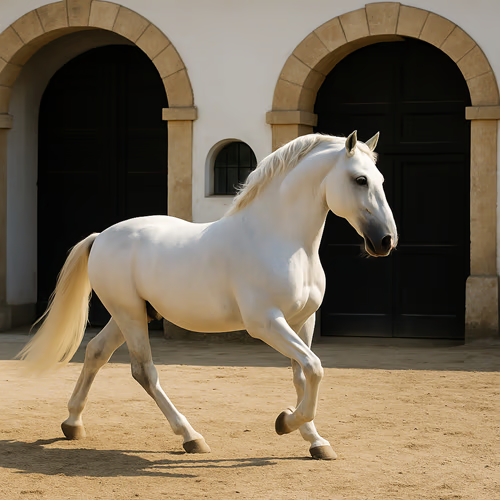
The Lipizzaner is a medium-sized horse that combines strength, endurance, and classical elegance. Its conformation is harmonious, and its body proportions make it perfectly suited for demanding dressage exercises, including movements derived from classical military riding—such as the levade and capriole.
Key Conformation Features of the Lipizzaner:
- Height at the withers: typically 155–165 cm, making it a medium-sized horse, yet very powerful and solid for its size.
- Head: noble, with expressive features, often with a characteristic convex (Roman) profile that gives it dignity and presence.
- Neck: long, strongly muscled, and beautifully arched in a swan-like curve, emphasizing its natural ability for self-carriage.
- Body: a short back combined with a broad, deep chest provides excellent stability and strength.
- Croup: rounded and well-muscled, allowing for powerful engagement of the hindquarters—essential for advanced dressage movements.
- Limbs: refined yet strong, with well-defined joints, indicating durability and sound structure.
- Hair: a thick mane and full tail add to its elegance and underline its noble appearance.
Coat Color
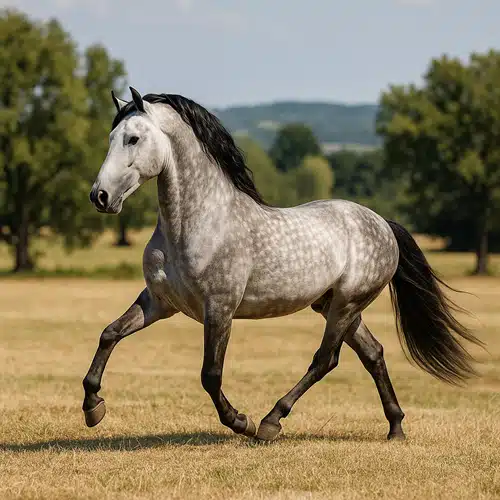
Lipizzaners are most commonly gray, although they are born dark—bay, black, or dark bay—and gradually lighten with age, achieving their characteristic silvery-white coat only after several years. Less commonly, black or bay individuals can be found, and these are highly valued due to their rarity.
Maturation
Lipizzaner horses develop slowly. They reach full physical and mental maturity only at around 6–7 years of age, which is later than many other breeds. However, this allows for harmonious development of the body and contributes to their longevity and ability to remain active even at 20 years of age and beyond.
Character and Temperament
The Lipizzaner is a breed that has been valued for centuries not only for its beauty and physical abilities, but above all for its exceptional character and temperament. It is precisely their personality that has made these horses an integral part of classical dressage and the renowned Spanish Riding School in Vienna.
The Lipizzaner is intelligent, calm, and highly trainable. It learns new skills very quickly, and once an exercise is mastered, it remembers it for life. This makes it perfectly suited for performing the demanding movements of haute école, which require both physical ability and complete cooperation with the rider.
Key Character Traits of Lipizzaners:
- Calm but not dull – maintains emotional balance, does not overreact, yet still retains energy.
- Excellent memory and concentration – highly focused on tasks, which supports consistent training.
- Low spookiness – does not react abruptly to external stimuli, making it a safe horse for everyday work.
- High tolerance to mental pressure – capable of enduring long and demanding training sessions without losing willingness to cooperate.
- Loyalty and attachment – forms a strong bond with humans, becoming not only a working partner but also a devoted companion.
Thanks to this set of traits, the Lipizzaner is considered an ideal horse for collection and classical dressage. Its patience and balance allow it to perform the most demanding movements while maintaining lightness and elegance.
Moreover, Lipizzaners excel in performance work—they not only execute complex dressage elements but do so with visible pride and confidence, making them true artists in the equestrian world.
Uses of the Lipizzaner Horse
The Lipizzaner is a breed that, from the very beginning of its existence, has been bred with representation, equestrian art, and prestige in mind. Thanks to its harmonious conformation, intelligence, and composure, Lipizzaners are used in many fields—from classical dressage and carriage driving to historical performances.
Classical Dressage
Lipizzaners are considered some of the finest dressage horses in history. Their natural ability for self-carriage, short back, and powerful hindquarters make them perfectly suited for collected work. They can effortlessly perform movements such as piaffe, passage, levade, and capriole—exercises regarded as the pinnacle of classical equestrian art. Their patience and willingness to cooperate make them ideal for long-term and demanding training.
Spanish Riding School
It is at the Spanish Riding School in Vienna that Lipizzaner horses gained worldwide fame. For over 400 years, they have demonstrated the highest level of equestrian artistry, presenting performances of exceptional quality. Often referred to as the “ballet of horses,” these shows attract tourists from around the world and are one of the symbols of Austria and European cultural heritage.
Shows, Carriage Driving, and Reenactments
Thanks to their dignity and impressive appearance, Lipizzaners excel in various parades and performances. They are often seen in historical carriages, during royal and military reenactments, or at official state ceremonies. Today, they are also used in competitive driving, where their strength, balance, and elegant movement are major advantages.
Other Uses
Although primarily associated with classical dressage, the Lipizzaner’s traits allow it to perform well in other roles as well. It can be a recreational horse for advanced riders, a show horse, or even a participant in traditional festivals and celebrations in Central European countries.
Movement and Abilities
The movement of the Lipizzaner has long been regarded as a model of classical beauty in equestrianism. It is a unique combination of strength, elegance, expression, and flexibility, which captivates both dressage experts and casual observers. Its gaits are naturally elevated, harmonious, and full of rhythm, making it an ideal horse for performances and advanced classical training.
Characteristics of the Basic Gaits:
- Walk – pure, even, and full of impulsion, with clear energy transfer from the hindquarters to the forehand. It maintains excellent rhythm and stability, forming the foundation for further training.
- Trot – elevated, ground-covering, and highly elastic. Lipizzaners have a natural ability to lift their legs and emphasize the suspension phase, giving their trot a striking lightness and expression.
- Canter – relatively short, but highly collected and perfectly balanced. This makes them well-suited for complex movements such as pirouettes and flying changes.
Special Abilities:
Lipizzaners are known for their natural talent for collection, which is the foundation of classical dressage. They easily perform:
- piaffe – an energetic trot in place,
- passage – a highly expressive, elevated trot with pronounced suspension,
- flying changes – smooth and precise, even at every stride,
- turns and pirouettes – enabled by strong collection and powerful hindquarters,
- elements of the so-called “airs above the ground,” such as levade, mezair, courbette, and capriole, which have fascinated audiences for centuries.
Style and Purpose:
The Lipizzaner is not a horse for racing or jumping—its true calling lies in classical dressage in the baroque style. This style emphasizes elegance, precision, and harmony—qualities that the Lipizzaner embodies at the highest level. Performances of these horses are often described as a “ballet on four legs,” as their movements resemble a dance full of lightness, expression, and pride.
Comparison of Lipizzaner Movement with Other Dressage Breeds
The movement of the Lipizzaner stands out for its collection, expression, and precision, which sets it apart from many other breeds used in dressage. Although it may not be as expansive as that of large sport horses, its harmony and natural ability for self-carriage make it truly unique.
Lipizzaner vs Hanoverian
Hanoverians have long, ground-covering gaits, ideal for modern competitive dressage at the highest level.
Lipizzaners present shorter, more collected, and elastic movement—perfect for classical elements requiring precision, such as piaffe, passage, and pirouettes.
Lipizzaner vs Friesian
Friesians are known for their spectacular, high knee action, but their movement can be less elastic and somewhat heavier.
Lipizzaners combine elevation with lightness, making their movement more springy and harmonious.
Lipizzaner vs Thoroughbred
Thoroughbreds have dynamic, long-striding movement focused on speed and galloping performance in racing.
Lipizzaners, on the other hand, are characterized by short, collected movement focused on balance and precision rather than speed.
Lipizzaner vs Andalusian (PRE)
Andalusian horses have a similar baroque style of movement—elastic and expressive, with a natural ability for collection.
Lipizzaners are distinguished by greater stability and consistency in work. Their movement may be less visually spectacular but is more structured and balanced.
While other breeds impress with scope, spectacle, or speed, Lipizzaners stand out for their precision, balance, and talent for classical dressage. This is why they are still considered an unmatched model in the art of the baroque riding school.
Breeding and Bloodlines
The breeding of Lipizzaner horses has been strictly controlled and state-managed from the very beginning. As early as the 16th century, these horses were considered a national treasure of the Habsburg monarchy, and to this day, many countries in Central and Southern Europe continue to protect them. This has made it possible to preserve the purity of the breed and its unique bloodlines, which are recognized worldwide.
Main Lipizzaner Breeding Centers:
- Lipica (Slovenia) – the cradle of the breed, where the Habsburgs founded the first stud farm in 1580. To this day, Lipica remains one of the most important breeding centers and a symbol of tradition.
- Piber (Austria) – this is where the horses destined for the Spanish Riding School in Vienna are bred. The stud plays a key role in preserving the breed and organizes numerous shows.
- Szilvásvárad (Hungary) – a center known for high-quality breeding, as well as for hosting international competitions and Lipizzaner performances.
- Đakovo (Croatia) – one of the oldest breeding locations, particularly known for traditional parades and carriage driving.
- Topoľčianky (Slovakia) – a stud farm famous for having the largest population of Lipizzaners in Europe, playing a major role in international genetic exchange.
Lipizzaner Stallion Lines
In Lipizzaner breeding, the division into stallion bloodlines is of key importance and has been carefully maintained for centuries. Each line carries specific traits related to conformation, temperament, and movement style:
- Pluto – a line originating from an Andalusian stallion. These horses are elegant, harmoniously built, and endowed with exceptional lightness of movement.
- Conversano – horses of this line are strong, more massive, with pronounced musculature, often more energetic and temperamental.
- Maestoso – characterized by nobility, a more elongated frame, and excellent proportions, making them well-suited for dressage.
- Favory – elegant horses with a calm temperament, known for their trainability and patience.
- Siglavy – a line with Arabian influence, giving horses a refined head profile, livelier temperament, and exceptional expression in movement.
- Neapolitano – horses of this line are strong, compact, and well-muscled, often with a more expressive character, making them impressive in performances.
Thanks to the preservation of these lines, Lipizzaners maintain genetic diversity while remaining true to the original ideal of the imperial horse—strong, elegant, and highly trainable.
Lipizzaner Horses in Poland
Although Lipizzaner horses are not a widespread breed in Poland, they have long attracted significant interest among enthusiasts of classical dressage and the baroque riding style. Their exceptional beauty, intelligence, and talent for collected work mean they are increasingly found in private stables and equestrian centers that emphasize tradition and artistry.
Breeding and Import
Lipizzaners in Poland are mainly introduced through imports from stud farms in Austria (Piber), Slovenia (Lipica), and Hungary (Szilvásvárad). Some horses are also brought in from Slovakia and Croatia, where the breed is more widely established. In Poland, there are small private breeding operations that aim to continue the tradition and preserve pure bloodlines, although the overall Lipizzaner population remains limited.
Uses in Poland
Horses of this breed are used in several areas:
- Classical dressage – thanks to their natural ability for collection and harmonious movement, Lipizzaners excel in both training and performances.
- Shows and historical reenactments – they often take part in events inspired by baroque and court traditions, where their presence attracts great interest from audiences.
- Carriage driving and parades – in Poland, as in their countries of origin, Lipizzaners are sometimes used in harness, adding elegance to ceremonies and cultural events.
- Natural horsemanship and therapy – their calm nature and intelligence make them suitable partners for natural training methods and, in some cases, therapeutic activities.
Popularity
Although not a common breed in Poland, the Lipizzaner is highly valued by those seeking unique, rare, and representative horses. They are especially appreciated by enthusiasts of the baroque riding school and classical dressage, who admire their balanced temperament and majestic appearance.
Interesting Facts and Cultural Significance
The Lipizzaner horse is not only an exceptional breed but also a living symbol of European tradition and culture. For centuries associated with the Habsburg court and the art of classical dressage, it remains one of the most recognizable horses in the world.
Symbol of the Spanish Riding School in Vienna
The Lipizzaner is an integral part of the performances at the Spanish Riding School—the oldest riding school in the world, operating continuously for over 450 years. Lipizzaner performances in Vienna are often referred to as the “ballet of horses,” and these shows are considered one of Austria’s greatest cultural attractions.
“Operation Cowboy” – an extraordinary story from 1945
At the end of World War II, many Lipizzaner herds were in danger. In 1945, American soldiers carried out a rescue mission known as Operation Cowboy, during which hundreds of horses were saved from destruction by Soviet forces. This episode remains one of the most famous moments in the breed’s history and highlights its cultural importance.
UNESCO – Intangible Cultural Heritage
In 2022, the tradition of Lipizzaner breeding was added to the UNESCO Intangible Cultural Heritage list. This recognition confirms that the Lipizzaner is not just a horse, but also part of the shared heritage of Central European nations, combining history, art, and tradition.
Presence in Art and Culture
For centuries, Lipizzaners have inspired artists—they have appeared in paintings, sculptures, and tapestries, often as symbols of majesty and elegance. They have also been featured in films and documentaries, as well as in opera and theatrical performances. Their silhouette, movement, and characteristic gray coat make them an enduring icon of beauty in the equestrian world.
A Cultural Ambassador of Europe
Today, Lipizzaners can be seen not only in Vienna but also at shows and festivals in Slovenia, Croatia, Hungary, and Slovakia. In many countries, they have become a tourist attraction and a key element in promoting national heritage, with their performances drawing audiences from all over the world.
Care and Health
Lipizzaner horses are considered a hardy, healthy, and exceptionally long-lived breed. Some individuals can live up to 30–35 years while maintaining good condition and a willingness to work. Their genetic resilience makes them highly valued by breeders, but—as with any breed—they require careful care tailored to their specific needs.
Key Care and Management Principles for Lipizzaners:
- Maintaining condition – Lipizzaners tend to gain weight easily, especially when not regularly exercised. Therefore, it is important to maintain a proper exercise routine to prevent obesity and joint strain.
- Balanced training – young horses in particular require harmonious training. Their later maturation (full maturity at 6–7 years) demands patience and gradual introduction of more demanding exercises. Overloading them too early can lead to injuries.
- Mane and tail care – Lipizzaners are known for their thick, abundant hair, which requires regular grooming and proper care. This helps keep the mane and tail healthy and prevents tangling.
- Stable feeding conditions – the breed has a sensitive digestive system, so it is important to maintain consistent feeding times and avoid sudden changes in diet. High-quality hay works best, supplemented with appropriate feed mixes and, especially, mineral supplements.
- Hoof health – although Lipizzaners generally have strong legs, some lines show a tendency toward laminitis and increased hoof sensitivity. Regular farrier care and a proper diet (limiting excess sugars and starch) help minimize risks.
Overall Health and Longevity
Lipizzaners are among the long-lived horse breeds—many remain fully active even beyond 20 years of age. This is the result of both their genetic resilience and breeding practices focused on selecting healthy and strong individuals.
With the right diet, regular exercise, and consistent care, the Lipizzaner rewards its owner with a long life and excellent condition, while its beauty and vitality can be enjoyed for many years.
FAQ
Is the Lipizzaner Suitable for Beginners?
Yes, under the supervision of a trainer. They are patient and stable, although they require consistency.
Can You Buy Lipizzaners in Poland?
Yes. There are several breeders and private owners who import and offer horses of this breed.
Is the Lipizzaner Suitable for Sport Competitions?
It performs best in classical dressage, shows, and carriage driving.
What Is the Typical Coat Color?
Gray—foals are born dark and lighten with age.
Are Lipizzaners Long-Lived?
Yes. They often live up to 30 years, and some even longer.
The Lipizzaner horse is a gem of classical elegance and dignity. Its history, appearance, and abilities make it one of the most recognizable horse breeds in the world. It excels not only in dressage, but also in recreation, therapy, and performances.
It is a horse for those who value tradition, culture, and a close bond with their equine partner.