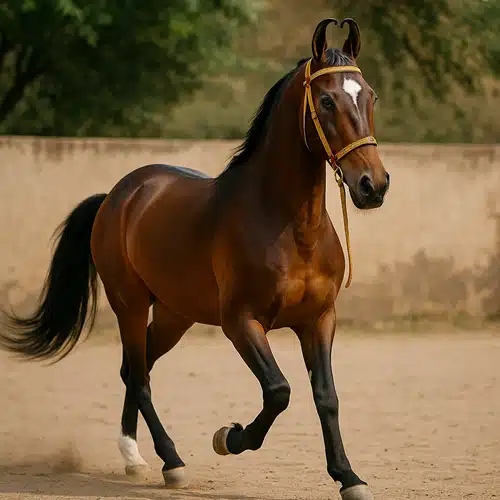
The Marwari horse is one of the most exotic and recognizable horse breeds in the world. It originates from the hot and arid regions of India. It is known for its distinctive inward-curving ears, loyalty to its rider, and remarkable endurance. This is a horse of deep cultural significance, not only practical use.
Table of Contents
Origin and History of the Marwari Horse
The Marwari horse originates from the Marwar region (present-day Jodhpur district) in the state of Rajasthan, in northwestern India—it is a horse breed native to India. This breed is deeply rooted in the history of the Indian subcontinent, with origins dating back at least to the 12th century, although some sources suggest that horses of a similar type existed in this region much earlier.
The breed was developed and refined by the warrior clans of the Rajputs, for whom the horse was not only a means of transport but also a symbol of honor, courage, and social status. Marwaris were indispensable in battle—thanks to their endurance, loyalty, and exceptional sense of direction, they were ideal war horses and mounts for commanders. They often accompanied Rajput warriors into combat until death, and their devotion was so strong that, according to tradition, horse and rider formed an inseparable bond.
Beyond their military role, Marwari horses were also used in royal escorts, court ceremonies, hunting, and displays. Their distinctive high-stepping gait (known as revaal) and inward-curving ears made them not only practical but also visually striking. During the Mughal Empire, they were valued by both Rajput rulers and Muslim princes—often exchanged as diplomatic gifts.
Worth reading:
- If you are interested in desert heritage and endurance, explore the Arabian horse, one of the oldest and most influential breeds in the world.
- You can also discover the Akhal-Teke horse, known for its unique appearance and origins in Central Asia.
- For a more classical and elegant type, check out the Andalusian horse, famous for its grace and presence in dressage.
- If you are drawn to aristocratic horses, read about the Lipizzaner horse, known for its history and classical training.
Thanks to long-term selective breeding and the harsh environmental conditions of the desert regions of Rajasthan, horses of this breed developed traits such as high resistance to heat, water scarcity, and difficult terrain, as well as a strong psychological bond with humans. Their strength, determination, and survival instinct were valued by both warriors and travelers.
After India gained independence in 1947, Marwari horses began to decline in importance. In modern India, the demand for utility and sport breeds increased, leading to a drastic reduction in the population of this breed. A ban on the export of Marwari horses was also introduced, which limited their promotion beyond the country’s borders. By the 1980s, the breed was close to extinction, and many original bloodlines had disappeared.
Fortunately, since the 1990s, there has been a revival of interest in the breed. Thanks to the efforts of local breeders, organizations such as the Marwari Horse Society, as well as support from equestrian tourism and horse enthusiasts in the West, the breed has begun to regain popularity. Today, Marwari horses can be found not only in India but also in selected centers in the United States, the United Kingdom, and Germany, where small breeding programs are maintained. However, the breed remains rare and strictly protected—both because of its cultural heritage and its unique functional traits.
Appearance and Distinctive Features
The Marwari horse stands out from other breeds not only for its exotic appearance but also for its symbolic significance.
Key Characteristics:
- Height: 150–165 cm
- Head: slender, with large eyes
- Ears: the most distinctive feature—curved inward, often touching at the tips
- Neck: long and arched
- Chest: narrow
- Withers: well-defined, with a short back
- Limbs: refined structure with strong, hard hooves
Coat Colors: most commonly chestnut, bay, gray, or black. White horses are considered sacred and are often reserved for priests and ceremonial events.
Temperament and Character of the Marwari Horse
Marwari horses stand out not only for their exotic appearance but, above all, for their character, which makes them exceptional partners for humans—both in work and recreation. They are known for their strong instinct of attachment to their handler, often described by breeders as “the loyalty of a dog in a horse’s body.”
For centuries, they were valued by warriors not only for their endurance and speed but also for their courage, intelligence, and trust in the rider. Horses of this breed can form an exceptionally strong bond with a single person—they are known to recognize their handler’s voice, respond to emotions, and show affection in ways rarely seen in other breeds.
Key Character Traits of Marwari Horses:
- Intelligent and perceptive – Marwaris learn new commands quickly and recognize recurring situations. Their natural curiosity helps them adapt to new environments, although they may need time to trust new people.
- Stress-resistant – bred for centuries to function in battle conditions and noisy environments, they remain calm where other horses might panic. They also handle long journeys, changing weather, and new surroundings well.
- Brave – one of the breed’s most valued traits. These horses do not shy away from obstacles, do not react impulsively, and can trust their rider even in difficult terrain. Their confidence comes from generations of use as war mounts.
- Faithful and loyal – Marwaris are often described as horses that “choose their person.” They can be deeply devoted, sometimes following their handler even without a bridle or lead rope. This makes them ideal for natural horsemanship, as well as therapy and recreational riding.
Relationship with Humans
Marwaris are not suitable for everyone—they require an approach based on mutual respect and consistency. Their alertness and independence can be misinterpreted as a difficult temperament, but in reality, they stem from high intelligence and a need for clear communication. In inexperienced hands, a Marwari may become withdrawn or distrustful, but with proper handling, it develops its full potential.
Ideal for Trail Riding and Partnership-Based Work
Thanks to these traits, Marwari horses excel in fieldwork—both in long-distance riding and relaxed trail rides. Their natural sense of direction, ability to avoid obstacles, and composure in challenging conditions make them excellent “trail horses.” They are often chosen by riders who value partnership rather than purely utilitarian riding.
Their awareness and strong survival instinct also allow them to assess situations independently—for example, stopping before dangerous ground or avoiding an obstacle the rider may not have noticed.
Uses of Marwari Horses
The Marwari breed combines not only historical significance and exotic appearance, but also practical versatility, although its primary uses still focus on cultural, ceremonial, and performance roles. Thanks to their exceptional temperament, resilience to harsh environments, and striking presence, these horses also perform well in endurance riding and natural horsemanship.
Parades, Ceremonies, and Weddings
In India, Marwari horses still play an important role in both religious and secular ceremonies, especially in regions such as Rajasthan, Gujarat, and Punjab. They take part in:
- traditional Hindu weddings – the groom often arrives riding a white Marwari horse adorned with richly decorated harness. The white horse symbolizes purity, honor, and prosperity, emphasizing the prestige of the event;
- military and state parades – these horses have long been used in displays involving armed forces and royal guards. They are trained to carry ceremonial armor and move in formation;
- folk shows and festivals – such as the Pushkar Camel & Horse Fair, where Marwaris are showcased in beauty contests, riding displays, and traditional drills.
Their distinctive inward-curving ears, proud gait, and dignified silhouette make them highly sought after as ceremonial horses by local authorities, wealthy families, and event organizers.
Endurance and Long-Distance Riding
Thanks to their exceptional endurance and ability to survive in extreme conditions, Marwari horses excel in trail riding and long-distance riding. They are highly resistant to:
- high temperatures typical of semi-desert regions of India,
- prolonged physical effort with minimal feed and water,
- low pressure and uneven terrain, including rocky paths, the sands of the Thar Desert, and the Aravalli mountain trails.
Although they are not yet widely used in international endurance competitions, in India they participate in local cross-country races and riding expeditions, often covering dozens of kilometers per day without significant fatigue. Marwaris are also used by local companies offering equestrian tourism in Rajasthan, where they carry tourists along ancient caravan routes and royal roads.
Natural Performances and Work with Humans
One of the most valued traits of Marwari horses is their intelligence and strong bond with humans, which makes them excellent for work such as:
- natural horsemanship (groundwork),
- liberty work – riding and performing without a bridle or lunge line,
- training based on non-verbal communication and mutual trust.
Thanks to their loyalty and rapid learning ability, Marwaris eagerly take part in partnership-based performances, such as working to music, synchronized routines, and vaulting. These horses show a remarkable ability to focus on humans, respond to subtle body cues, and anticipate their handler’s intentions.
Their alertness, quick reflexes, and responsiveness to external stimuli also make them well-suited for exercises focused on developing the human–horse relationship. As a result, they are often chosen by individuals involved in equestrian education, recreational riding, and natural therapy (although, due to their lively temperament, they are rarely used in traditional hippotherapy).
Movement and Aptitudes
The Marwari horse moves lightly, with a smooth gait typical of oriental breeds. It possesses a natural gait called revaal—rhythmic and comfortable for the rider.
- Walk – long and elastic
- Trot – light and relatively flat
- Canter – rhythmic and balanced
- Revaal – a natural four-beat gait that makes long-distance riding easier
This gait is somewhat similar to the tölt of Icelandic horses, making riding comfortable even for many hours.
Breeding and Registration of Marwari Horses
Breeding of Marwari horses in India is currently under strict supervision by organizations dedicated to preserving native Indian horse breeds. Due to its cultural and historical significance, the Marwari horse is considered a national asset, and its breeding, selection, and identification are managed within registered systems aimed at protecting the purity of the breed.
Organizations Registering Marwari Horses
The breed is primarily registered and overseen by three main structures:
- Indigenous Horse Society of India – one of the key organizations focused on preserving India’s native horse breeds. It maintains a national database of Marwari, Kathiawari, and Manipuri horses, organizes shows and championships, and supports educational and promotional activities related to equine heritage.
- Marwari Horse Society – an organization bringing together private breeders and enthusiasts of the breed. It develops breeding standards, promotes Marwari horses both domestically and internationally, and maintains its own pedigree registry. It also works toward international recognition (e.g., by FEI).
- Local private breeder registries in Rajasthan and Gujarat – some traditional breeding families still maintain their own studbooks, informal registries, and bloodlines, often passed down orally or documented internally. Although not always integrated with official systems, these breeders play a crucial role in preserving the original traits of the breed.
Export Ban and International Restrictions
Since 2000, the government of India has enforced a ban on the export of Marwari horses, which remains in place today. This decision was made due to the risk of the breed’s decline and the need to protect its genetic resources within the country. The ban applies not only to live horses but also to semen, embryos, and other genetic material. Exceptions are extremely rare and granted only for specialized purposes, such as scientific research.
As a result, Marwari horses are extremely rare outside India. The few individuals found abroad were exported before the ban, mainly in the 1980s and 1990s. The largest populations outside India can be found in:
- the United States – where small private breeding farms and show centers operate (e.g., Maharani Farm),
- the United Kingdom – mostly among enthusiasts of Indian culture and traditional horsemanship,
- Australia – with a few pre-2000 imports owned privately.
All Marwari horses outside India are now considered unique and valuable specimens, and their offspring cannot be officially recognized by Indian registries, as they are not part of the controlled national breeding system.
Breed Status and Conservation Efforts
The Marwari breed has not yet been officially recognized by the Fédération Équestre Internationale or the World Association of Zoos and Aquariums as endangered, but it is listed in the Indian Livestock Census as a breed with a limited population and significant cultural importance. It is estimated that there are currently between 2,500 and 4,000 purebred Marwari horses worldwide, with over 90% located in India.
Conservation efforts include:
- promoting the breed at national shows and exhibitions,
- supporting traditional Rajput breeding programs,
- educational and social awareness campaigns,
- discussions on potentially easing export restrictions, provided genetic control is maintained.
Marwari Horses in Poland and Around the World
There are no officially registered Marwari horse breeding farms in Poland, but enthusiasts of oriental horses and natural performances are showing increasing interest in the breed. Globally, the largest populations are found:
- in India (Rajasthan),
- in the United States (a dozen or so individuals),
- in the United Kingdom,
- in Australia (a few horses listed in registries).
Interesting Facts and Legends
- Marwari ears can rotate independently and may turn up to 180°
- In India, it is believed that a Marwari horse chooses its rider once for life
- In ancient poems, these horses were referred to as “sacred steeds”
- In Hindu tradition, the Marwari is the horse of a warrior—a symbol of courage
Care and Health of Marwari Horses
As an oriental breed, Marwari horses are considered exceptionally hardy and long-lived, thanks to centuries of selection in the harsh semi-desert conditions of India. Their bodies are well adapted to high temperatures, dry air, and limited nutrition. However, keeping them in temperate climates—especially in colder and more humid European conditions—requires adapting their living conditions and care to their natural needs.
Protection from Cold and Moisture
Marwari horses have a thin, short coat and do not develop a dense winter undercoat like many other breeds. As a result, they are sensitive to low temperatures, rainfall, and prolonged dampness. In cooler climates, they require:
- blanketing during the autumn and winter period, even in stabled conditions,
- constant access to dry, well-ventilated shelter,
- avoiding prolonged exposure to wet ground, which may lead to skin and hoof problems.
Regular monitoring for signs of cold stress (such as muscle shivering, tucked posture, or lethargy) is essential, especially during transitional seasons.
Feeding – Efficient Metabolism
Marwari horses, like other desert breeds, have an efficient metabolism. This means they do not require large amounts of feed and may even respond poorly to overfeeding or excess energy. They do best on a diet based on:
- high-quality hay and forage,
- limited amounts of concentrated feed, preferably without oats or with low starch content,
- access to minerals, especially zinc, selenium, and copper,
- electrolytes and herbal supplements during training or hot weather.
It is important to avoid sudden dietary changes—Marwaris are sensitive to digestive disturbances, although they are less prone to colic than some European breeds.
Physical Activity and Human Interaction
Due to their high intelligence and alertness, Marwari horses require daily movement and mental stimulation. They do not cope well with isolation, boredom, or lack of human interaction. The best results are achieved by providing them with:
- regular in-hand walks or free turnout,
- training based on communication and trust (e.g., groundwork, liberty work),
- opportunities to explore the environment—trail riding is ideal, allowing the horse to release energy and maintain a natural rhythm of movement.
When left without stimulation, horses of this breed may show signs of frustration or withdrawal. Therefore, their mental well-being should be treated just as seriously as their physical health.
Unique Ear Structure – Care and Awareness
One of the most distinctive features of the Marwari horse is its inward-curving ears—often referred to as a “horse with curved ears”—which in some individuals nearly touch at the tips. While this trait is highly striking, it also requires special attention in care:
- the ears can accumulate moisture, dirt, sweat, or insects, especially in temperate climates,
- they should be cleaned regularly, gently checking the inside of the ear and removing any impurities,
- during rain or high humidity, it is recommended to use protective ear covers if the horse is particularly sensitive.
Neglecting ear hygiene can lead to inflammation, irritation, and infections.
Marwari Horse Compared to Other Breeds
Marwari vs Arabian Horse
The Arabian horse is known for endurance, elegance, and speed—ideal for long-distance riding. The Marwari offers an equally distinctive appearance, but its strength lies in resilience and its unique ear structure. The Arabian is energetic and subtly elegant, while the Marwari is exotic and enduring.
Marwari vs Hanoverian
The Hanoverian is a sport horse that excels in dressage, show jumping, and eventing. The Marwari has a lighter, more oriental build and stands out for its adaptability in harsh conditions. The Hanoverian represents top-level sport, while the Marwari embodies endurance and tradition.
Marwari vs Thoroughbred
The Thoroughbred is synonymous with speed and lightness—its build is sleek and aerodynamic. The Marwari is less sport-oriented but more resilient to difficult conditions and generally hardier. The Thoroughbred is the horse of speed, while the Marwari represents endurance and unique beauty.
Marwari vs Paso Fino
The Paso Fino is famous for its smooth, four-beat gait. The Marwari does not offer the same type of gait but stands out for its endurance and distinctive, expressive character valued in traditional settings. The Paso Fino offers riding comfort, while the Marwari represents legend and culture.
Marwari vs Rocky Mountain Horse
The Rocky Mountain Horse is a gentle family horse with a smooth gait. The Marwari is also calm but shows greater courage and independence. The Rocky Mountain Horse offers comfort on the trail, while the Marwari represents pride and authenticity.
Marwari vs American Saddlebred
The American Saddlebred is a show horse known for its flashy movement and stage elegance. The Marwari has an equally striking appearance, but in a more subtle and culturally rich way rather than purely show-oriented. The Saddlebred belongs to the show ring, while the Marwari is a cultural symbol and rare exotic breed.
Longevity and Health
Marwari horses are known for their long lifespan and resistance to many diseases typical of European breeds. With proper care and management, they can live up to 25–30 years, and in India there are cases of horses living even beyond 35 years. They often maintain full physical fitness and a willingness to work well into old age.
They are not prone to:
- laminitis,
- chronic infections,
- metabolic sensitivities.
However, they may be sensitive to:
- inappropriate diets high in carbohydrates,
- cold and damp conditions,
- overly intensive training without proper preparation.
FAQ
Is the Marwari Horse Suitable for Beginners?
No. It requires an experienced and calm rider.
Is the Marwari Horse Suitable for Sport?
It does not compete in Olympic disciplines, but it performs very well in shows, endurance riding, and trail riding.
Can You Buy a Marwari Horse in Poland?
Currently, no. Due to the export ban from India, horses of this breed are extremely rare outside Asia.
Do Marwari Horses’ Ears Really Touch?
Yes—the ears curve inward and can touch at the tips, which is a distinctive feature of the breed.
Are Marwari Horses Long-Lived?
Yes. Thanks to their resilience and lean body structure, they often live for over 25 years.
The Marwari horse is a remarkable breed—full of history, courage, and exotic charm. It combines oriental beauty, loyalty, and a strong ability to form deep bonds with humans. Although rare in Europe, it remains a living symbol of Indian culture and a dream for many riders who value authenticity.