
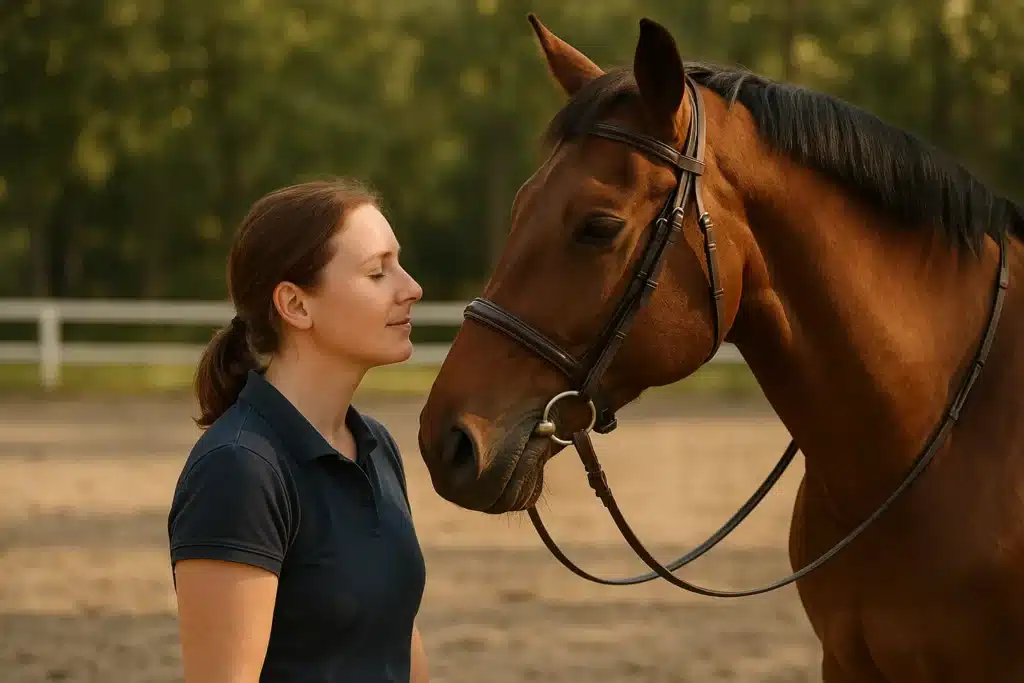
Patience with a Horse: Horses have an extraordinary ability to teach people what they often lack the most – patience. It is not just about calmly waiting for a horse to complete an exercise. It is something much deeper – understanding that every step of progress, every bond, and every reaction requires time, consistency, and calmness.
Working with a horse is a meeting of two worlds – the human one, full of rush, plans, and expectations, and the equine one, based on nature, rhythm, and instinct. Humans often want immediate results: a correct gait, a balanced canter, a perfect response to the leg. The horse, meanwhile, reminds us that trust is not built in a single day, and that understanding requires silence and observation.
Patience in the stable is not just about waiting. It is the ability to accept that something may not go well today, that the horse has the right to have a bad day, and that mistakes are part of the process. Over time, the rider begins to notice subtle signals – a slight flick of the ear, a soft breath, a relaxed neck. It is in these small moments that true communication reveals itself.
A horse does not live in a hurry. It does not know deadlines, training plans, or sporting ambitions. It reacts here and now. It teaches that the most is achieved by those who can pause, breathe calmly, and wait for the relationship to mature.
“The horse does not know haste – it knows only the rhythm of nature.”
To zdanie doskonale oddaje istotę więzi człowieka i konia. Kiedy jeździec zaczyna dostosowywać się do rytmu swojego zwierzęcia, a nie odwrotnie, odkrywa, że cierpliwość nie jest słabością, lecz siłą. To właśnie ona pozwala budować zaufanie, rozwijać umiejętności i czerpać prawdziwą radość z każdej wspólnej chwili.
Table of Contents
Patience – The First Lesson a Horse Teaches
The first contact with a horse teaches that nothing happens instantly. A horse does not understand our words – only the tone of voice, gestures, and the emotions we project. It is an animal extremely sensitive to human energy. If you approach it with haste, tension, or anger, it will immediately sense it and respond with distrust. But if you remain calm and give it time to get to know you and become comfortable with your presence, it will begin to trust you.
Patience is the first and most important language through which you can communicate with a horse. It is not enough to learn techniques such as leading, seat, or the use of aids. You must learn to listen – not only with your ears, but with your whole being. A horse does not teach through words, but through reactions. If you make a mistake, it will show you through its behavior. Not out of anger, but out of the simplicity of its nature.
Beginner riders often expect quick results. They want the horse to immediately understand a cue, to step forward at the leg, or to lower its head with a light contact on the reins. However, a horse needs time to learn these signals, to trust the human, and to connect touch with the correct response. Impatience in this process only pushes the goal further away – because a horse does not learn under stress.
Worth reading:
Patience with a horse is the ability to pause and breathe. It is the awareness that each day can bring something different. Sometimes the horse is willing to cooperate, and other times it may be distracted or tense. And in those moments, instead of demanding more, it is worth giving it space and time.
Many experienced trainers say that a horse is a mirror of a human. It reflects our emotions and moods. If you are calm, the horse will be calm as well. If you rush, it will become nervous. That is why working with a horse is not only about learning riding skills, but above all about learning self-control.
The patience you develop with a horse later becomes your strength in other areas of life. It teaches you that rushing does not bring lasting results, and that trust and mutual understanding are built step by step – often in silence, between one breath and the next.
Why Horses Do Not Tolerate Pressure?
A horse is a flight animal – in nature, its survival depended on reacting quickly to danger. Every sudden movement, raised voice, or tension in a human’s body is interpreted by the horse as a warning signal. That is why its first instinct is to flee or resist. This is not disobedience, but a natural instinct.
The more pressure you apply, the more the horse shuts down. Trying to force anything – stronger leg aids, a harsher pull on the reins, shouting – may bring results, but only for a moment. The horse will do what you ask, but not because it understands, rather because it is afraid. And fear never leads to true trust.
Trust and cooperation appear only when the horse feels that the human is a guide, not a threat. When it knows it can make a mistake without punishment, that it has time to understand signals, and that its effort will be noticed and rewarded with calmness.
Patience in working with a horse means accepting the pace at which the animal learns. Some horses understand new things very quickly, while others need days or even weeks. If a rider tries to rush this process, the result will be the opposite – the horse will become tense, lose trust, and start to avoid work.
The pressure humans often apply comes from the need for control. We want the horse to respond immediately, to behave “perfectly.” Meanwhile, the horse reminds us that nature does not operate in haste. Trust, like balance or obedience, develops gradually – through repetition, consistency, and calmness.
A horse that is given time begins to want to cooperate on its own. It seeks contact, responds to subtle signals, and becomes more attentive. This is when the magic appears – not forced obedience, but a true bond based on mutual respect.
For humans, this is a powerful lesson. The horse teaches that not everything can be rushed, and that pressure never brings lasting results. Sometimes it is enough to take a step back, breathe deeply, and allow the process to unfold at its own rhythm. Because true strength in working with a horse lies not in physical force, but in calmness and understanding.
How Does Training a Horse Teach Humility and Consistency?
In horse training, there are no shortcuts. Every stage requires repetition, calmness, and trust. One day everything goes perfectly – the horse responds lightly, works with engagement, and every movement feels smooth. The next day may be completely different – as if it has forgotten everything it learned before. That is when a person’s patience, humility, and consistency are truly tested.
A horse does not function like a machine. It has its own emotions, moods, and off days. It may be distracted by the wind, a sound from the stable, or the presence of another horse. It does not do this out of spite – it simply lives in the present moment and reacts to its surroundings. Therefore, a trainer or rider must learn to accept this variability and respond with calmness rather than frustration.
Humility toward a horse means understanding that we do not always know better. Sometimes the horse shows us that we are moving too fast, that an exercise is too difficult, or that our mood is not suitable for cooperation. In such moments, instead of forcing, it is better to pause and return to simpler tasks. This is a lesson horses teach without words – that it is worth listening, observing, and adapting, rather than imposing our own rhythm.
Anyone who trains a horse knows the value of small successes. Sometimes it is just a few calm, relaxed steps, a soft contact on the reins, a gentle lowering of the neck, or a brave approach to an obstacle. These moments teach gratitude for small things and show that true progress is the sum of many small steps.
Horses also teach consistency – without it, there is no trust. If you allow a horse to ignore a cue once and then react sharply the next time, you create confusion. The animal needs clear, calm rules and predictability. That is why every movement, every reaction, and every reward must be thoughtful.
It is this daily consistency that builds the bond. The horse begins to understand that it can trust – because its human responds in the same way, with equal calmness and understanding. And the human, by learning this regularity, develops a quality that is useful not only in the stable, but in all areas of life.
Training a horse teaches humility toward nature, patience toward the process, and respect for a being that communicates differently than we do. Those who learn humility in the stable find it easier to cope with failures, mistakes, and challenges in everyday life. Because horses show that true strength does not lie in dominance, but in trust and consistency, built day by day.
Mindfulness in the Stable – The Key to Understanding Yourself
When you are with a horse, you must be fully present in the moment. It does not matter what happened in the morning or what awaits you in the evening. Thoughts about work, school, your phone, or daily responsibilities fade into the background. For the horse, only this moment matters—your energy, your breathing, your attitude. If you are distracted, the horse will sense it immediately. If you are tense, it will become tense as well.
Being around a horse requires complete presence. Every gesture, touch, and signal must have meaning. When you lead a horse, you cannot be thinking about something else. When you groom it, you must stay focused on its reactions—whether it closes its eyes in relaxation or tenses its muscles because something is bothering it. Mindfulness in the stable is the art of noticing small details that say more than words ever could.
Many experienced riders say that contact with a horse is a form of moving meditation. It requires inner silence and a level of focus that is hard to find in everyday life. When you sit in the saddle, you feel every step, the rhythm of breathing, and the balance of your own body. It is a moment when you truly listen—to yourself and to the horse.
Mindfulness also develops emotional balance. In horsemanship, there is no room for impulsiveness. If the horse becomes frightened or refuses to cooperate, your reaction must remain calm and measured. Instead of anger, empathy and reflection are needed. This teaches you to recognize your own emotions, control them, and transform them into conscious actions—not only in the stable, but beyond it as well.
Being mindful around a horse also means understanding that the relationship is not only about training. Time spent together, without expectations or goals, builds true trust. When you simply stand next to the horse, listen to its breathing, and observe the movement of its ears or tail—something extraordinary happens. You begin to see that the horse is not just an animal, but also a mirror of your inner world.
Mindfulness in the stable is therefore not just a training technique, but a way to better understand yourself. It teaches that calmness is stronger than haste, and empathy more effective than control. Through it, you become not only a better rider, but also a more aware person—someone who can listen, observe, and respond with heart rather than ego.
Patience Toward Your Horse’s Emotions and Your Own
A horse will not understand your frustration through words—it does not know human language, but it reads emotions perfectly. It recognizes them in your movements, your breathing, your tone of voice, and even in the way you hold the reins. For the horse, all of these are signals. If your body is tense, if your breathing becomes quick and shallow, the horse will assume something is wrong. It may tense up, stop, refuse to cooperate, or simply move away. Not because it is stubborn, but because it feels your emotions and reacts exactly as they allow.
Patience toward the horse begins with patience toward yourself. When you feel frustration because something is not working, the most important thing is to pause. Take a step back, breathe deeply, and allow the tension to fade. The horse will not understand anger, but it will understand calmness. Only in an atmosphere of trust and balance can it truly learn and develop.
Many riders eventually discover that working with a horse is actually working on themselves. It is not the horse that is “difficult”—it is the human who must learn to be more consistent, calm, and clear in communication. If you cannot control your own emotions, you will not be able to guide the relationship with your horse. The animal becomes your mirror—it reflects every bit of tension and uncertainty you bring into the stable.
Patience in such moments is not giving up on the goal, but choosing the right moment. Sometimes it is better to stop the training, switch to a relaxed walk, or simply stroke the horse and end the day with the feeling that you gave it a sense of safety. These decisions build trust—they show the horse that you are someone who responds not with anger, but with understanding.
This lesson carries far beyond the stable. In relationships with people, the mechanism is the same. When we react impulsively, we fuel conflict. When we remain calm, we are able to hear more, understand more, and avoid unnecessary tension.
A horse teaches that emotions are natural, but what we do with them defines us as partners—both in working with horses and in life. Patience toward yourself and another being is not weakness. It is the highest form of strength—the quiet, steady kind that does not need to prove itself to be effective.
How Do These Lessons Translate Into Life Beyond the Stable?
The patience that horses teach does not end the moment you leave the stable. It is a skill that gradually seeps into every area of life. At work, at home, and in relationships with others—the principle remains the same: haste and pressure rarely lead to lasting results. What we experience with horses becomes a model to follow in the human world as well.
In the stable, we learn to accept that some things take time—that not everything can be forced. This awareness naturally carries over into everyday life. We begin to respond more calmly to delays, setbacks, or the mistakes of others. We realize that the process of learning, working, or building relationships cannot be rushed—just as a horse’s trust cannot be rushed.
Horses also teach flexibility. Every day is different—sometimes cooperation flows perfectly, and other times plans must change because the horse is tense or tired. Life works the same way: sometimes things do not go as planned, obstacles appear, and circumstances shift. Instead of frustration, a person shaped by working with horses learns to adapt, look for solutions, and maintain balance.
Many riders say that horses also teach humility in relationships with people. Working with horses is not about dominance, but about cooperation. Life is similar—it is not always about being right, but about understanding the other side. Patience and calmness create space for dialogue, build trust, and help reduce tension.
The rhythm of the stable—daily routines, grooming, and working with the horse—also teaches gratitude for small things. A calm breath, a soft look from the horse, a successful training session after many attempts. This mindset carries into life—we begin to notice small joys instead of chasing perfection.
A horse reminds us that every action has its own rhythm. You cannot rush the process of growth, learning, or building relationships. Sometimes the greatest progress comes when we let go—when we stop pushing and allow things to develop at their natural pace.
This philosophy, simple yet profound, makes us more aware, calmer, and more empathetic. Horses teach that patience is not just a rider’s virtue—it is a way of life that helps us better understand ourselves and others, live more mindfully, and carry greater peace within.
Patience is the most valuable gift that comes from contact with a horse. It teaches calmness, balance, and the understanding that every step matters. Those who learn to wait in the stable will learn to wait in life as well.
“A horse does not need your anger. It needs your calm.”
FAQ
How does a horse teach patience to beginner riders?
Through its reactions. If the rider rushes or becomes tense, the horse stops cooperating. In this way, it naturally demands calmness and focus.
Can patience be developed through working with horses?
Yes. Regular contact with a horse requires consistency, repetition, and empathy—qualities that naturally build patience over time.
Do horses feel human emotions?
Yes, very clearly. They respond to tone of voice, gestures, and even subtle changes in body tension. That’s why emotional balance in a human is key to building a good relationship.
Why does working with horses develop patience more than other activities?
Because horses respond not to words, but to emotions. You cannot deceive them or rush the learning process. Every step requires calmness, consistency, and trust, which naturally teaches patience and inner balance.
Do horses really “feel” human emotions?
Yes. Horses are incredibly sensitive animals that can detect tension in a person’s body, tone of voice, and even the rhythm of breathing. Before they respond to a command, they read the energy you project. That is why working with a horse is like looking into a mirror of your emotions—it reveals what you truly feel.
How can you practice patience in everyday contact with a horse?
Start by carefully observing your horse’s reactions. Pay attention to its body language—ears, tail, and posture. Give it time to understand your cues instead of expecting immediate results. And most importantly, reward every small success—even the smallest sign of progress.