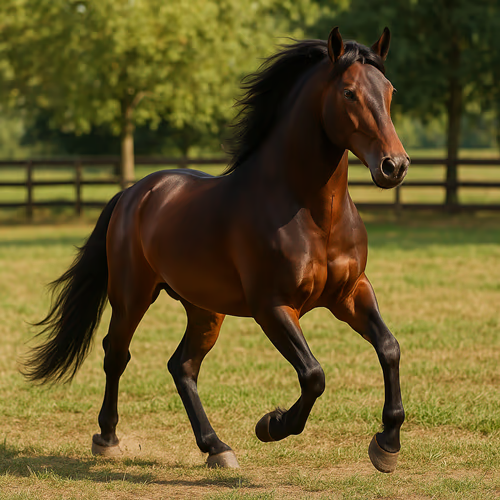
The Morgan horse is one of the oldest and most valued breeds developed in North America. It originated at the turn of the 18th and 19th centuries and quickly gained a reputation as an exceptionally versatile horse—used for farm work, riding, driving, and even in the military.
Morgans are known for their elegance, harmonious build, and outstanding character. They are loyal, intelligent, and full of energy, yet easy to handle. Thanks to these qualities, they were not only working horses but also faithful companions to American pioneers, farmers, and soldiers.
Today, Morgan horses are appreciated worldwide as a versatile breed—they excel in recreation, amateur sport, driving work, and even in dressage or western disciplines. They are horses with a remarkable history and timeless charm, and they remain a true pride of America.
Table of Contents
Origin and History of the Breed
The Morgan breed has its roots in the United States and is one of the few breeds developed almost entirely from the legacy of a single stallion. The founder of the breed was the famous horse Figure, born in 1789 in Massachusetts. His owner was a teacher and musician, Justin Morgan, from whom the breed takes its name.
Figure stood out from the very beginning. Although he measured only about 145 cm at the withers, he was exceptionally strong and versatile. He could work in the fields, pull heavy wagons, and at the same time perform excellently under saddle—including in fast riding and skill-based displays. His energetic, upright movement, excellent condition, and friendly character quickly brought him widespread recognition.
Worth reading:
- If you are interested in another American breed with elegance and presence, explore the American Saddlebred, known for its stylish movement.
- For a more comfort-focused riding experience, discover the Tennessee Walking Horse, famous for its smooth and natural gait.
- If you value endurance and history, read about the Arabian horse, one of the oldest and most influential breeds in the world.
- For a more sport-oriented direction, check out the Hanoverian horse, known for its success in modern equestrian competitions.
However, Figure’s greatest value turned out to be the consistency of his traits. His offspring regularly inherited a harmonious build, endurance, and an exceptional temperament. In this way, a consistent and uniform breeding line was established, which was eventually officially recognized as a distinct breed—the Morgan horse.
In the 19th century, Morgans were widespread across America. They were used on farms, in forestry work, as carriage horses, and also in the military—especially during the American Civil War. Thanks to their endurance and adaptability, they became indispensable companions to both pioneers and soldiers.
Today, Morgan horses are considered a national symbol of America. The breed also played a key role in the development of other American breeds, including the American Saddlebred, Standardbred, and Tennessee Walking Horse. Despite more than two centuries passing, Morgans have retained their defining traits—elegance, versatility, and loyalty to humans.

Appearance and Conformation
The Morgan horse is a breed distinguished by its compact, muscular build and exceptional harmony of proportions. Although it is not among the tallest warmblood horses, its conformation gives it a proud, strong, and elegant appearance at the same time. Morgans perfectly combine the strength of a working horse with the lightness and elegance of a riding horse.
Typical Breed Characteristics:
- Height at the withers: usually 145–155 cm, although some individuals may reach up to 160 cm.
- Head: noble, with a broad forehead, expressive eyes, and a straight or slightly concave profile, giving Morgans an intelligent and attentive expression.
- Neck: medium length, clearly arched and set high, adding elegance. A slightly swan-like neck is typical for the breed.
- Body: short, strong, and straight back, with a slightly rounded and well-muscled croup. Deep, well-sprung ribs and a broad chest provide excellent respiratory capacity.
- Limbs: refined, proportional, with strong bone and stable joints. Morgans are known for very hard hooves, which rarely require intensive care or additional protection.
- Coat color: most commonly bay, chestnut, and black—these are the classic colors of the breed. Less common are gray, palomino, or buckskin (often found in the so-called “color line” bred mainly in the USA). The coat is short, smooth, and glossy, while the mane and tail are often thick and full, enhancing their striking appearance.
Overall Impression
Despite their relatively small size, Morgan horses appear highly impressive. They have a compact body, strong legs, and powerful hindquarters, giving them great strength relative to their size. At the same time, their elegant silhouette and energetic movement make them stand out in competitions and shows, attracting the attention of spectators.
Character and Temperament
Morgan horses have long been considered among the most friendly and loyal toward humans. Their excellent temperament is valued just as highly as their versatility. These are horses that can adapt to various conditions, and their mindset makes them ideal partners for work, recreation, and sport alike.
Key Psychological Traits:
- Brave but not spooky – Morgans remain calm in difficult situations and do not lose emotional balance even under stress. This makes them well-suited for trail riding and driving.
- Loyal to the rider – they quickly form strong bonds with humans and willingly follow their handler. They are often described as horses that “want to please” and enjoy performing tasks.
- Intelligent and quick learners – they naturally grasp new exercises with ease. Their sharpness and curiosity make training both effective and rewarding.
- Emotionally balanced – their temperament is stable; they are not naturally nervous or aggressive. This makes them suitable for both beginners and experienced riders.
Versatility of Character
Morgans are highly adaptable—they perform well in various equestrian disciplines, farm work, recreation, and shows. Their friendly nature also makes them popular in therapy work and activities with children, as they remain patient and gentle even with inexperienced handlers.
Morgan horses combine the qualities of a sport horse and a family companion. This makes them one of the most versatile breeds in the world—a horse that can be both a reliable working partner and a loyal everyday companion.
Uses of the Morgan Horse
The Morgan horse has always been considered an exceptionally versatile breed. Its strength, endurance, and stable temperament make it well-suited for both recreation and professional sport. It is a horse that can adapt to the rider’s needs—whether for ranch work, trail riding, or competition.
Recreational and Trail Riding
Morgans are confident, stable, and fearless in the field. Their balanced temperament makes them suitable for group riding, mountain trails, and even challenging terrain. They are often chosen as family and recreational horses because they are patient and tolerant of beginner riders.
Dressage and Classical Style
Although not as flashy as Iberian or Hanoverian horses, Morgans perform well in dressage. Their rhythmic gaits, obedience, and intelligence allow them to work successfully in medium and higher-level classes. Their compact build also supports classical riding styles, where harmony and communication with the rider are key.
Western Riding and Ranch Work
In the United States, Morgans have long been valued as cowboy horses. Their agility, quick reactions, and intelligence make them ideal for working with cattle. They compete in western disciplines such as reining, cutting, and trail, where a combination of speed, precision, and cooperation with the rider is required.
Driving and Carriage Work
Thanks to their conformation and expressive movement, Morgans are also popular in driving sports and carriage shows. In the 19th century, they were among the most favored carriage horses in cities, and today their elegance makes them stand out in driving competitions and historical reenactments.
A Versatile Sport Horse
Morgans are not limited to a single discipline—they can also compete in show jumping, endurance riding, and eventing. Although they are not a specialized breed for these disciplines, their ambition, endurance, and intelligence allow them to achieve very good results.
Movement and Performance Abilities
Morgan horses are known for the harmony and smoothness of their movement. Their gaits are naturally comfortable, making them pleasant to ride even during long hours in the saddle. Thanks to their flexible build and well-developed hindquarters, a Morgan’s movement combines strength, energy, and elegance.
Walk
The Morgan moves with a confident, rhythmic, and expressive walk. The strides are ground-covering, and the horse naturally engages its hindquarters. This makes the walk stable and comfortable for the rider, especially appreciated during long trail rides.
Trot
The Morgan’s trot is elastic, springy, and well-suspended. These horses have a natural ability to work from the hindquarters, giving their movement lightness and fluidity. Their trot is not only impressive in the arena but also very comfortable to sit, which is why the breed is popular for recreational and classical riding.
Canter
The Morgan’s canter is balanced, light, and dynamic. The horse moves smoothly without excessive impulsion, making it easier for the rider to maintain balance. Thanks to a good moment of suspension, the canter is both expressive and practical for sport and everyday work.
Additional Gaits (Gaited)
In some bloodlines, particularly in the United States, Morgans may possess additional gaits such as the foxtrot or rack. These are extremely smooth and comfortable forms of movement, allowing the rider to remain seated without bouncing, even over long distances. This makes Morgans one of the most comfortable breeds for long-distance riding.
Versatility of Movement
The Morgan’s movement combines practicality and elegance—it is comfortable enough for recreation and therapy, yet expressive enough for shows and competitions. This makes the breed not only visually appealing but also capable of providing an exceptional riding experience.
Comparison of the Morgan Horse with Other Breeds
Although the Morgan horse is less well-known in Europe than breeds like the Hanoverian or Arabian, it has unique traits that set it apart.
Morgan vs Arabian Horse
- Similarities: both breeds are durable, intelligent, and long-lived (often 25–30 years).
- Differences: Arabians are lighter, more refined, and more sensitive, while Morgans have a more solid build and a calmer temperament. The Morgan is generally easier to handle for intermediate riders.
Morgan vs Thoroughbred
- Similarities: both horses have high energy and sport potential.
- Differences: Thoroughbreds are much faster but require experienced riders and intensive training. Morgans are more versatile—they perform well in both recreation and sport and are easier to maintain.
Morgan vs Friesian
- Similarities: both breeds have impressive movement and striking appearance.
- Differences: Friesians are heavier, less enduring in the field, and more specialized (shows, dressage). The Morgan is more practical—combining elegance with functionality across multiple disciplines.
Morgan vs German Breeds (Hanoverian, Holsteiner, Westphalian)
- Similarities: all are excellent sport horses with balanced conformation.
- Differences: German breeds specialize in top-level dressage and show jumping, while Morgans emphasize versatility. Morgans are more often chosen as family and recreational horses rather than for Olympic-level sport.
Morgan vs Mustang
- Similarities: both originate from North America and are known for endurance.
- Differences: Mustangs are more primitive and require more challenging training. The Morgan is a domesticated breed, predictable, and well-adapted to working with humans.
Breeding and Registration
The Morgan breed has a long tradition and is carefully overseen by breeding organizations. The most important institution is the American Morgan Horse Association, which maintains the official studbook in the United States and ensures the purity of the breed. Registration is only possible for horses with documented lineage tracing back to the foundation stallion, Figure.
Outside the United States, there are also affiliated organizations and associations in Canada, the United Kingdom, Germany, and France that register Morgan horses and promote the breed internationally. Thanks to this, the Morgan population has spread worldwide while maintaining consistent breeding standards.
Morgan Breeding Types
Several main breeding types have developed over time:
- Lippitt (traditional type) – closest to the original Morgan, with a strong build, smaller size, and versatile working abilities. These horses are often bred in smaller, traditional farms.
- Western type – lighter, more agile, and faster, suited for ranch work, western competitions, and trail riding. Valued for endurance and resilience.
- Sport type – taller and more refined, selected for Olympic disciplines such as dressage and show jumping. This type is mainly developed in Europe, where Morgans are increasingly seen in competitions.
- Gaited type – a line with additional special gaits (e.g., foxtrot, rack). These horses provide exceptional comfort in the saddle, especially over long distances.
Breeding Criteria
To be registered as a Morgan horse, an individual must meet specific requirements:
- documented pedigree recorded in the studbook,
- conformity with the breed standard in terms of conformation, movement, and temperament,
- good health and absence of hereditary defects.
Morgan Horses in Poland and Around the World
Poland
In Poland, the Morgan breed is still relatively little known, but it is gaining popularity among horse enthusiasts and fans of American breeds. Currently, there are several private breeders and individual owners who import Morgans mainly from Germany and the United States. Due to their friendly temperament and versatility, Morgans are chosen both for recreational riding and shows. They are also increasingly seen at events promoting western breeds and within equestrian communities focused on western riding.
Worldwide
Globally, Morgan horses are a well-established breed with a rich tradition. The largest populations can be found in:
- United States – the country of origin and still the main breeding center. It is estimated that over 100,000 Morgans are registered there. They can be found in nearly every state, both in recreation and sport.
- Canada – the breed also has a long history here. Morgans are popular in recreation, driving, and ranch work.
- United Kingdom – Morgans are valued as versatile family and utility horses. Local associations have also been established to support breeding.
- Australia and New Zealand – Morgans have adapted well to the climate of Oceania and are valued in endurance riding and recreational use.
- Germany – one of the largest Morgan breeding centers in Europe. German breeders promote the breed in western competitions and shows and also export horses to neighboring countries, including Poland.
Global Development of the Breed
Morgans have earned a reputation as a “universal” horse, which is why local breeding associations and studbooks are developing in many countries. Thanks to exports from the United States, the breed has spread across all continents. Today, it is considered a national treasure of America, but it is increasingly found in Europe as a family, sport, and show horse.
Interesting Facts About the Breed
- Civil War horses – Morgans played an important role in the history of the United States. During the American Civil War, they were used by both the Union and Confederate armies. Their loyalty, endurance, and ability to work in harsh conditions made them ideal cavalry horses.
- Loyalty and courage – Morgans were known for their extraordinary bond with their riders. Many soldiers wrote that these horses saved their lives, remaining calm under fire and helping them escape dangerous situations.
- Black Hawk (1833–1856) – one of the most famous sons of Figure. He gained great popularity in the 19th century and had a major influence on the development of other American breeds, including Standardbreds and American Saddlebreds. To this day, he is considered a foundation of many breeding lines.
- State horse of Vermont – in 1961, the Morgan horse was designated the official state horse of Vermont, where the legendary foundation stallion Figure was born. In 2003, this status was formally reaffirmed, strengthening the Morgan’s role as a national symbol.
- America’s all-purpose horse – in the 19th century, Morgans were called “the horse that can do it all,” as they combined the roles of working, riding, driving, and sport horses. This nickname still reflects their true nature today.
- Presence in culture – Morgans appear in literature and films with historical themes. In books about the Civil War or life on ranches, they are often portrayed as loyal companions of the American West.
Care and Health
Morgan horses are considered long-lived and resilient, often remaining in good health even beyond 25–30 years of age. Their compact build, strong bones, and durability allow for many years of use, but they still require informed and consistent care.
Care Recommendations:
- Regular exercise – Morgans tend to gain weight easily due to their efficient metabolism. Even for recreational horses, daily activity is recommended: trail riding, lunging, dressage work, or vaulting.
- Diet control – they are not demanding in terms of feeding, but they can gain weight quickly. Their diet should be based on good-quality forage (hay, grass), with limited concentrates. It is best to avoid excessive oats and include vitamin and mineral supplements.
- Mane and tail care – Morgans often have thick, full, and sometimes wavy manes and tails. Regular grooming is necessary to prevent tangles and maintain their attractive appearance.
- Hoof care – although Morgan hooves are naturally strong and durable, they can be sensitive to excessive moisture. Horses kept in muddy conditions may develop issues such as thrush. Regular trimming and dry footing are essential.
- Musculoskeletal health – excess weight can lead to joint strain and metabolic issues (such as laminitis). Prevention includes both proper nutrition and consistent exercise.
Longevity and Resilience
Morgans are known as “horses for life.” With proper conditions, veterinary care, and thoughtful training, they can remain active under saddle even in later years. Many live well beyond 30 years while maintaining good condition and a willingness to work.
FAQ
Is the Morgan Horse Suitable for Children?
Yes—especially for recreational riding and learning to ride.
Can a Morgan Horse Compete in Competitions?
Yes, in many disciplines: dressage, driving, western, endurance riding, and show jumping.
Can You Buy a Morgan Horse in Poland?
Yes, although they are rare. They are most often imported from Germany or the United States.
What Are the Most Common Health Issues?
A tendency toward obesity and susceptibility to laminitis—especially with an improper diet or lack of exercise.
How Long Do Horses of This Breed Live?
Even over 30 years with proper care.
The Morgan horse is a versatile, elegant, and exceptionally friendly horse. It is ideal for families, beginners, and athletes alike. Its reputation comes from a combination of strength, intelligence, and loyalty. It is a horse that blends tradition with modernity—an American classic at its finest.